Tan Juan, Chen Xue-Jiao, Shen Chun-Ling, Zhang Hong-Xin, Tang Ling-Yun, Lu Shun-Yuan, Wu Wen-Ting, Kuang Ying, Fei Jian, Wang Zhu-Gang
State Key Laboratory of Medical Genomics, Research Center for Experimental Medicine, Rui-Jin Hospital Affiliated to Shanghai Jiao Tong University School of Medicine (SJTUSM), Building 17, No. 197, Ruijin 2nd Rd, Shanghai, 200025, China.
Model Organism Division, E-Institutes of Shanghai Universities, SJTUSM, Shanghai, 200025, China.
Neural Dev. 2017 Mar 24;12(1):4. doi: 10.1186/s13064-017-0081-6.
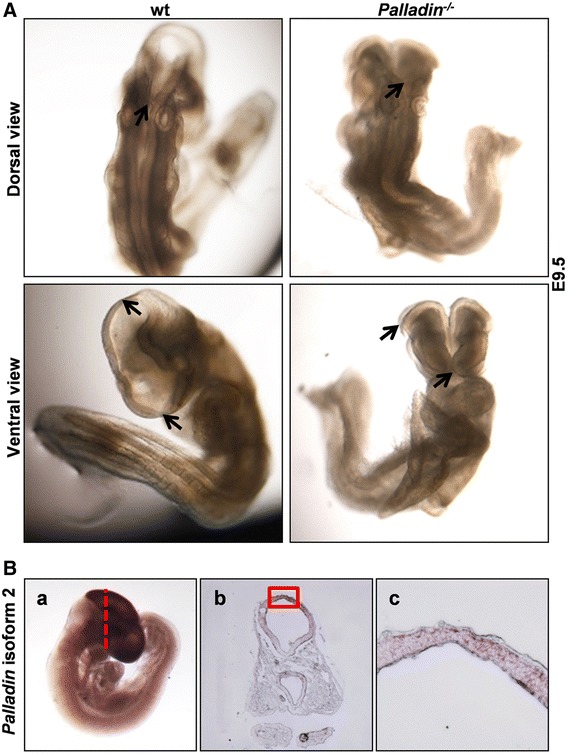
The actin cytoskeleton-associated protein palladin plays an important role in cell motility, morphogenesis and adhesion. In mice, Palladin deficient embryos are lethal before embryonic day (E) 15.5, and exhibit severe cranial neural tube and body wall closure defects. However, the mechanism how palladin regulates the process of cranial neural tube closure (NTC) remains unknown.
In this paper, we use gene knockout mouse to elucidate the function of palladin in the regulation of NTC process.
We initially focuse on the expression pattern of palladin and found that in embryonic brain, palladin is predominantly expressed in the neural folds at E9.5. We further check the major cellular events in the neural epithelium that may contribute to NTC during the early embryogenesis. Palladin deficiency leads to a disturbance of cytoskeleton in the neural tube and the cultured neural progenitors. Furthermore, increased cell proliferation, decreased cell differentiation and diminished apical cell apoptosis of neural epithelium are found in palladin deficient embryos. Cell cycle of neural progenitors in Palladin embryos is much shorter than that in wt ones. Cell adhesion shows a reduction in Palladin neural tubes.
Palladin is expressed with proper spatio-temporal pattern in the neural folds. It plays a crucial role in regulating mouse cranial NTC by modulating cytoskeleton, proliferation, differentiation, apoptosis, and adhesion of neural epithelium. Our findings facilitate further study of the function of palladin and the underlying molecular mechanism involved in NTC.
肌动蛋白细胞骨架相关蛋白帕拉丁在细胞运动、形态发生和黏附中起重要作用。在小鼠中,帕拉丁基因缺失的胚胎在胚胎第15.5天之前致死,并表现出严重的颅神经管和体壁闭合缺陷。然而,帕拉丁调节颅神经管闭合(NTC)过程的机制仍不清楚。
在本文中,我们使用基因敲除小鼠来阐明帕拉丁在调节NTC过程中的功能。
我们最初关注帕拉丁的表达模式,发现在胚胎脑中,帕拉丁在E9.5时主要在神经褶中表达。我们进一步检查了神经上皮中可能在早期胚胎发育过程中促进NTC的主要细胞事件。帕拉丁缺乏导致神经管和培养的神经祖细胞中的细胞骨架紊乱。此外,在帕拉丁基因缺失的胚胎中发现神经上皮细胞增殖增加、细胞分化减少和顶端细胞凋亡减少。帕拉丁基因缺失胚胎中的神经祖细胞的细胞周期比野生型胚胎中的短得多。帕拉丁神经管中的细胞黏附减少。
帕拉丁在神经褶中以适当的时空模式表达。它通过调节神经上皮的细胞骨架、增殖、分化、凋亡和黏附,在调节小鼠颅神经管闭合中起关键作用。我们的发现有助于进一步研究帕拉丁的功能以及参与颅神经管闭合的潜在分子机制。