Department of Neurosurgery, Huashan Hospital of Fudan University, NO. 12 Wulumuqi mid Road, Jing'an District, Shanghai, 200040, China.
School of Life Science, South China Normal University, Key Laboratory of Ecology and Environmental Science in Higher Education of Guangdong Province, Guangzhou, 510631, PR China.
Sci Rep. 2017 Mar 24;7(1):387. doi: 10.1038/s41598-017-00392-5.
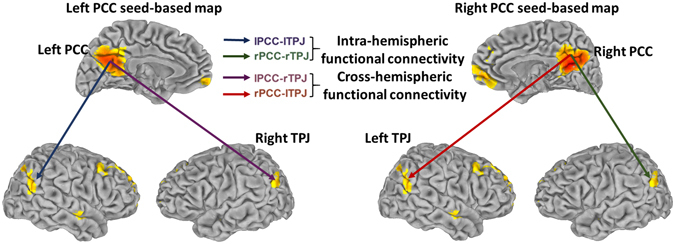
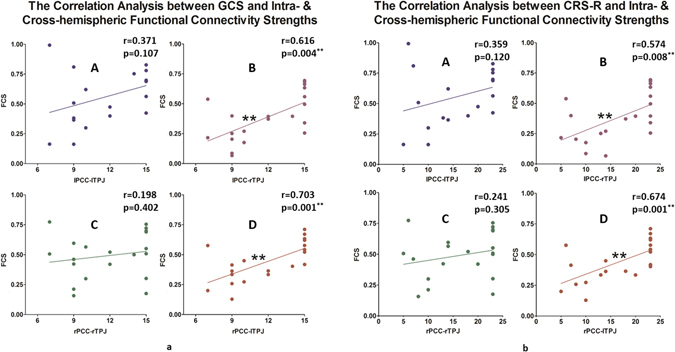
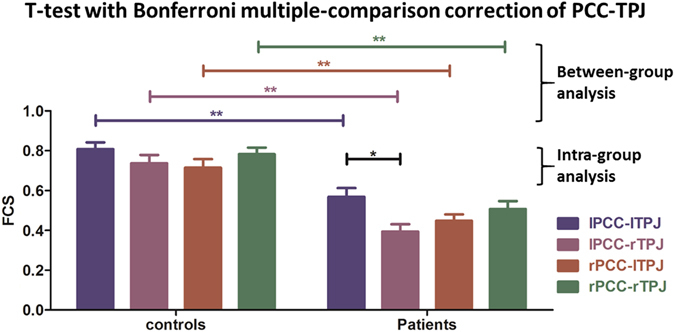
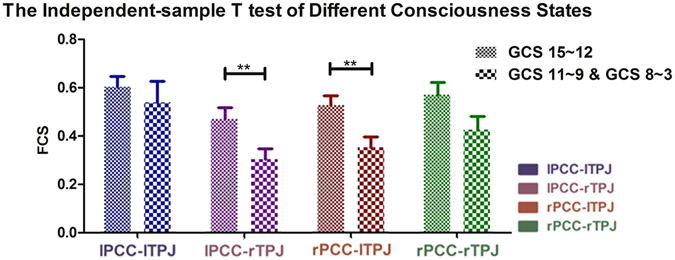
Previous studies have demonstrated that altered states of consciousness are related to changes in resting state activity in the default-mode network (DMN). Anatomically, the DMN can be divided into anterior and posterior regions. The anterior DMN includes the perigenual anterior cingulate cortex and other medial prefrontal cortical regions, whereas the posterior DMN includes regions such as the posterior cingulate cortex (PCC) and the temporal parietal junction (TPJ). Although differential roles have been attributed to the anterior and posterior DMN regions, their exact contributions to consciousness levels remain unclear. To investigate the specific role of the posterior DMN in consciousness levels, we investigated 20 healthy controls (7 females, mean age = 33.6 years old) and 20 traumatic brain injury (TBI) patients (5 females, mean age = 43 years old) whose brain lesions were mainly restricted to the bilateral frontal cortex but retained a well-preserved posterior DMN (e.g., the PCC and the TPJ) and who exhibited varying levels of consciousness. We investigated the intra- and cross-functional connectivity strengths (FCSs) between the right/left PCC and the right/left TPJ and their correlation with consciousness levels. Significant reductions in both the intra- and cross-hemispheric FCSs were observed in patients compared with controls. A significant correlation with consciousness levels was observed only for the cross-hemispheric PCC-TPJ FCS but not for the intra-hemispheric PCC-TPJ FCS. Taken together, our results show that the cross-hemispheric posterior DMN is related to consciousness levels in a specific group of patients without posterior structural lesions. We therefore propose that the PCC may be central in maintaining consciousness through its cross-hemispheric FC with the TPJ.
先前的研究表明,意识状态的改变与默认模式网络 (DMN) 的静息状态活动变化有关。从解剖学上看,DMN 可以分为前后两个区域。前 DMN 包括前扣带回皮质的中央旁回和其他内侧前额叶皮质区域,而后 DMN 包括后扣带回皮质 (PCC) 和颞顶联合区 (TPJ) 等区域。尽管已经赋予了前 DMN 和后 DMN 区域不同的作用,但它们对意识水平的确切贡献仍不清楚。为了研究后 DMN 在意识水平中的特定作用,我们调查了 20 名健康对照者(7 名女性,平均年龄 33.6 岁)和 20 名创伤性脑损伤 (TBI) 患者(5 名女性,平均年龄 43 岁),他们的脑损伤主要局限于双侧额叶皮质,但保留了一个完好的后 DMN(例如,PCC 和 TPJ),并表现出不同程度的意识。我们调查了右/左 PCC 与右/左 TPJ 之间的内-功能连接强度(FCS)和交叉功能连接强度,并与意识水平进行了相关性分析。与对照组相比,患者的内-和交叉-半球 FCS 均显著降低。只有交叉-半球的 PCC-TPJ FCS 与意识水平显著相关,而内-半球的 PCC-TPJ FCS 则没有。综上所述,我们的结果表明,在后 DMN 中,特定的跨半球后部区域与特定患者群体的意识水平有关,而这些患者没有后结构损伤。因此,我们提出 PCC 可能通过与 TPJ 的交叉半球 FC 来维持意识。