Department of Psychology, Graduate School of Humanities and Sociology, The University of Tokyo, Japan.
Institute of Cultural Sciences, Chuo University, Tokyo, Japan.
J Neuropsychol. 2020 Mar;14(1):183-192. doi: 10.1111/jnp.12199. Epub 2019 Dec 21.
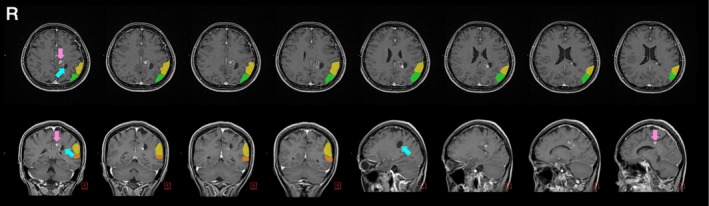
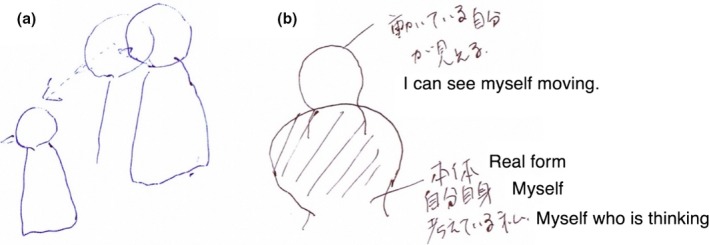
An out-of-body experience (OBE) is a phenomenon whereby an individual views his/her body and the world from a location outside the physical body. Previous studies have suggested that the temporoparietal junction (TPJ), the brain region responsible for integrating multisensory signals, is responsible for OBE development. Here, however, we first present a case of OBE after brain tumour development in the posterior cingulate cortex (PCC). The patient was a 46-year-old right-handed female; she underwent brain surgery. She reported that she had experienced OBEs several times monthly (during daily life) before surgery but never after surgery. She defined her OBEs explicitly; she drew pictures. Her OBEs exhibited phenomenological, overt dissociation of the subjective and objective bodies. We discuss the mechanisms underlying this phenomenon and the relationship between OBEs and the PCC in terms of anatomical and functional brain connectivity. Our case sheds some light on the mechanism involved in creating spatial (dis)unity between the self and the body.
离体体验(OBE)是一种现象,个体可以从身体之外的位置观察自己的身体和世界。先前的研究表明,负责整合多感觉信号的颞顶联合区(TPJ)是 OBE 发展的关键。然而,在这里,我们首次提出了一个在后扣带回皮层(PCC)发展后出现 OBE 的病例。患者是一名 46 岁的右利手女性;她接受了脑部手术。她报告说,在手术前,她每月都会经历几次 OBE(在日常生活中),但手术后从未经历过。她明确定义了自己的 OBE,并用图画描绘了出来。她的 OBE 表现出明显的主观和客观身体分离的现象学特征。我们讨论了这种现象的机制,以及 OBE 与 PCC 之间在解剖和功能脑连接方面的关系。我们的病例为理解自我和身体之间空间(不)统一的形成机制提供了一些线索。