Probst Mareike, Kühn Jens-Peter, Modeß Christiane, Scheuch Eberhard, Seidlitz Anne, Hosten Norbert, Siegmund Werner, Weitschies Werner
Department of Biopharmaceutics and Pharmaceutical Technology, Center of Drug Absorption and Transport (C_DAT), Ernst Moritz Arndt University Greifswald, Felix-Hausdorff-Straße 3, 17487, Greifswald, Germany.
Institute of Diagnostic Radiology and Neuroradiology, University Medicine Greifswald, Ferdinand-Sauerbruch-Straße, 17475, Greifswald, Germany.
Drug Saf Case Rep. 2017 Dec;4(1):7. doi: 10.1007/s40800-017-0049-9.
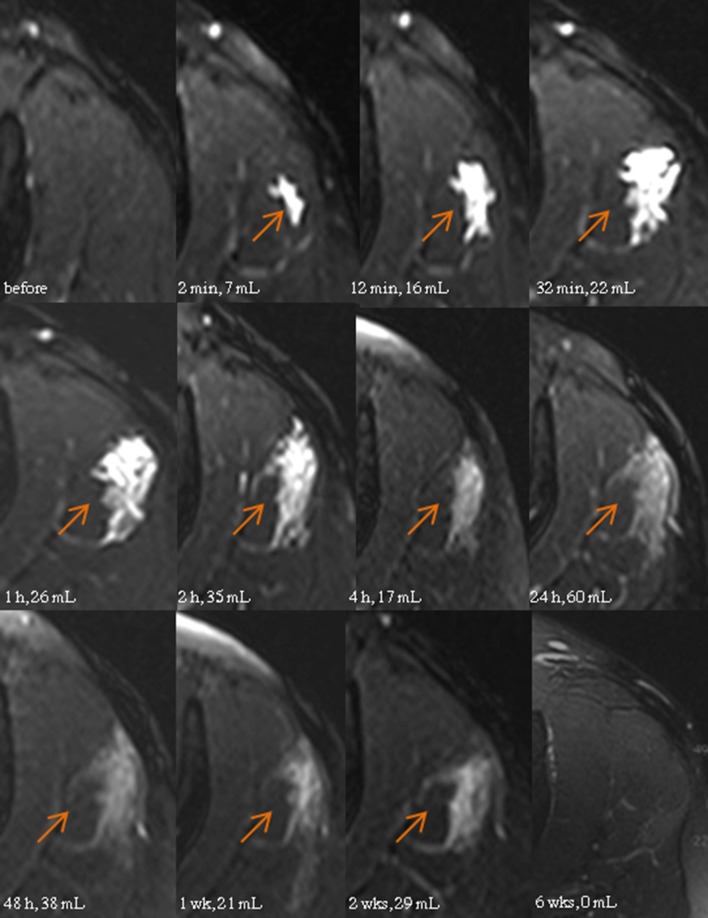
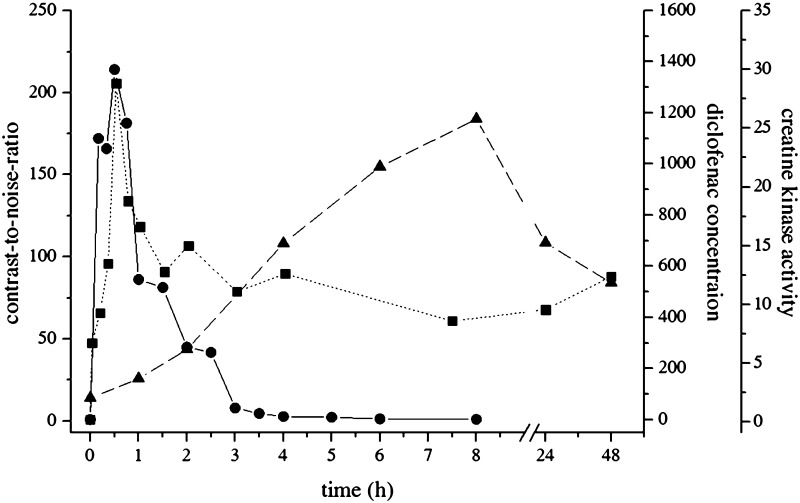
Intramuscular injection of diclofenac is still frequently practiced, although there is ample evidence that the risk of local tissue intolerability is highly underestimated. The aim of this study was to evaluate local toxicity in a patient using magnetic resonance imaging. A patient who gave written informed consent received a medically indicated intramuscular administration of diclofenac 75 mg/2 mL. Simultaneously with magnetic resonance imaging of the depot, a clinical-chemical evaluation and quantification of diclofenac in plasma was performed. A manifold enhancement of the T2-weighted magnetic resonance signal was observed in a muscle area of approximately 60 mL volume, with maximum signal intensity 30 min after injection, the time of maximum diclofenac plasma exposure. Plasma creatine kinase activity was elevated approximately sixfold within 8 h and normalized within 1 week, whereas the magnetic resonance enhancement disappeared within 5 weeks. Interestingly, the patient did not complain about any clinical symptoms at the injection site. Asymptomatic tissue injury after intramuscular injection of diclofenac, caused by intramuscular dosing, can be reliably evaluated by magnetic resonance imaging and should be applied early during the development of parenteral dosage forms. Clinical Trials Registration Number: BB130/16 (Ethics Committee of the University Medicine Greifswald).
尽管有充分证据表明局部组织不耐受风险被严重低估,但双氯芬酸的肌肉注射仍经常被采用。本研究的目的是利用磁共振成像评估患者的局部毒性。一名签署了书面知情同意书的患者接受了一次符合医学指征的75毫克/2毫升双氯芬酸肌肉注射。在对注射部位进行磁共振成像的同时,对血浆中的双氯芬酸进行了临床化学评估和定量分析。在一个体积约为60毫升的肌肉区域观察到T2加权磁共振信号有多种增强,注射后30分钟信号强度达到最大值,此时正是双氯芬酸血浆暴露量最大的时候。血浆肌酸激酶活性在8小时内升高了约6倍,并在1周内恢复正常,而磁共振增强在5周内消失。有趣的是,患者在注射部位没有任何临床症状的主诉。肌肉注射双氯芬酸后由肌肉给药引起的无症状组织损伤,可以通过磁共振成像可靠地评估,并且应该在肠胃外剂型的研发早期应用。临床试验注册号:BB130/16(格赖夫斯瓦尔德大学医学伦理委员会)