van Meir H, Nout R A, Welters M J P, Loof N M, de Kam M L, van Ham J J, Samuels S, Kenter G G, Cohen A F, Melief C J M, Burggraaf J, van Poelgeest M I E, van der Burg S H
Department of Gynecology, Leiden University Medical Center, Leiden, the Netherlands; Centre for Human Drug Research, Leiden, the Netherlands.
Department of Radiation Oncology, Leiden University Medical Center , Leiden, the Netherlands.
Oncoimmunology. 2016 Dec 23;6(2):e1267095. doi: 10.1080/2162402X.2016.1267095. eCollection 2017.
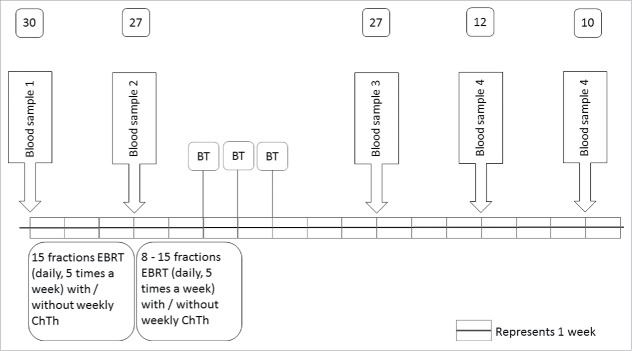
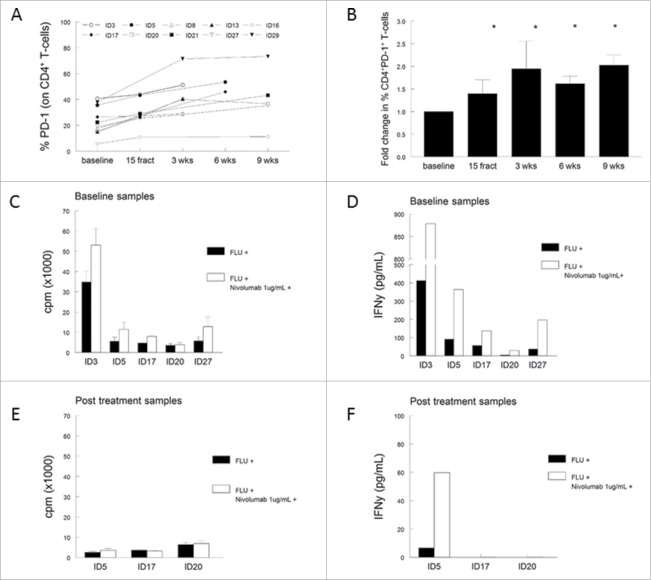
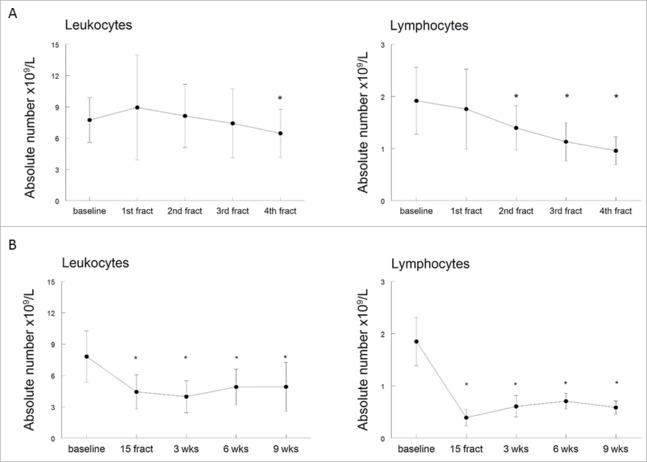
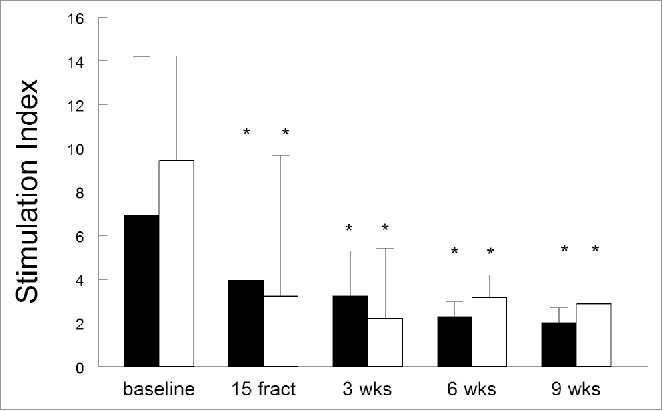
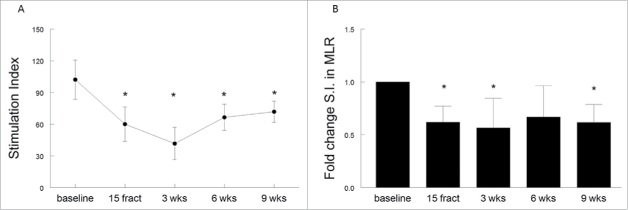
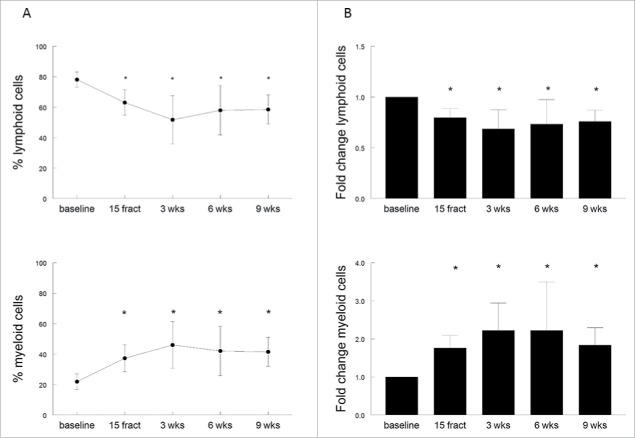
New treatments based on combinations of standard therapeutic modalities and immunotherapy are of potential use, but require a profound understanding of immune modulatory properties of standard therapies. Here, the impact of standard (chemo)radiotherapy on the immune system of cervical cancer patients was evaluated. Thirty patients with cervical cancer were treated with external beam radiation therapy (EBRT), using conventional three-dimensional or intensity modulated radiation therapy without constraints for bone marrow sparing. Serial blood sampling for immunomonitoring was performed before, midway and at 3, 6 and 9 weeks after EBRT to analyze the composition of lymphocyte and myeloid-cell populations, the expression of co-stimulatory molecules, T-cell reactivity and antigen presenting cell (APC) function. Therapy significantly decreased the absolute numbers of circulating leukocytes and lymphocytes. Furthermore, the capacity of the remaining T cells to respond to antigenic or mitogenic stimulation was impaired. During treatment the frequency of both CD4 and CD8 T cells dropped and CD4 T cells displayed an increased expression of programmed cell death-1 (PD-1). blocking of PD-1 successfully increased T-cell reactivity in all five samples isolated before radiotherapy but was less successful in restoring reactivity in samples isolated at later time points. Moreover, (chemo)radiotherapy was associated with an increase in both circulating monocytes and myeloid-derived suppressor cells (MDSCs) and an impaired capacity of APCs to stimulate allogeneic T cells. T-cell reactivity was slowly restored at 6-9 weeks after cessation of therapy. We conclude that conventional (chemo)radiotherapy profoundly suppresses the immune system in cervical cancer patients, and may restrict its combination with immunotherapy.
基于标准治疗方式与免疫疗法联合的新疗法具有潜在应用价值,但需要深入了解标准疗法的免疫调节特性。在此,评估了标准(化疗)放疗对宫颈癌患者免疫系统的影响。30例宫颈癌患者接受了体外放射治疗(EBRT),采用传统三维或调强放射治疗,未对骨髓保护作限制。在EBRT前、治疗中期以及治疗后3周、6周和9周进行系列采血以进行免疫监测,分析淋巴细胞和髓样细胞群体的组成、共刺激分子的表达、T细胞反应性和抗原呈递细胞(APC)功能。治疗显著降低了循环白细胞和淋巴细胞的绝对数量。此外,剩余T细胞对抗原或丝裂原刺激的反应能力受损。治疗期间,CD4和CD8 T细胞的频率均下降,且CD4 T细胞程序性细胞死亡蛋白1(PD-1)的表达增加。阻断PD-1在放疗前分离的所有5个样本中成功增加了T细胞反应性,但在恢复后期分离样本的反应性方面效果较差。此外,(化疗)放疗与循环单核细胞和髓源性抑制细胞(MDSC)的增加以及APC刺激同种异体T细胞的能力受损有关。治疗停止后6 - 9周,T细胞反应性缓慢恢复。我们得出结论,传统(化疗)放疗会严重抑制宫颈癌患者的免疫系统,并可能限制其与免疫疗法的联合应用。