Newman-Toker David E, Moy Ernest, Valente Ernest, Coffey Rosanna, Hines Anika L
1Department of Neurology, The Johns Hopkins University School of Medicine, Baltimore, MD, USA.
2Agency for Healthcare Research and Quality, Rockville, MD, USA.
Diagnosis (Berl). 2014 Jun;1(2):155-166. doi: 10.1515/dx-2013-0038. Epub 2014 Apr 3.
Some cerebrovascular events are not diagnosed promptly, potentially resulting in death or disability from missed treatments. We sought to estimate the frequency of missed stroke and examine associations with patient, emergency department (ED), and hospital characteristics.
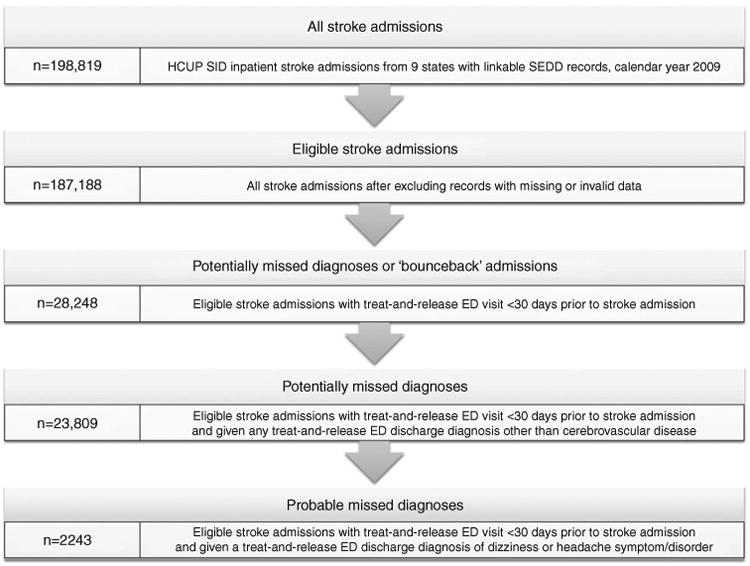
Cross-sectional analysis using linked inpatient discharge and ED visit records from the 2009 Healthcare Cost and Utilization Project State Inpatient Databases and 2008-2009 State ED Databases across nine US states. We identified adult patients admitted for stroke with a treat-and-release ED visit in the prior 30 days, considering those given a non-cerebrovascular diagnosis as probable (benign headache or dizziness diagnosis) or potential (any other diagnosis) missed strokes.
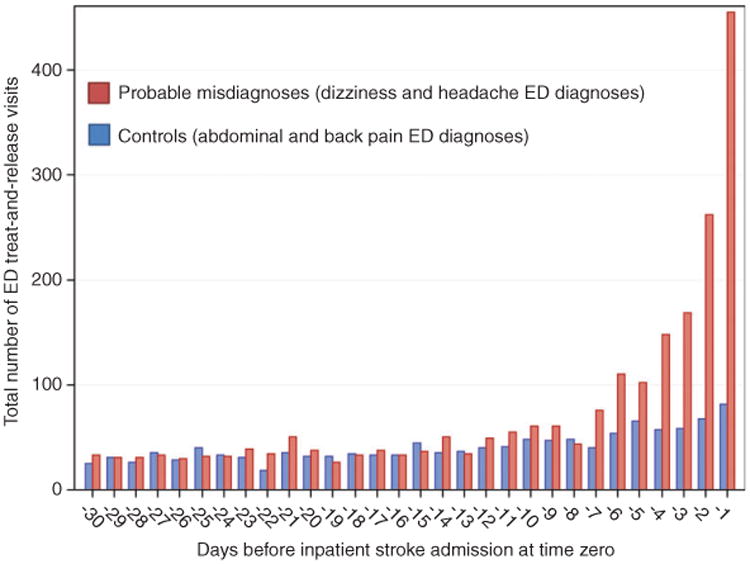
There were 23,809 potential and 2243 probable missed strokes representing 12.7% and 1.2% of stroke admissions, respectively. Missed hemorrhages (n = 406) were linked to headache while missed ischemic strokes (n = 1435) and transient ischemic attacks (n = 402) were linked to headache or dizziness. Odds of a probable misdiagnosis were lower among men (OR 0.75), older individuals (18-44 years [base]; 45-64:OR 0.43; 65-74:OR 0.28; ≥ 75:OR 0.19), and Medicare (OR 0.66) or Medicaid (OR 0.70) recipients compared to privately insured patients. Odds were higher among Blacks (OR 1.18), Asian/Pacific Islanders (OR 1.29), and Hispanics (OR 1.30). Odds were higher in non-teaching hospitals (OR 1.45) and low-volume hospitals (OR 1.57).
We estimate 15,000-165,000 misdiagnosed cerebrovascular events annually in US EDs, disproportionately presenting with headache or dizziness. Physicians evaluating these symptoms should be particularly attuned to the possibility of stroke in younger, female, and non-White patients.
一些脑血管事件未能得到及时诊断,可能因错过治疗而导致死亡或残疾。我们试图估算漏诊中风的发生率,并研究其与患者、急诊科及医院特征之间的关联。
采用横断面分析,数据来源于2009年医疗成本和利用项目州住院数据库以及美国九个州2008 - 2009年的州急诊科数据库中的住院出院记录与急诊科就诊记录的链接。我们确定了在过去30天内因中风入院且在急诊科接受治疗后出院的成年患者,将那些被诊断为非脑血管疾病(良性头痛或头晕诊断)或可能漏诊(任何其他诊断)的患者视为可能漏诊的中风患者。
有23,809例可能漏诊和2243例很可能漏诊的中风病例,分别占中风入院病例的12.7%和1.2%。漏诊的脑出血(n = 406)与头痛有关,而漏诊的缺血性中风(n = 1435)和短暂性脑缺血发作(n = 402)与头痛或头晕有关。男性(OR 0.75)、老年人(18 - 44岁[基线];45 - 64岁:OR 0.43;65 - 74岁:OR 0.28;≥75岁:OR 0.19)以及医疗保险(OR 0.66)或医疗补助(OR 0.70)受益人与私人保险患者相比,很可能误诊的几率较低。黑人(OR 1.18)、亚裔/太平洋岛民(OR 1.29)和西班牙裔(OR 1.30)的几率较高。在非教学医院(OR 1.45)和低容量医院(OR 1.57)几率较高。
我们估计美国急诊科每年有15,000 - 165,000例脑血管疾病误诊病例,其中以头痛或头晕症状表现的比例过高。评估这些症状的医生应特别关注年轻、女性和非白人患者中风的可能性。