Banini Bubu A, Sanyal Arun J
Division of Gastroenterology, Hepatology, and Nutrition, Department of Internal Medicine, Virginia Commonwealth University School of Medicine, Richmond, Virginia, USA.
Curr Opin Gastroenterol. 2017 May;33(3):134-141. doi: 10.1097/MOG.0000000000000356.
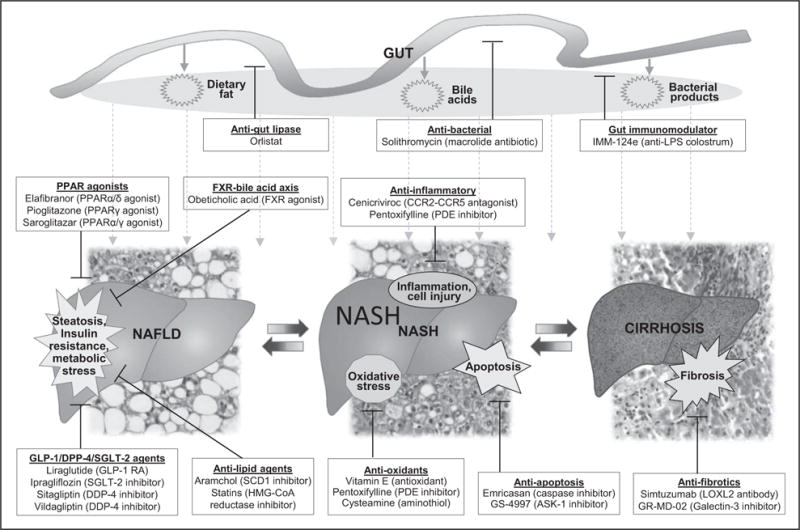
Nonalcoholic steatohepatitis (NASH), the aggressive form of nonalcoholic fatty liver disease (NAFLD), can progress to cirrhosis and hepatocellular cancer in 5-15% of patients and is rapidly becoming the leading cause for end-stage liver disease. Dietary caloric restriction and exercise, currently the cornerstone of therapy for NAFLD, can be difficult to achieve and maintain, underscoring the dire need for pharmacotherapy. This review presents the agents currently used in managing NAFLD and their pharmacologic targets. It also provides an overview of NAFLD agents currently under development.
Therapies for NASH can be broadly classified into agents that target the metabolic perturbations driving disease pathogenesis (such as insulin resistance and de novo lipogenesis) and agents that target downstream processes including cell stress, apoptosis, inflammation, and fibrosis. Modulation of peroxisome proliferator-activator receptors, farnesoid-X-receptors, and the glucagon-like peptide 1 pathway have been shown to improve liver histology. The intestinal microbiome and metabolic endotoxemia are novel targets that are currently under review. Antioxidants such as vitamin E, and more recently anti-inflammatory agents such as apoptosis signal-regulating kinase 1 inhibitors show promise as therapy for NASH. Several antifibrotic agents including cysteine-cysteine motif chemokine receptor type 2 and type 5 antagonists have been shown to inhibit the progression of fibrosis toward cirrhosis.
There are currently several agents in the drug pipeline for NASH. Within the next few years, the availability of therapeutic options for NAFLD will hopefully curb the rising trend of NAFLD-related end stage liver disease.
非酒精性脂肪性肝炎(NASH)是非酒精性脂肪性肝病(NAFLD)的严重形式,5%-15%的患者会发展为肝硬化和肝细胞癌,并且正迅速成为终末期肝病的主要病因。饮食热量限制和运动是目前NAFLD治疗的基石,但难以实现和维持,这凸显了药物治疗的迫切需求。本综述介绍了目前用于管理NAFLD的药物及其药理学靶点。还概述了目前正在研发的NAFLD药物。
NASH的治疗方法可大致分为针对驱动疾病发病机制的代谢紊乱(如胰岛素抵抗和从头脂肪生成)的药物,以及针对包括细胞应激、凋亡、炎症和纤维化在内的下游过程的药物。过氧化物酶体增殖物激活受体、法尼醇X受体和胰高血糖素样肽1途径的调节已被证明可改善肝脏组织学。肠道微生物群和代谢性内毒素血症是目前正在研究的新靶点。抗氧化剂如维生素E,以及最近的抗炎药物如凋亡信号调节激酶1抑制剂显示出作为NASH治疗药物的潜力。几种抗纤维化药物,包括CXC趋化因子受体2型和5型拮抗剂,已被证明可抑制纤维化向肝硬化的进展。
目前有几种治疗NASH的药物正在研发中。在未来几年内,NAFLD治疗选择的出现有望遏制与NAFLD相关的终末期肝病的上升趋势。