Lefebvre Eric, Moyle Graeme, Reshef Ran, Richman Lee P, Thompson Melanie, Hong Feng, Chou Hsin-L, Hashiguchi Taishi, Plato Craig, Poulin Dominic, Richards Toni, Yoneyama Hiroyuki, Jenkins Helen, Wolfgang Grushenka, Friedman Scott L
Tobira Therapeutics, Inc., South San Francisco, CA, United States of America.
Chelsea and Westminster Hospital, London, United Kingdom.
PLoS One. 2016 Jun 27;11(6):e0158156. doi: 10.1371/journal.pone.0158156. eCollection 2016.
BACKGROUND & AIMS: Interactions between C-C chemokine receptor types 2 (CCR2) and 5 (CCR5) and their ligands, including CCL2 and CCL5, mediate fibrogenesis by promoting monocyte/macrophage recruitment and tissue infiltration, as well as hepatic stellate cell activation. Cenicriviroc (CVC) is an oral, dual CCR2/CCR5 antagonist with nanomolar potency against both receptors. CVC's anti-inflammatory and antifibrotic effects were evaluated in a range of preclinical models of inflammation and fibrosis.
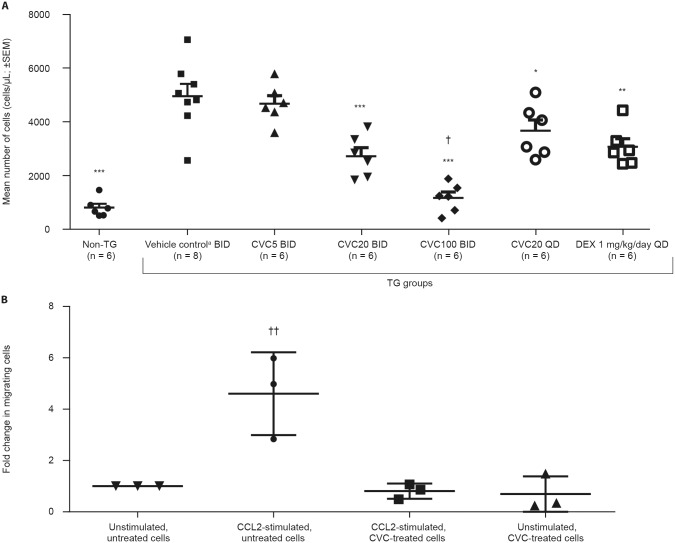
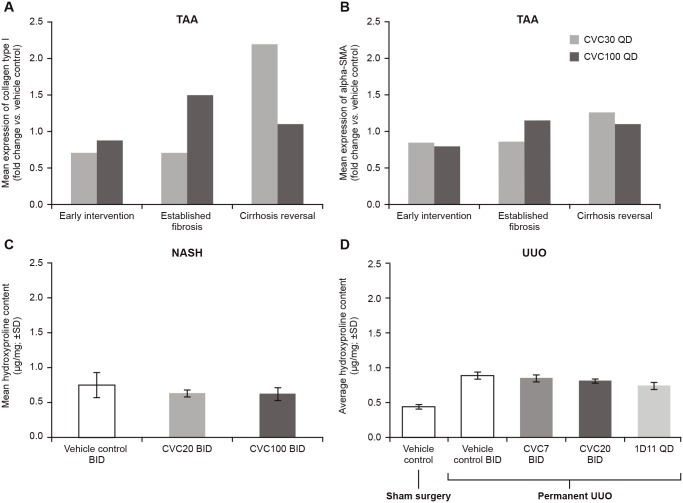
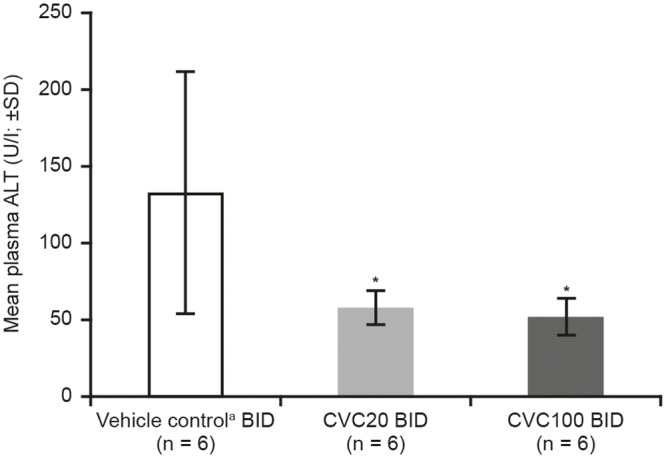
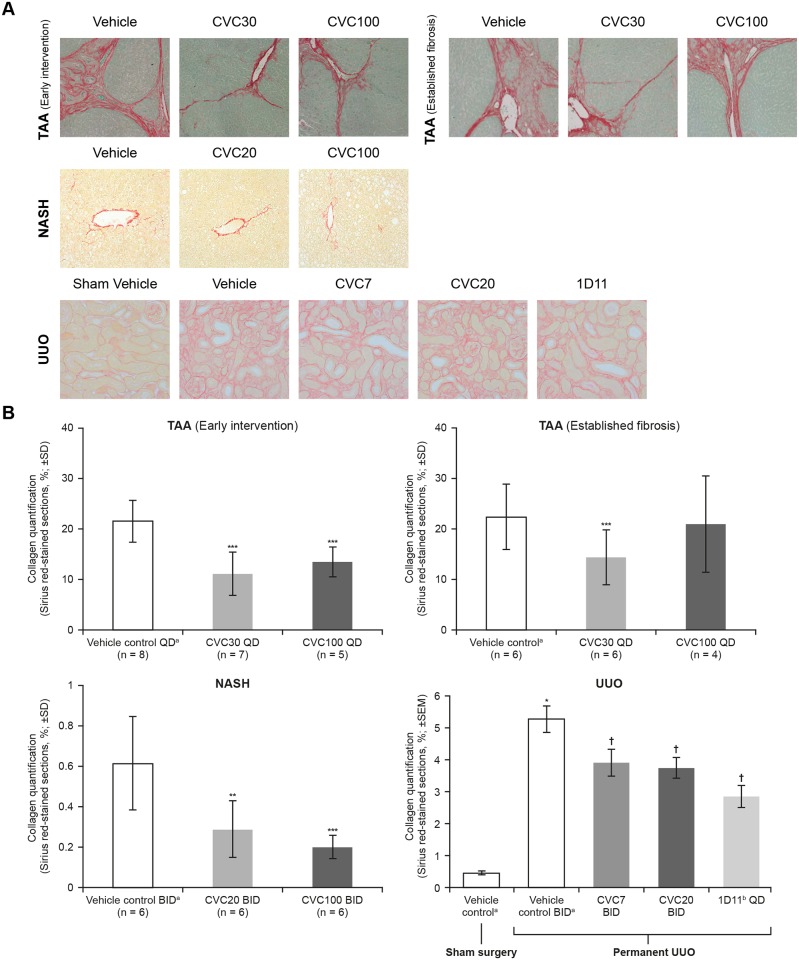
Monocyte/macrophage recruitment was assessed in vivo in a mouse model of thioglycollate-induced peritonitis. CCL2-induced chemotaxis was evaluated ex vivo on mouse monocytes. CVC's antifibrotic effects were evaluated in a thioacetamide-induced rat model of liver fibrosis and mouse models of diet-induced non-alcoholic steatohepatitis (NASH) and renal fibrosis. Study assessments included body and liver/kidney weight, liver function test, liver/kidney morphology and collagen deposition, fibrogenic gene and protein expression, and pharmacokinetic analyses.
CVC significantly reduced monocyte/macrophage recruitment in vivo at doses ≥20 mg/kg/day (p < 0.05). At these doses, CVC showed antifibrotic effects, with significant reductions in collagen deposition (p < 0.05), and collagen type 1 protein and mRNA expression across the three animal models of fibrosis. In the NASH model, CVC significantly reduced the non-alcoholic fatty liver disease activity score (p < 0.05 vs. controls). CVC treatment had no notable effect on body or liver/kidney weight.
CVC displayed potent anti-inflammatory and antifibrotic activity in a range of animal fibrosis models, supporting human testing for fibrotic diseases. Further experimental studies are needed to clarify the underlying mechanisms of CVC's antifibrotic effects. A Phase 2b study in adults with NASH and liver fibrosis is fully enrolled (CENTAUR Study 652-2-203; NCT02217475).
C-C趋化因子受体2型(CCR2)和5型(CCR5)与其配体(包括CCL2和CCL5)之间的相互作用,通过促进单核细胞/巨噬细胞募集和组织浸润以及肝星状细胞活化来介导纤维化形成。cenicriviroc(CVC)是一种口服的CCR2/CCR5双重拮抗剂,对两种受体均具有纳摩尔级别的效力。在一系列炎症和纤维化的临床前模型中评估了CVC的抗炎和抗纤维化作用。
在巯基乙酸盐诱导的腹膜炎小鼠模型中体内评估单核细胞/巨噬细胞募集。在体外对小鼠单核细胞评估CCL2诱导的趋化作用。在硫代乙酰胺诱导的大鼠肝纤维化模型以及饮食诱导的非酒精性脂肪性肝炎(NASH)和肾纤维化小鼠模型中评估CVC的抗纤维化作用。研究评估包括体重、肝/肾重量、肝功能测试、肝/肾形态和胶原沉积、纤维化相关基因和蛋白表达以及药代动力学分析。
CVC在剂量≥20mg/kg/天时可显著减少体内单核细胞/巨噬细胞募集(p<0.05)。在这些剂量下,CVC显示出抗纤维化作用,在三种纤维化动物模型中胶原沉积、Ⅰ型胶原蛋白和mRNA表达均显著降低(p<0.05)。在NASH模型中,CVC显著降低非酒精性脂肪性肝病活动评分(与对照组相比,p<0.05)。CVC治疗对体重或肝/肾重量无显著影响。
CVC在一系列动物纤维化模型中显示出强大的抗炎和抗纤维化活性,支持对纤维化疾病进行人体试验。需要进一步的实验研究来阐明CVC抗纤维化作用的潜在机制。一项针对患有NASH和肝纤维化的成年人的2b期研究已完成入组(CENTAUR研究652-2-203;NCT02217475)。