White Steven M, Sanders Christopher J, Shortall Christopher R, Purse Bethan V
Centre for Ecology & Hydrology, Benson Lane, Wallingford, Oxfordshire, OX10 8BB, UK.
Wolfson Centre for Mathematical Biology, Mathematical Institute, Radcliffe Observatory Quarter, Woodstock Road, Oxford, Oxfordshire, OX2 6GG, UK.
Parasit Vectors. 2017 Mar 27;10(1):162. doi: 10.1186/s13071-017-2097-5.
Understanding seasonal patterns of abundance of insect vectors is important for optimisation of control strategies of vector-borne diseases. Environmental drivers such as temperature, humidity and photoperiod influence vector abundance, but it is not generally known how these drivers combine to affect seasonal population dynamics.
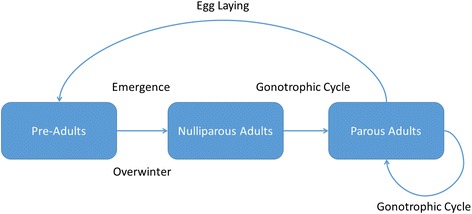
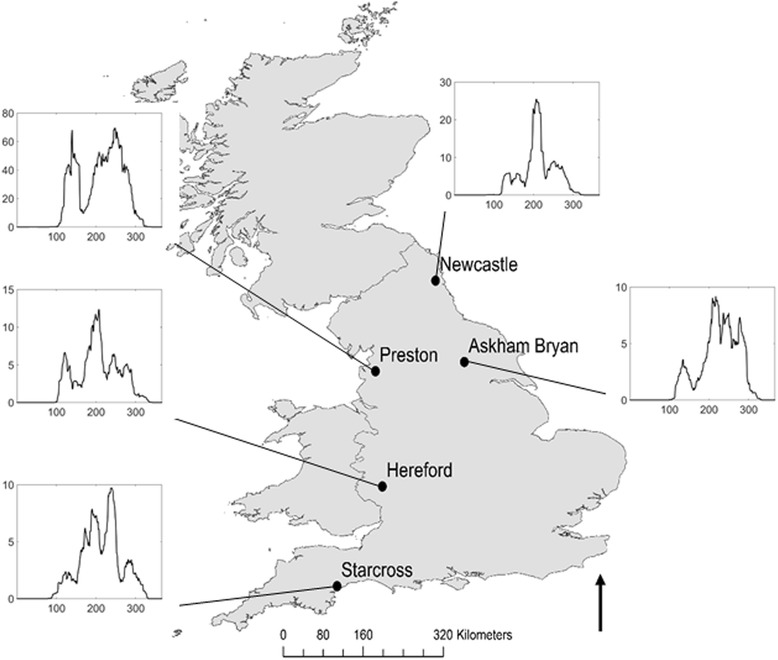
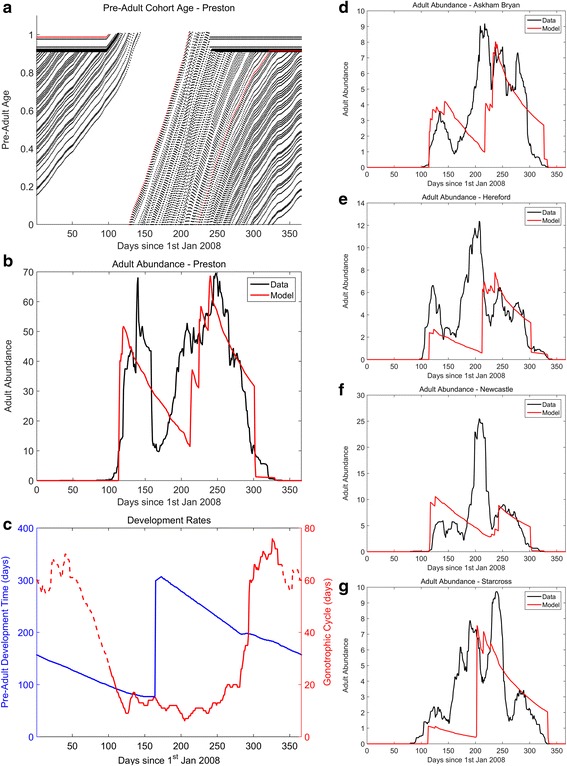
In this paper, we derive and analyse a novel mechanistic stage-structured simulation model for Culicoides biting midges-the principle vectors of bluetongue and Schmallenberg viruses which cause mortality and morbidity in livestock and impact trade. We model variable life-history traits as functional forms that are dependent on environmental drivers, including air temperature, soil temperature and photoperiod. The model is fitted to Obsoletus group adult suction-trap data sampled daily at five locations throughout the UK for 2008.
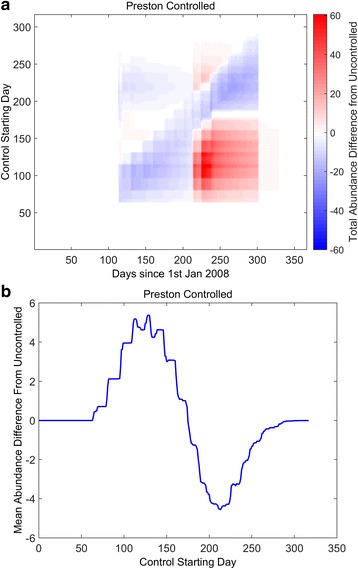
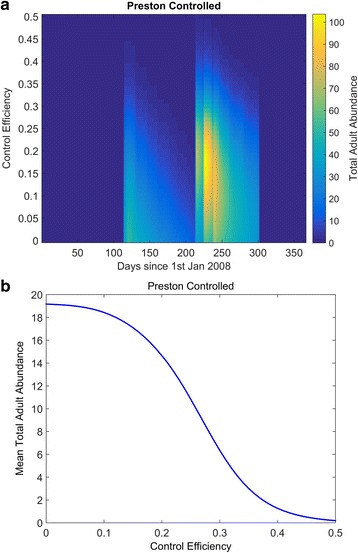
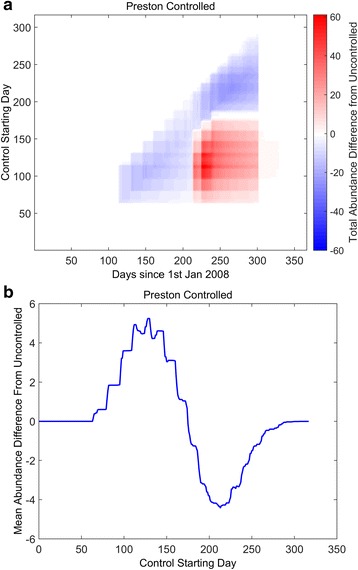
The model predicts population dynamics that closely resemble UK field observations, including the characteristic biannual peaks of adult abundance. Using the model, we then investigate the effects of insecticide control, showing that control strategies focussing on the autumn peak of adult midge abundance have the highest impact in terms of population reduction in the autumn and averaged over the year. Conversely, control during the spring peak of adult abundance leads to adverse increases in adult abundance in the autumn peak.
The mechanisms of the biannual peaks of adult abundance, which are important features of midge seasonality in northern Europe and are key determinants of the risk of establishment and spread of midge-borne diseases, have been hypothesised over for many years. Our model suggests that the peaks correspond to two generations per year (bivoltine) are largely determined by pre-adult development. Furthermore, control strategies should focus on reducing the autumn peak since the immature stages are released from density-dependence regulation. We conclude that more extensive modelling of Culicoides biting midge populations in different geographical contexts will help to optimise control strategies and predictions of disease outbreaks.
了解昆虫媒介数量的季节性模式对于优化病媒传播疾病的控制策略至关重要。温度、湿度和光周期等环境驱动因素会影响媒介数量,但这些驱动因素如何共同作用以影响季节性种群动态通常并不清楚。
在本文中,我们推导并分析了一种针对库蠓(叮咬蠓)的新型机制阶段结构模拟模型,库蠓是蓝舌病和施马伦贝格病毒的主要传播媒介,这些病毒会导致牲畜死亡和发病,并影响贸易。我们将可变的生活史特征建模为依赖于环境驱动因素的函数形式,包括气温、土壤温度和光周期。该模型拟合了2008年在英国五个地点每日采样的奥氏库蠓成虫吸虫器数据。
该模型预测的种群动态与英国实地观测结果非常相似,包括成虫数量特征性的双年度峰值。然后,我们使用该模型研究杀虫剂控制的效果,结果表明,就秋季种群减少以及全年平均而言,针对成虫数量秋季峰值的控制策略影响最大。相反,在成虫数量春季峰值期间进行控制会导致秋季峰值时成虫数量出现不利增加。
北欧蠓季节性的重要特征——成虫数量双年度峰值的机制,多年来一直是人们猜测的对象,这些峰值是蠓传播疾病建立和传播风险的关键决定因素。我们的模型表明,这些峰值对应每年两代(双季繁殖),很大程度上由成虫前发育决定。此外,控制策略应侧重于降低秋季峰值,因为未成熟阶段不受密度依赖调节的限制。我们得出结论,在不同地理环境下对库蠓种群进行更广泛的建模将有助于优化控制策略和疾病爆发预测。