Xu Xianglong, Zuo Hanxiao, Shi Zumin, Rao Yunshuang, Wang LianLian, Zeng Huan, Zhang Lei, Sharma Manoj, Reis Cesar, Zhao Yong
School of Public Health and Management, Chongqing Medical University, Chongqing, China.
Research Center for Medicine and Social Development, Chongqing Medical University, Chongqing, China.
BMJ Open. 2017 Mar 27;7(3):e014544. doi: 10.1136/bmjopen-2016-014544.
This study aimed to explore determinants of second pregnancy and underlying reasons among pregnant Chinese women.
The study was a population-based cross-sectional survey.
16 hospitals in 5 provinces of Mainland China were included.
A total of 2345 pregnant women aged 18 years or above were surveyed face to face by investigators between June and August 2015.
The pregnancy statuses (first or second pregnancy) and reasons for entering second pregnancy.
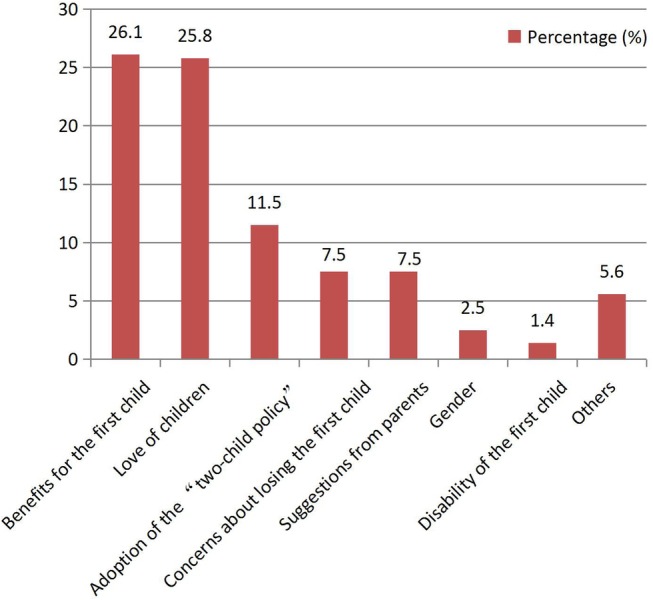
A total of 1755 (74.8%) and 590 (25.2%) women in their respective first and second pregnancies were enrolled in this study. The most common self-reported reasons for entering second pregnancy among participants included the benefits to the first child (26.1%), love of children (25.8%), adoption of the 2-child policy (11.5%), concerns about losing the first child (7.5%) and suggestions from parents (7.5%). Pregnant women with low (prevalence ratio (PR) 1.96; 95% CI 1.62 to 2.36) and moderate education level (PR 1.97; 95% CI 1.65 to 2.36) were more likely to have a second pregnancy than their higher educated counterparts. Income was inversely associated with second pregnancy. However, unemployed participants (PR 0.79; 95% CI 0.66 to 0.95) were less likely to enter a second pregnancy than those employed. Women with moderate education were 3 times more likely to have a second child following the '2-child policy' than the low education level subgroup.
1 in every 4 pregnant women is undergoing a second pregnancy. The benefits of the firstborn or the love of children were the key drivers of a second pregnancy. Low socioeconomic status was positively associated with a second pregnancy as well. The new 2-child policy will have an influence on China's demographics.
本研究旨在探讨中国孕妇再次怀孕的决定因素及潜在原因。
本研究为基于人群的横断面调查。
纳入中国大陆5个省份的16家医院。
2015年6月至8月期间,调查人员对2345名年龄在18岁及以上的孕妇进行了面对面调查。
怀孕状态(首次或再次怀孕)以及再次怀孕的原因。
本研究共纳入了1755名(74.8%)首次怀孕和590名(25.2%)再次怀孕的女性。参与者中自我报告的再次怀孕最常见原因包括对第一个孩子有益(26.1%)、喜爱孩子(25.8%)、实施二孩政策(11.5%)、担心失去第一个孩子(7.5%)以及父母的建议(7.5%)。与受教育程度较高的孕妇相比,受教育程度低(患病率比(PR)1.96;95%置信区间1.62至2.36)和中等教育水平(PR 1.97;95%置信区间1.65至2.36)的孕妇更有可能再次怀孕。收入与再次怀孕呈负相关。然而,与有工作的参与者相比,失业参与者再次怀孕的可能性较小(PR 0.79;95%置信区间0.66至0.95)。中等教育水平的女性在“二孩政策”实施后生育第二个孩子的可能性是低教育水平亚组的3倍。
每4名孕妇中就有1名正在经历再次怀孕。头胎的益处或对孩子的喜爱是再次怀孕的主要驱动因素。社会经济地位低也与再次怀孕呈正相关。新的二孩政策将对中国的人口结构产生影响。