Zhang Dandan, Liu Fen, Cui Tianxin, Zhuang Xinqi, Zhang Jianzhong, Lei Xiaoyu, Zhang Yin-Ping
School of Nursing, Xi'an Jiaotong University Health Science Center, Xi'an, Shaanxi Province, China.
Institute of Clinical Research, Affiliated Nanhua Hospital, Hengyang Medical School, University of South China, Hengyang, Hunan Province, China.
J Glob Health. 2025 Jan 3;15:04001. doi: 10.7189/jogh.15.04001.
As fertility rates decline and population ageing intensifies, the conflict between career and childbearing continues to impact clinicians, especially women. Exploring gender differences in the fertility intentions of male and female clinicians could help with identifying barriers to childbearing, developing effective policies to support work-life balance, and addressing the gap in research on gender disparities in this field.
We conducted a cross-sectional survey among health care personnel in Chinese public hospitals. Through cluster sampling from highly active WeChat groups, we gathered 698 responses from clinicians to the third fertility intention questionnaire online. We then used descriptive statistics and χ tests for analysis.
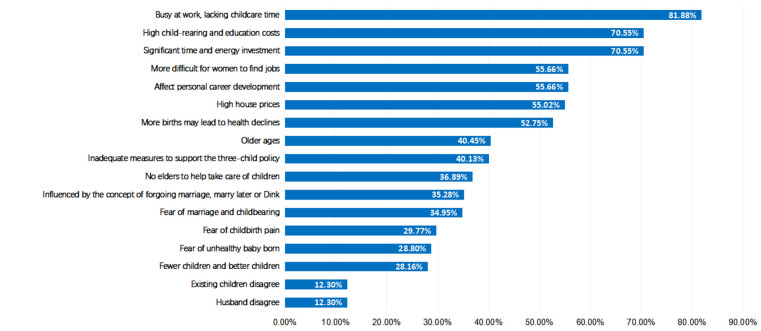
Men (28.28%) had higher intentions of having a third child than women (20.71%) (P = 0.013). In terms of reasons, female clinicians were more concerned than male clinicians about the impact on their career development (P = 0.002), difficulties in job hunting (P = 0.039), and physical injuries caused by multiple births (P < 0.001), and whether the elderly can help (P = 0.001). Conversely, men's apprehensions centred on economic factors such as real house costs (P < 0.001), policy support (P = 0.036), and wives' disagreement (P < 0.001). In discussing governmental interventions, men showed a higher level of interest in policies related to child care (P < 0.001), employment stability for women (P < 0.001), extended maternity leave (P < 0.001), and financial assistance than women (P < 0.001).
Our findings show substantial gender-specific differences in third-child fertility intentions among clinicians. To address this, the government should consider divisions in family roles, future societal needs, and women's career development. Policies should focus on balancing work and family by offering affordable childcare, flexible parenting leave, financial incentives, and career support, ensuring childbirth does not negatively impact women's professional growth, and fostering gender equality in parenting.
随着生育率下降和人口老龄化加剧,职业与生育之间的冲突持续影响着临床医生,尤其是女性。探索男女临床医生生育意愿的性别差异,有助于识别生育障碍,制定支持工作与生活平衡的有效政策,并填补该领域性别差异研究的空白。
我们对中国公立医院的医护人员进行了一项横断面调查。通过从活跃度高的微信群中进行整群抽样,我们收集了698名临床医生对第三次生育意愿问卷的在线回复。然后我们使用描述性统计和χ检验进行分析。
男性(28.28%)生育三孩的意愿高于女性(20.71%)(P = 0.013)。在原因方面,女性临床医生比男性临床医生更担心对其职业发展的影响(P = 0.002)、求职困难(P = 0.039)、多胎生育造成的身体损伤(P < 0.001)以及老人是否能提供帮助(P = 0.001)。相反,男性的担忧集中在经济因素上,如实房成本(P < 0.001)、政策支持(P = 0.036)以及妻子不同意(P < 0.001)。在讨论政府干预措施时,男性对与儿童照料相关的政策(P < 0.001)、女性就业稳定性(P < 0.001)、延长产假(P < 0.001)以及经济援助的兴趣高于女性(P < 0.001)。
我们的研究结果表明,临床医生在三孩生育意愿上存在显著的性别差异。为解决这一问题,政府应考虑家庭角色分工、未来社会需求以及女性职业发展。政策应侧重于通过提供负担得起的儿童照料、灵活的育儿假、经济激励和职业支持来平衡工作与家庭,确保生育不会对女性职业成长产生负面影响,并在育儿方面促进性别平等。