Carlson Maryn O, Gazave Elodie, Gore Michael A, Smart Christine D
Plant Pathology and Plant-Microbe Biology Section, School of Integrative Plant Science, Cornell UniversityGeneva, NY, USA; Plant Breeding and Genetics Section, School of Integrative Plant Science, Cornell UniversityIthaca, NY, USA.
Plant Breeding and Genetics Section, School of Integrative Plant Science, Cornell University Ithaca, NY, USA.
Front Genet. 2017 Mar 13;8:26. doi: 10.3389/fgene.2017.00026. eCollection 2017.
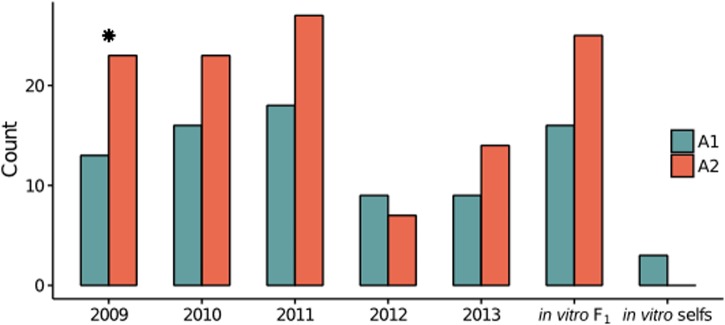
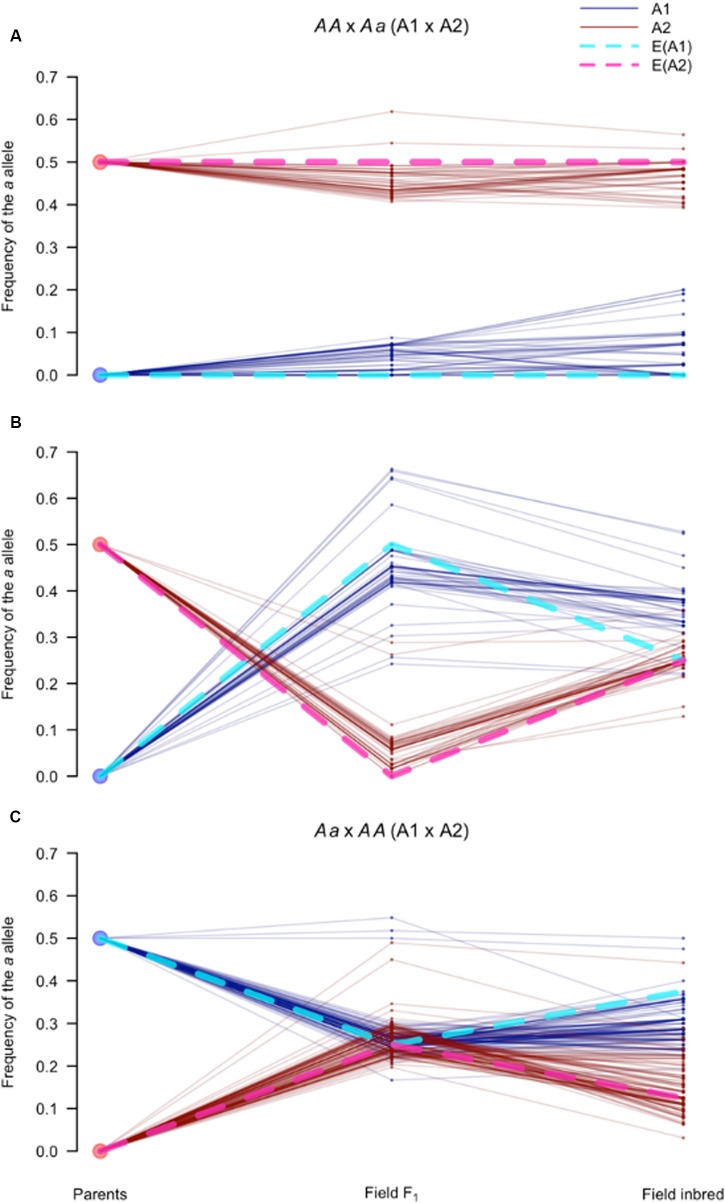
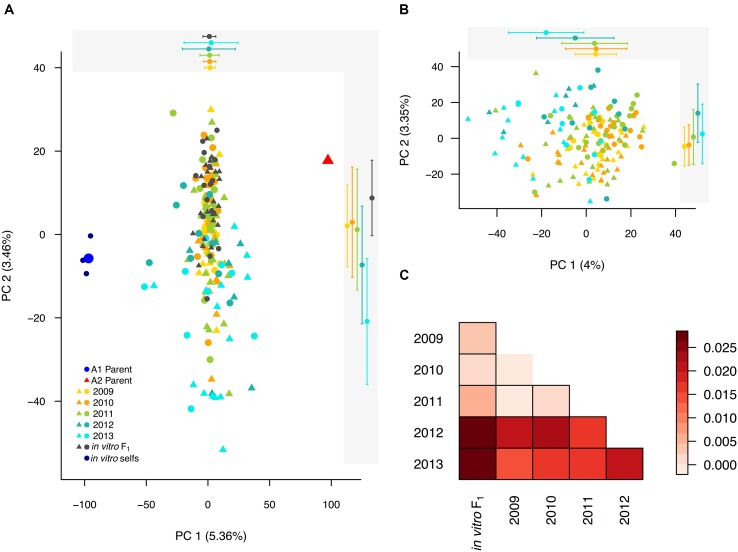
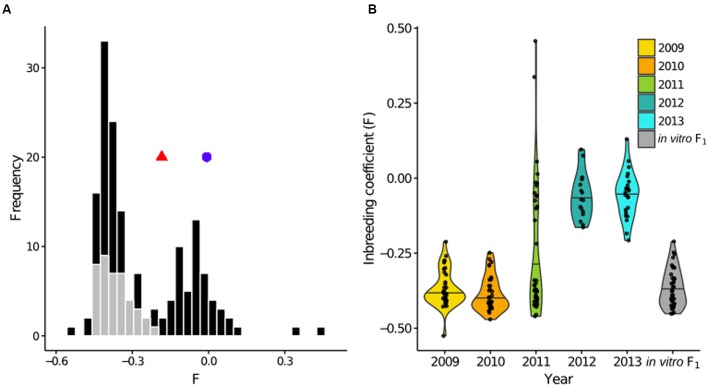
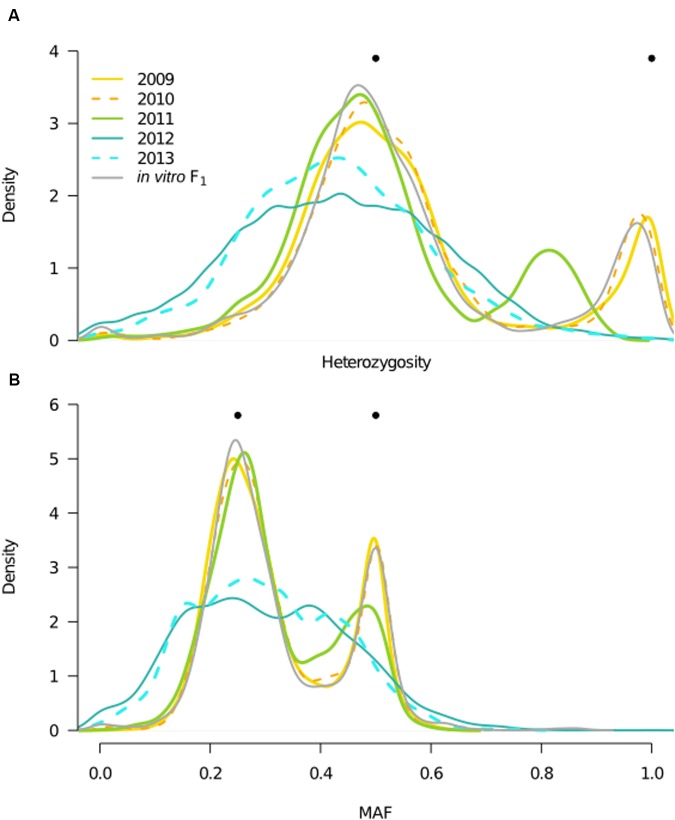
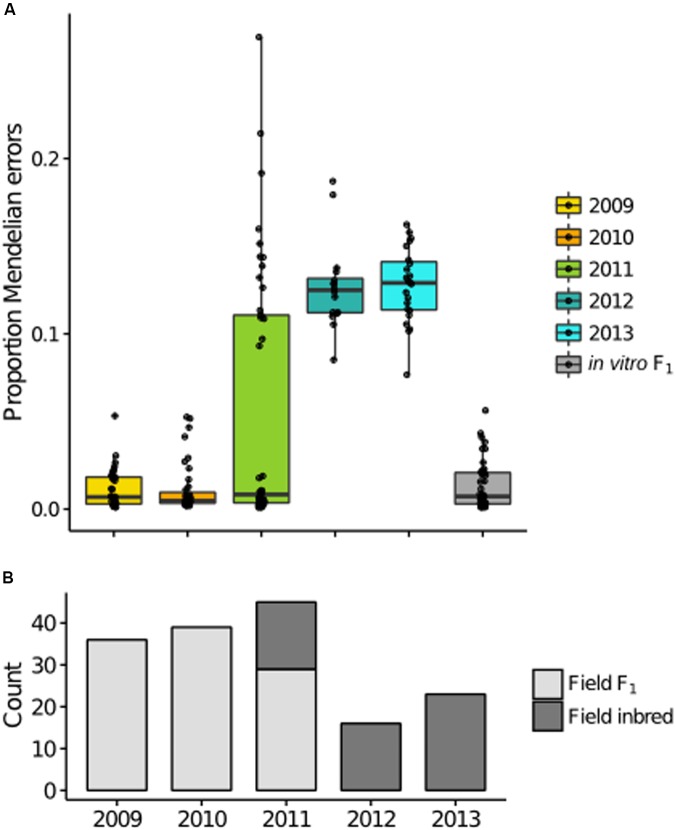
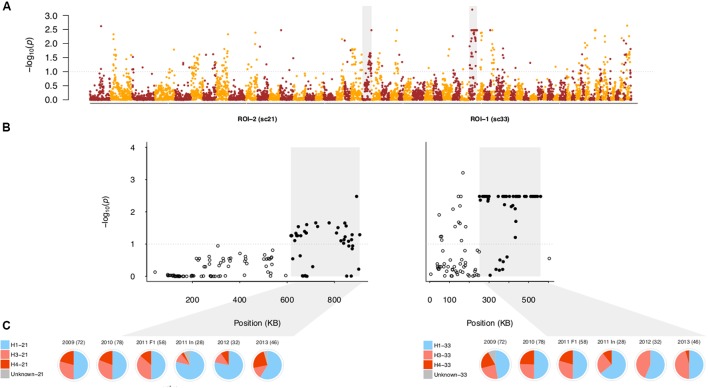
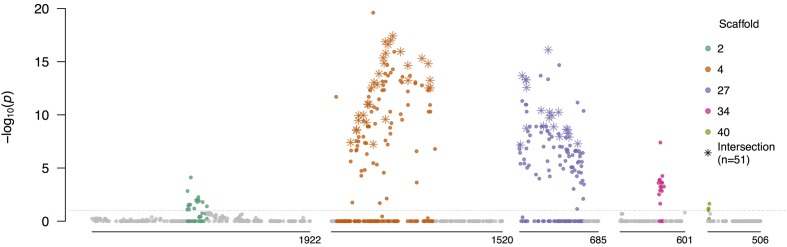
Defining the contributions of dispersal, reproductive mode, and mating system to the population structure of a pathogenic organism is essential to estimating its evolutionary potential. After introduction of the devastating plant pathogen, , into a grower's field, a lack of aerial spore dispersal restricts migration. Once established, coexistence of both mating types results in formation of overwintering recombinant oospores, engendering persistent pathogen populations. To mimic these conditions, in 2008, we inoculated a field with two isolates of opposite mating type. We analyzed pathogenic isolates collected in 2009-2013 from this experimental population, using genome-wide single-nucleotide polymorphism markers. By tracking heterozygosity across years, we show that the population underwent a generational shift; transitioning from exclusively F in 2009-2010, to multi-generational in 2011, and ultimately all inbred in 2012-2013. Survival of F oospores, characterized by heterozygosity excess, coupled with a low rate of selfing, delayed declines in heterozygosity due to inbreeding and attainment of equilibrium genotypic frequencies. Large allele and haplotype frequency changes in specific genomic regions accompanied the generational shift, representing putative signatures of selection. Finally, we identified an approximately 1.6 Mb region associated with mating type determination, constituting the first detailed genomic analysis of a mating type region (MTR) in . Segregation patterns in the MTR exhibited tropes of sex-linkage, where maintenance of allele frequency differences between isolates of opposite mating type was associated with elevated heterozygosity despite inbreeding. Characterizing the trajectory of this experimental system provides key insights into the processes driving persistent, sexual pathogen populations.
确定扩散、繁殖模式和交配系统对致病生物种群结构的贡献对于评估其进化潜力至关重要。在将这种毁灭性的植物病原体引入种植者的田地后,缺乏气传孢子扩散限制了迁移。一旦定殖,两种交配型的共存会导致越冬重组卵孢子的形成,从而产生持久的病原体种群。为了模拟这些条件,2008年,我们用两种相反交配型的分离株接种了一块田地。我们使用全基因组单核苷酸多态性标记分析了2009年至2013年从这个实验种群中收集的致病分离株。通过追踪多年间的杂合性,我们发现该种群经历了一代转变;从2009 - 2010年的纯F型,转变为2011年的多代型,最终在2012 - 2013年全部自交。以杂合性过剩为特征的F卵孢子的存活,加上低自交率,延迟了由于近亲繁殖导致的杂合性下降以及平衡基因型频率的达到。特定基因组区域的大等位基因和单倍型频率变化伴随着代际转变,代表了假定的选择特征。最后,我们确定了一个与交配型决定相关的约1.6 Mb区域,这是对该病原体交配型区域(MTR)的首次详细基因组分析。MTR中的分离模式表现出性连锁特征,即尽管近亲繁殖,但相反交配型分离株之间等位基因频率差异的维持与杂合性升高有关。描述这个实验系统的轨迹为驱动持久性有性病原体种群的过程提供了关键见解。