Gharaibeh Mohammad Y, Alzoubi Karem H, Khabour Omar F, Tinawi Lubna, Hamad Rawan, Keewan Esraa F, Matarneh Sulaiman K, Alomari Mahmoud A
Department of Medical Laboratory Sciences, Faculty of Applied Medical Sciences, Jordan University of Science and Technology, Irbid, Jordan.
Department of Clinical Pharmacy, Faculty of Pharmacy, Jordan University of Science and Technology, Irbid, Jordan.
Cardiol Res. 2012 Aug;3(4):172-179. doi: 10.4021/cr198e. Epub 2012 Jul 20.
Evidence indicates that the pathophysiological process of cardiovascular (CV) disease begins at early age, though the manifestations of the disease do not appear until middle age adulthood. Risk factors for CV disease, particularly lipoprotein profiles, are affected by physiological abnormalities, and lifestyle related issues. To evaluate prevalence of CV diseases risk factors among university students and to investigate relation between number of risk factors and body anthropometric, hematological and biochemical indices parameters.
In this cross sectional study, 348 students were randomly recruited. Blood glucose, cholesterol profile (total, HDL, and LDL cholesterol), and triglyceride were measured using standard protocols. Physical activity (PA) level was assessed using the short-form Arabic version of the International Physical Activity Questionnaires (IPAQ).
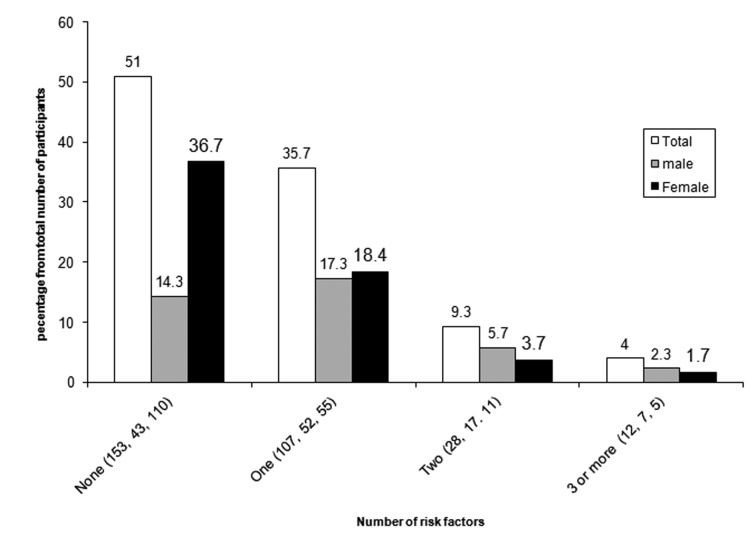
The most commonly encountered CV disease risk factor was low levels of HDL-C, followed by physical inactivity, high levels TG, and obese BMI. When stratified by gender, females were less likely to have low HDL-C, and high TG, whereas, males were more likely to have overweight or obese BMI (P < 0.001). About 49% of the participants had at least one CV disease risk factor, where as the prevalence of having one, two and three or more CV disease risk factors were 35.7%, 9.3% and 4%, respectively. Additionally, the number of CV disease risk factors showed strong positive correlation with increases in body fat and bone percentages, glucose, total cholesterol, TG, LDL-C, BMI, and WHR (range of R: 0.17 to 0.603). On the other hand, physical activity, percentages of body water and muscle, HDL-C showed inverse strong correlation with cardiovascular risk factors (range of R: -0.239 to -0.412).
Results indicate the high prevalence of CV disease risk factors among university students, and stress the need for early intervention programs to counteract these risks.
有证据表明,心血管(CV)疾病的病理生理过程始于早年,尽管该疾病的表现直到中年才出现。心血管疾病的危险因素,尤其是脂蛋白谱,受生理异常和生活方式相关问题的影响。本研究旨在评估大学生心血管疾病危险因素的患病率,并调查危险因素数量与人体测量学、血液学和生化指标参数之间的关系。
在这项横断面研究中,随机招募了348名学生。使用标准方案测量血糖、胆固醇谱(总胆固醇、高密度脂蛋白胆固醇和低密度脂蛋白胆固醇)以及甘油三酯。使用国际体力活动问卷(IPAQ)的阿拉伯文简版评估体力活动(PA)水平。
最常见的心血管疾病危险因素是高密度脂蛋白胆固醇水平低,其次是缺乏体力活动、甘油三酯水平高和肥胖的体重指数。按性别分层时,女性患高密度脂蛋白胆固醇低和甘油三酯高的可能性较小,而男性超重或肥胖体重指数的可能性较大(P < 0.001)。约49%的参与者至少有一个心血管疾病危险因素,其中有一个、两个和三个或更多心血管疾病危险因素的患病率分别为35.7%、9.3%和4%。此外,心血管疾病危险因素的数量与体脂和骨百分比、血糖、总胆固醇、甘油三酯、低密度脂蛋白胆固醇、体重指数和腰臀比的增加呈强正相关(R范围:0.17至0.603)。另一方面,体力活动、身体水分和肌肉百分比、高密度脂蛋白胆固醇与心血管危险因素呈强负相关(R范围:-0.239至-0.412)。
结果表明大学生心血管疾病危险因素的患病率很高,并强调需要早期干预计划来应对这些风险。