Vogel Marco M E, Combs Stephanie E, Kessel Kerstin A
Department of Radiation Oncology, Technische Universität München (TUM), Munich, Germany; Institute for Innovative Radiotherapy, Helmholtz Zentrum München, Neuherberg, Germany.
Front Oncol. 2017 Mar 13;7:37. doi: 10.3389/fonc.2017.00037. eCollection 2017.
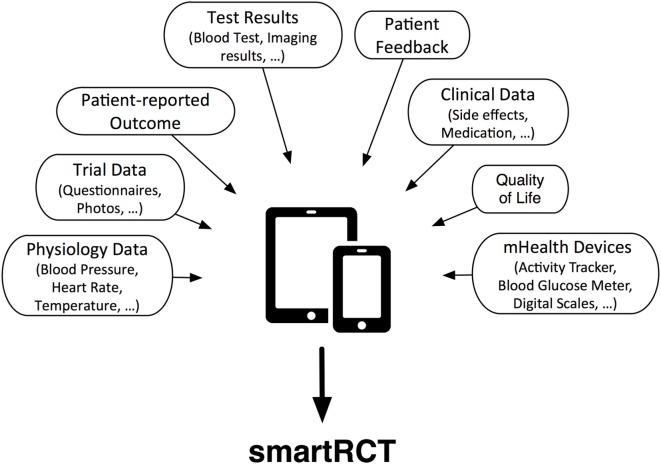
Nowadays, applications (apps) for smartphones and tablets have become indispensable especially for young generations. The estimated number of mobile devices will exceed 2.16 billion in 2016. Over 2.2 million apps are available in the Google Play store, and about 1.8 million apps are available in the Apple App Store. Google and Apple distribute nearly 70,000 apps each in the category Health and Fitness, and about 33,000 and 46,000 each in medical apps. It seems like the willingness to use mHealth apps is high and the intention to share data for health research is existing. This leads to one conclusion: the time for app-accompanied clinical trials (smartRCTs) has come. In this perspective article, we would like to point out the stones put in the way while trying to implement apps in clinical research. Further, we try to offer a glimpse of what the future of smartRCT research may hold.
如今,智能手机和平板电脑应用程序(app)已变得不可或缺,尤其是对年轻一代而言。预计2016年移动设备数量将超过21.6亿。谷歌应用商店中有超过220万款应用程序,苹果应用商店中约有180万款应用程序。谷歌和苹果在健康与健身类别中各自分发近7万款应用程序,在医疗应用程序方面,各自约有3.3万款和4.6万款。使用移动医疗应用程序的意愿似乎很高,且存在为健康研究共享数据的意向。这得出一个结论:应用程序辅助临床试验(智能随机对照试验)的时代已经到来。在这篇观点文章中,我们想指出在临床研究中尝试应用应用程序时所面临的阻碍。此外,我们试图 glimpse of what the future of smartRCT research may hold.(此句英文有误,无法准确翻译,可改为“此外,我们试图展望智能随机对照试验研究的未来可能是怎样的。”)