Do Huyen Phuc, Tran Bach Xuan, Le Pham Quyen, Nguyen Long Hoang, Tran Tung Thanh, Latkin Carl A, Dunne Michael P, Baker Philip Ra
School of Public Health and Social Work, Queensland University of Technology, Brisbane, QLD, Australia,
Institute for Global Health Innovations, Duy Tan University, Danang, Vietnam,
Patient Prefer Adherence. 2018 Oct 8;12:2065-2084. doi: 10.2147/PPA.S169397. eCollection 2018.
To synthesize evidence of the effects and potential effect modifiers of different electronic health (eHealth) interventions to help people quit smoking.
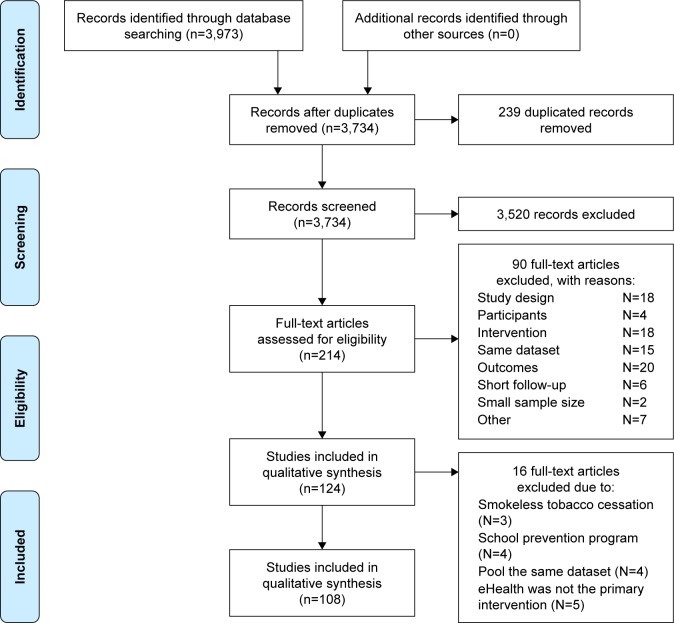
Four databases (MEDLINE, PsycINFO, Embase, and The Cochrane Library) were searched in March 2017 using terms that included "smoking cessation", "eHealth/mHealth" and "electronic technology" to find relevant studies. Meta-analysis and meta-regression analyses were performed using Mantel-Haenszel test for fixed-effect risk ratio (RR) and restricted maximum-likelihood technique, respectively. Protocol Registration Number: CRD42017072560.
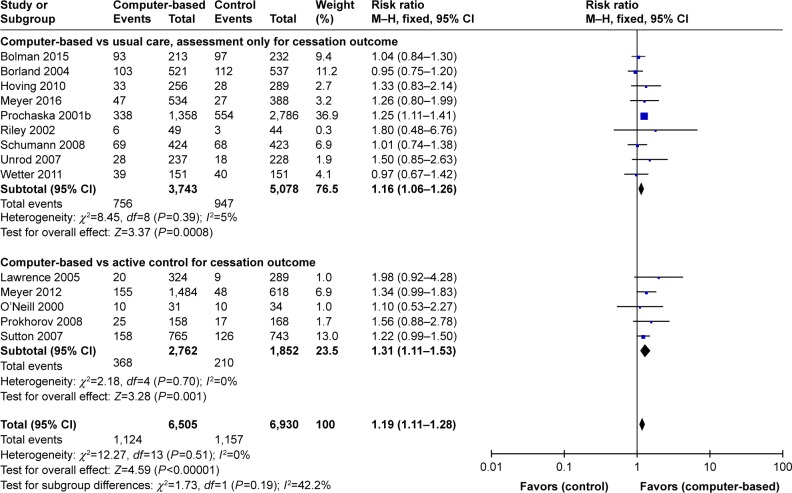
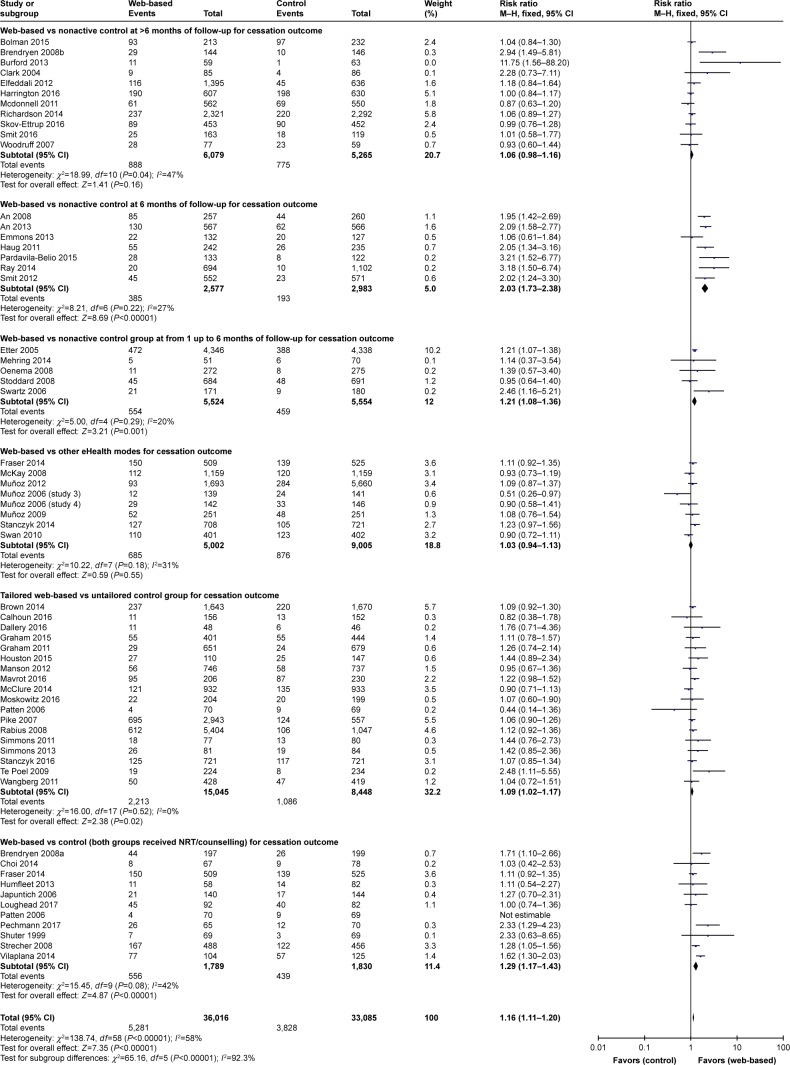
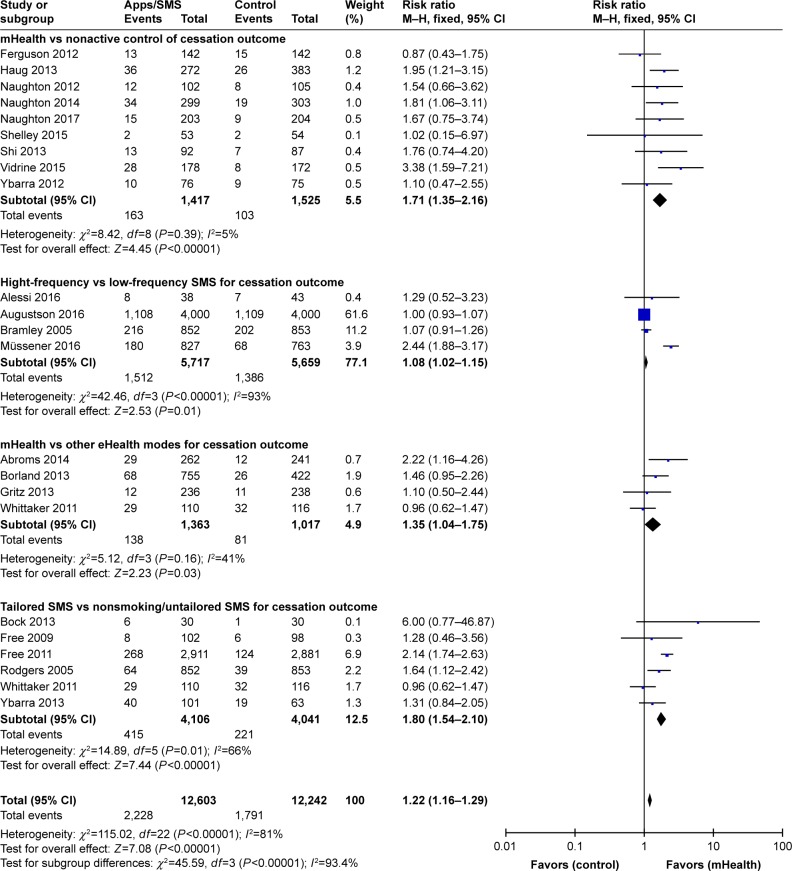
The review included 108 studies and 110,372 participants. Compared to nonactive control groups (eg, usual care), smoking cessation interventions using web-based and mobile health (mHealth) platform resulted in significantly greater smoking abstinence, RR 2.03 (95% CI 1.7-2.03), and RR 1.71 (95% CI 1.35-2.16), respectively. Similarly, smoking cessation trials using tailored text messages (RR 1.80, 95% CI 1.54-2.10) and web-based information and conjunctive nicotine replacement therapy (RR 1.29, 95% CI 1.17-1.43) may also increase cessation. In contrast, little or no benefit for smoking abstinence was found for computer-assisted interventions (RR 1.31, 95% CI 1.11-1.53). The magnitude of effect sizes from mHealth smoking cessation interventions was likely to be greater if the trial was conducted in the USA or Europe and when the intervention included individually tailored text messages. In contrast, high frequency of texts (daily) was less effective than weekly texts.
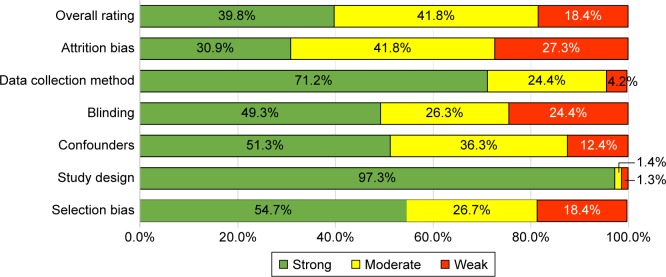
There was consistent evidence that web-based and mHealth smoking cessation interventions may increase abstinence moderately. Methodologic quality of trials and the intervention characteristics (tailored vs untailored) are critical effect modifiers among eHealth smoking cessation interventions, especially for web-based and text messaging trials. Future smoking cessation intervention should take advantages of web-based and mHealth engagement to improve prolonged abstinence.
综合不同电子健康(eHealth)干预措施对帮助人们戒烟的效果及潜在效应修饰因素的证据。
2017年3月检索了四个数据库(MEDLINE、PsycINFO、Embase和Cochrane图书馆),使用了包括“戒烟”、“电子健康/移动健康(mHealth)”和“电子技术”等术语来查找相关研究。分别使用Mantel-Haenszel检验固定效应风险比(RR)和受限最大似然技术进行荟萃分析和荟萃回归分析。方案注册号:CRD42017072560。
该综述纳入了108项研究和110372名参与者。与非活性对照组(如常规护理)相比,使用基于网络和移动健康(mHealth)平台的戒烟干预措施导致戒烟成功率显著更高,RR分别为2.03(95%CI 1.7 - 2.03)和RR 1.71(95%CI 1.35 - 2.16)。同样,使用定制短信的戒烟试验(RR 1.80,95%CI 1.54 - 2.10)和基于网络的信息与联合尼古丁替代疗法(RR 1.29,95%CI 1.17 - 1.43)也可能增加戒烟成功率。相比之下,计算机辅助干预对戒烟几乎没有益处(RR 1.31,95%CI 1.11 - 1.53)。如果试验在美国或欧洲进行,且干预措施包括个性化定制短信,那么mHealth戒烟干预措施的效应大小可能更大。相反,高频短信(每日)的效果不如每周短信。
有一致的证据表明,基于网络和mHealth的戒烟干预措施可能适度提高戒烟成功率。试验的方法学质量和干预特征(定制与非定制)是eHealth戒烟干预措施中的关键效应修饰因素,特别是对于基于网络和短信的试验。未来的戒烟干预应利用基于网络和mHealth的参与方式来提高长期戒烟成功率。