Spieker Maximilian, Haberkorn Sebastian, Gastl Mareike, Behm Patrick, Katsianos Stratis, Horn Patrick, Jacoby Christoph, Schnackenburg Bernhard, Reinecke Petra, Kelm Malte, Westenfeld Ralf, Bönner Florian
Department of Cardiology, Pulmonology and Vascular Medicine, Heinrich Heine University Düsseldorf, Moorenstraße 5, 40225, Düsseldorf, Germany.
Philips Healthcare, Hamburg, Germany.
J Cardiovasc Magn Reson. 2017 Mar 29;19(1):38. doi: 10.1186/s12968-017-0350-x.
While most patients recover from suspected acute myocarditis (sAMC) some develop progressive disease with 5-year mortality up to 20%. Recently, parametric Cardiovascular Magnetic Resonance (CMR) approaches, quantifying native T1 and T2 relaxation time, have demonstrated the ability to increase diagnostic accuracy. However, prognostic implications of T2 values in this cohort are unknown. The purpose of the study was to investigate the prognostic relevance of elevated CMR T2 values in patients with sAMC.
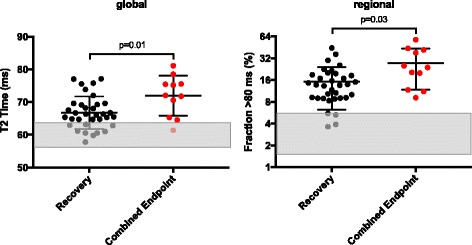
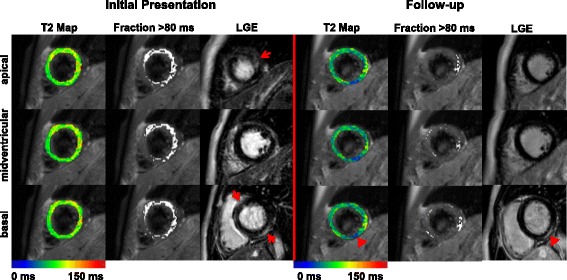
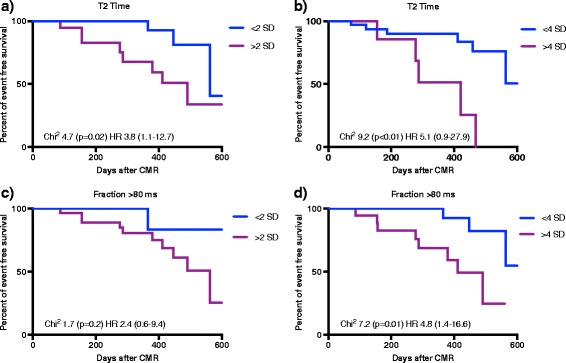
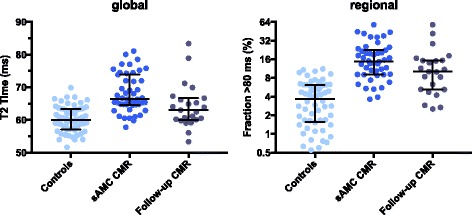
We carried out a prospective study in 46 patients with sAMC defined by current ESC recommendations. A combined endpoint was defined by the occurrence of at least one major adverse cardiac event (MACE) and hospitalisation for heart failure. Event rate was 24% (n = 11) for 1-year-MACE and hospitalisation. A follow-up after 11 ± 7 months was performed in 98% of the patients. Global T2 values were significantly increased at acute stage of disease compared to controls and decreased over time. During acute disease, elevated global T2 time (odds ratio 6.3, p < 0.02) as well as myocardial fraction with T2 time >80 ms (odds ratio 4.9, p < 0.04) predicted occurrence of the combined endpoint. Patients with clinical recovery revealed significantly decreased T2 relaxation times at follow-up examinations; however, T2 values were still elevated compared to healthy controls.
Assessment of myocardial T2 relaxation times at initial presentation facilitates CMR-based risk stratification in patients with acute myocarditis. T2 Mapping may emerge as a new tool to monitor inflammatory myocardial injuries during the course of disease.
虽然大多数疑似急性心肌炎(sAMC)患者可康复,但部分患者会发展为进展性疾病,5年死亡率高达20%。最近,参数化心血管磁共振(CMR)方法,即对固有T1和T2弛豫时间进行量化,已证明能够提高诊断准确性。然而,该队列中T2值的预后意义尚不清楚。本研究的目的是探讨CMR T2值升高在sAMC患者中的预后相关性。
我们对46例符合当前欧洲心脏病学会(ESC)推荐定义的sAMC患者进行了一项前瞻性研究。联合终点由至少发生一次主要不良心脏事件(MACE)和因心力衰竭住院来定义。1年MACE和住院的事件发生率为24%(n = 11)。98%的患者在11±7个月后进行了随访。与对照组相比,疾病急性期的整体T2值显著升高,并随时间下降。在急性疾病期间,整体T2时间升高(比值比6.3,p < 0.02)以及T2时间>80 ms的心肌分数(比值比4.9,p < 0.04)可预测联合终点的发生。临床康复的患者在随访检查时T2弛豫时间显著降低;然而,与健康对照组相比,T2值仍升高。
在初次就诊时评估心肌T2弛豫时间有助于对急性心肌炎患者进行基于CMR的风险分层。T2成像可能成为疾病过程中监测炎症性心肌损伤的一种新工具。