Wang Candice, Huang Chin-Chou, Lin Shing-Jong, Chen Jaw-Wen
Department of Medical Education Department of Medical Research Department of Medicine, Division of Cardiology, Taipei Veterans General Hospital Cardiovascular Research Center Institute of Pharmacology Institute of Clinical Medicine, National Yang-Ming University, Taipei, Taiwan, R.O.C.
Medicine (Baltimore). 2017 Mar;96(13):e4079. doi: 10.1097/MD.0000000000004079.
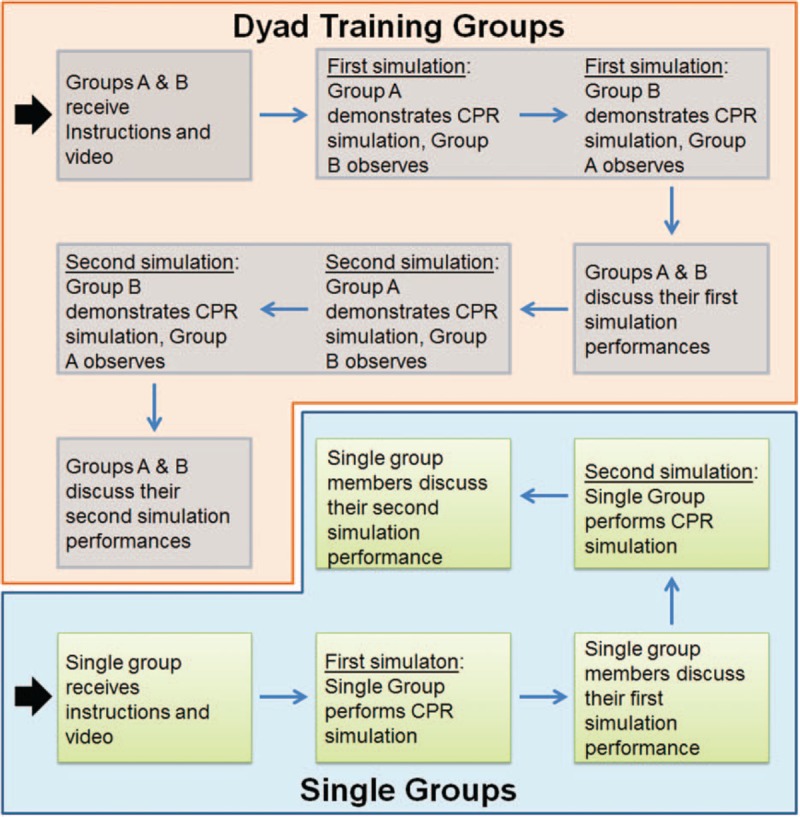
We investigated the effects of dyadic training on medical students' resuscitation performance during cardiopulmonary resuscitation (CPR) training.We provided students with a 2-hour training session on CPR for simulated cardiac arrest. Student teams were split into double groups (Dyad training groups: Groups A and B) or Single Groups. All groups received 2 CPR simulation rounds. CPR simulation training began with peer demonstration for Group A, and peer observation for Group B. Then the 2 groups switched roles. Single Groups completed CPR simulation without peer observation or demonstration. Teams were then evaluated based on leadership, teamwork, and team member skills.Group B had the highest first simulation round scores overall (P = 0.004) and in teamwork (P = 0.001) and team member skills (P = 0.031). Group B also had the highest second simulation round scores overall (P < 0.001) and in leadership (P = 0.033), teamwork (P < 0.001), and team member skills (P < 0.001). In the first simulation, there were no differences between Dyad training groups with those of Single Groups in overall scores, leadership scores, teamwork scores, and team member scores. In the second simulation, Dyad training groups scored higher in overall scores (P = 0.002), leadership scores (P = 0.044), teamwork scores (P = 0.005), and team member scores (P = 0.008). Dyad training groups also displayed higher improvement in overall scores (P = 0.010) and team member scores (P = 0.022).Dyad training was effective for CPR training. Both peer observation and demonstration for peers in dyad training can improve student resuscitation performance.
我们研究了双人训练对医学生心肺复苏(CPR)培训期间复苏表现的影响。我们为学生提供了为期2小时的模拟心脏骤停CPR培训课程。学生团队被分为双人组(双人训练组:A组和B组)或单人组。所有组都进行了2轮CPR模拟。CPR模拟训练开始时,A组进行同伴示范,B组进行同伴观察。然后两组交换角色。单人组在没有同伴观察或示范的情况下完成CPR模拟。随后根据领导能力、团队合作和团队成员技能对各团队进行评估。B组在第一轮模拟中的总体得分(P = 0.004)、团队合作(P = 0.001)和团队成员技能(P = 0.031)方面均最高。B组在第二轮模拟中的总体得分(P < 0.001)、领导能力(P = 0.033)、团队合作(P < 0.001)和团队成员技能(P < 0.001)方面也最高。在第一次模拟中,双人训练组与单人组在总体得分、领导得分、团队合作得分和团队成员得分方面没有差异。在第二次模拟中,双人训练组在总体得分(P = 0.002)、领导得分(P = 0.044)、团队合作得分(P = 0.005)和团队成员得分(P = 0.008)方面得分更高。双人训练组在总体得分(P = 0.010)和团队成员得分(P = 0.022)方面也有更高的提升。双人训练对CPR培训有效。双人训练中的同伴观察和同伴示范都可以提高学生的复苏表现。