Ward-Caviness Cavin K, Neas Lucas M, Blach Colette, Haynes Carol S, LaRocque-Abramson Karen, Grass Elizabeth, Dowdy Z Elaine, Devlin Robert B, Diaz-Sanchez David, Cascio Wayne E, Miranda Marie Lynn, Gregory Simon G, Shah Svati H, Kraus William E, Hauser Elizabeth R
Duke Molecular Physiology Institute, Duke University School of Medicine, Durham, NC, United States of America.
Institute of Epidemiology II, Helmholtz Zentrum München, Neuherberg, Germany.
PLoS One. 2017 Mar 29;12(3):e0173880. doi: 10.1371/journal.pone.0173880. eCollection 2017.
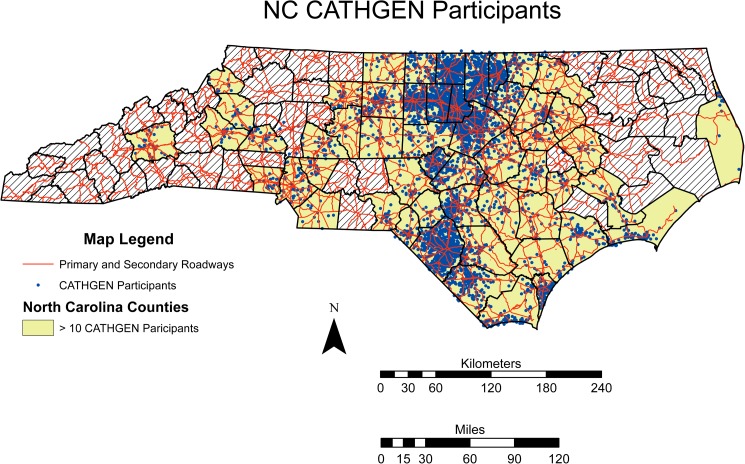
Air pollution is a worldwide contributor to cardiovascular disease mortality and morbidity. Traffic-related air pollution is a widespread environmental exposure and is associated with multiple cardiovascular outcomes such as coronary atherosclerosis, peripheral arterial disease, and myocardial infarction. Despite the recognition of the importance of both genetic and environmental exposures to the pathogenesis of cardiovascular disease, studies of how these two contributors operate jointly are rare. We performed a genome-wide interaction study (GWIS) to examine gene-traffic exposure interactions associated with coronary atherosclerosis. Using race-stratified cohorts of 538 African-Americans (AA) and 1562 European-Americans (EA) from a cardiac catheterization cohort (CATHGEN), we identify gene-by-traffic exposure interactions associated with the number of significantly diseased coronary vessels as a measure of chronic atherosclerosis. We found five suggestive (P<1x10⁻⁵) interactions in the AA GWIS, of which two (rs1856746 and rs2791713) replicated in the EA cohort (P < 0.05). Both SNPs are in the PIGR-FCAMR locus and are eQTLs in lymphocytes. The protein products of both PIGR and FCAMR are implicated in inflammatory processes. In the EA GWIS, there were three suggestive interactions; none of these replicated in the AA GWIS. All three were intergenic; the most significant interaction was in a regulatory region associated with SAMSN1, a gene previously associated with atherosclerosis and B cell activation. In conclusion, we have uncovered several novel genes associated with coronary atherosclerosis in individuals chronically exposed to increased ambient concentrations of traffic air pollution. These genes point towards inflammatory pathways that may modify the effects of air pollution on cardiovascular disease risk.
空气污染是导致全球心血管疾病死亡和发病的一个因素。与交通相关的空气污染是一种广泛存在的环境暴露因素,与多种心血管疾病后果相关,如冠状动脉粥样硬化、外周动脉疾病和心肌梗死。尽管人们认识到遗传和环境暴露因素在心血管疾病发病机制中都很重要,但关于这两种因素如何共同作用的研究却很少。我们进行了一项全基因组相互作用研究(GWIS),以检验与冠状动脉粥样硬化相关的基因 - 交通暴露相互作用。利用来自心脏导管插入术队列(CATHGEN)的538名非裔美国人(AA)和1562名欧裔美国人(EA)的种族分层队列,我们确定了与显著病变的冠状动脉血管数量相关的基因 - 交通暴露相互作用,以此作为慢性动脉粥样硬化的一个指标。我们在非裔美国人的GWIS中发现了5个提示性(P<1x10 - 5)相互作用,其中两个(rs1856746和rs2791713)在欧裔美国人队列中得到重复验证(P < 0.05)。这两个单核苷酸多态性(SNP)都位于PIGR - FCAMR基因座,并且是淋巴细胞中的表达数量性状基因座(eQTL)。PIGR和FCAMR的蛋白质产物都与炎症过程有关。在欧裔美国人的GWIS中,有3个提示性相互作用;这些在非裔美国人的GWIS中均未得到重复验证。所有这3个都是基因间的;最显著的相互作用位于与SAMSN1相关的一个调控区域,SAMSN1是一个先前与动脉粥样硬化和B细胞活化相关的基因。总之,我们发现了几个与长期暴露于环境交通空气污染增加的个体的冠状动脉粥样硬化相关的新基因。这些基因指向了可能改变空气污染对心血管疾病风险影响的炎症途径。