Kraus William E, Muoio Deborah M, Stevens Robert, Craig Damian, Bain James R, Grass Elizabeth, Haynes Carol, Kwee Lydia, Qin Xuejun, Slentz Dorothy H, Krupp Deidre, Muehlbauer Michael, Hauser Elizabeth R, Gregory Simon G, Newgard Christopher B, Shah Svati H
Division of Cardiology, Department of Medicine, Duke University, Durham, North Carolina, United States of America.
Duke Molecular Physiology Institute, Duke University, Durham, North Carolina, United States of America.
PLoS Genet. 2015 Nov 5;11(11):e1005553. doi: 10.1371/journal.pgen.1005553. eCollection 2015 Nov.
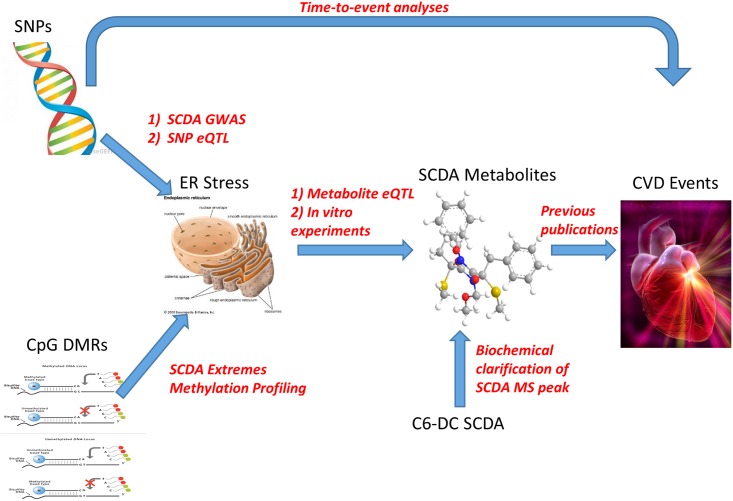
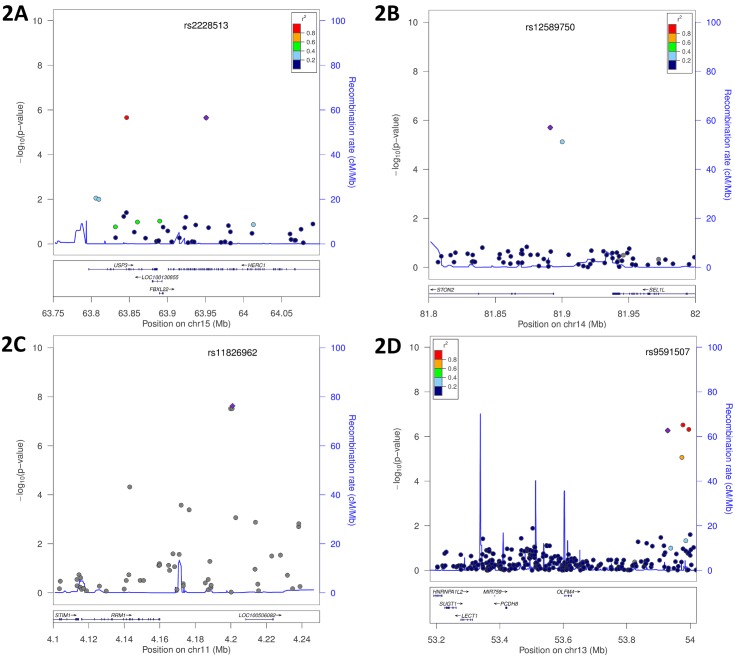
Levels of certain circulating short-chain dicarboxylacylcarnitine (SCDA), long-chain dicarboxylacylcarnitine (LCDA) and medium chain acylcarnitine (MCA) metabolites are heritable and predict cardiovascular disease (CVD) events. Little is known about the biological pathways that influence levels of most of these metabolites. Here, we analyzed genetics, epigenetics, and transcriptomics with metabolomics in samples from a large CVD cohort to identify novel genetic markers for CVD and to better understand the role of metabolites in CVD pathogenesis. Using genomewide association in the CATHGEN cohort (N = 1490), we observed associations of several metabolites with genetic loci. Our strongest findings were for SCDA metabolite levels with variants in genes that regulate components of endoplasmic reticulum (ER) stress (USP3, HERC1, STIM1, SEL1L, FBXO25, SUGT1) These findings were validated in a second cohort of CATHGEN subjects (N = 2022, combined p = 8.4x10⁻⁶-2.3x10⁻¹⁰). Importantly, variants in these genes independently predicted CVD events. Association of genomewide methylation profiles with SCDA metabolites identified two ER stress genes as differentially methylated (BRSK2 and HOOK2). Expression quantitative trait loci (eQTL) pathway analyses driven by gene variants and SCDA metabolites corroborated perturbations in ER stress and highlighted the ubiquitin proteasome system (UPS) arm. Moreover, culture of human kidney cells in the presence of levels of fatty acids found in individuals with cardiometabolic disease, induced accumulation of SCDA metabolites in parallel with increases in the ER stress marker BiP. Thus, our integrative strategy implicates the UPS arm of the ER stress pathway in CVD pathogenesis, and identifies novel genetic loci associated with CVD event risk.
某些循环短链二羧酰基肉碱(SCDA)、长链二羧酰基肉碱(LCDA)和中链酰基肉碱(MCA)代谢物的水平具有遗传性,并可预测心血管疾病(CVD)事件。对于影响这些代谢物中大多数水平的生物学途径,我们知之甚少。在此,我们对来自一个大型CVD队列的样本进行了遗传学、表观遗传学和转录组学与代谢组学的分析,以识别CVD的新型遗传标记,并更好地理解代谢物在CVD发病机制中的作用。利用CATHGEN队列(N = 1490)中的全基因组关联研究,我们观察到几种代谢物与基因位点之间的关联。我们最显著的发现是SCDA代谢物水平与调节内质网(ER)应激成分的基因变异有关(USP3、HERC1、STIM1、SEL1L、FBXO25、SUGT1)。这些发现在CATHGEN受试者的第二个队列中得到了验证(N = 2022,合并p = 8.4×10⁻⁶ - 2.3×10⁻¹⁰)。重要的是,这些基因中的变异独立地预测了CVD事件。全基因组甲基化谱与SCDA代谢物的关联确定了两个ER应激基因存在差异甲基化(BRSK2和HOOK2)。由基因变异和SCDA代谢物驱动的表达定量性状位点(eQTL)途径分析证实了ER应激的扰动,并突出了泛素蛋白酶体系统(UPS)分支。此外,在患有心脏代谢疾病的个体中发现的脂肪酸水平存在的情况下培养人肾细胞,会诱导SCDA代谢物的积累,同时内质网应激标志物BiP也会增加。因此,我们的综合策略表明ER应激途径的UPS分支参与了CVD发病机制,并识别出与CVD事件风险相关的新型基因位点。