Concha-Velasco Fátima, González-Lagos Elsa, Seas Carlos, Bustamante Beatriz
Instituto de Medicina Tropical "Alexander von Humboldt", Universidad Peruana Cayetano Heredia, Lima, Perú.
Facultad de Medicina, Universidad Peruana Cayetano Heredia, Lima, Perú.
PLoS One. 2017 Mar 29;12(3):e0174459. doi: 10.1371/journal.pone.0174459. eCollection 2017.
The first-line combination therapy for HIV-associated cryptococcal meningitis (CM), a condition of high mortality particularly in the first two weeks of treatment, consists of amphotericin B plus flucytosine (5-FC). Given that 5-FC remains unavailable in many countries, the knowledge of factors influencing mycological clearance in patients treated with second-line therapy could contribute to effective management.
To determine the factors associated with the clearance of Cryptococcus sp. from the cerebrospinal fluid by the second week of effective antifungal therapy (early mycological clearance) in HIV-associated CM.
Retrospective cohort study based on secondary data corresponding to HIV-associated CM cases hospitalized at a tertiary health care center in Lima, Peru where 5-FC remains unavailable. Risk factors associated with early mycological clearance were analyzed by generalized linear regression models.
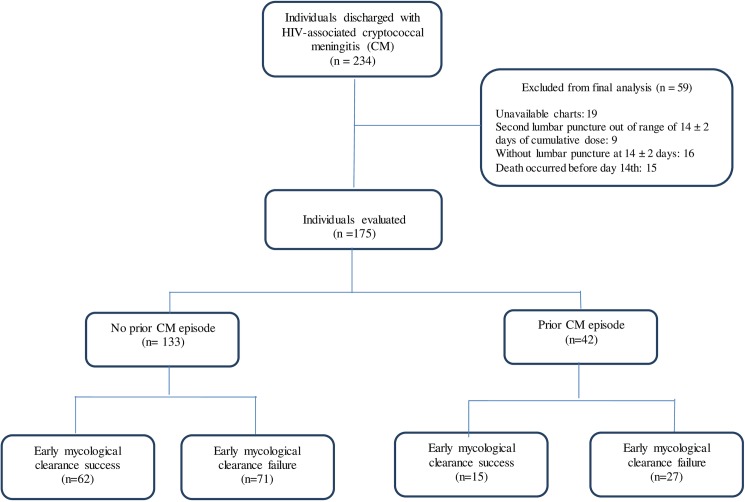
From January 2000 to December 2013, 234 individuals were discharged with a diagnosis of HIV-associated CM; in 215 we retrieved the required data. The inpatient mortality was 20% (43/215), 15 of them in the first two weeks of treatment. In the final model (157 cases), adjusted for age, previous episode of CM, ART use, type of antifungal treatment, raised intracranial pressure, frequency of therapeutic lumbar punctures, baseline fungal burden and treatment period, the factors associated with early mycological clearance were: Amphotericin B deoxycholate plus fluconazole as combination therapy (RR, 1.56; 95% CI, 1.14-2.14); severe baseline intracranial pressure (≥35 cm H2O) (RR, 0.57; 95% CI, 0.33-0.99); and baseline fungal burden over 4.5 log10 CFU/mL (RR, 0.61 95% CI: 0.39-0.95).
In a setting without access to first-line therapy for CM, the combination therapy with amphotericin B deoxycholate plus fluconazole was positively associated with early mycological clearance, while high fungal burden and severe baseline intracranial pressure were negatively associated, and thus related to failure.
艾滋病相关隐球菌性脑膜炎(CM)的一线联合治疗方案为两性霉素B加氟胞嘧啶(5-FC),该病死亡率很高,尤其是在治疗的头两周内。鉴于许多国家仍无法获得5-FC,了解二线治疗患者真菌清除的影响因素有助于有效管理。
确定在艾滋病相关CM中,有效抗真菌治疗第二周(早期真菌清除)时脑脊液中隐球菌清除相关的因素。
基于秘鲁利马一家三级医疗中心住院的艾滋病相关CM病例的二次数据进行回顾性队列研究,该中心无法获得5-FC。通过广义线性回归模型分析与早期真菌清除相关的危险因素。
2000年1月至2013年12月,234例患者出院诊断为艾滋病相关CM;215例患者获取了所需数据。住院死亡率为20%(43/215),其中15例在治疗的头两周内死亡。在最终模型(157例)中,调整年龄、既往CM发作史、抗逆转录病毒治疗使用情况、抗真菌治疗类型、颅内压升高、治疗性腰椎穿刺频率、基线真菌负荷和治疗时间后,与早期真菌清除相关的因素为:两性霉素B脱氧胆酸盐加氟康唑联合治疗(RR,1.56;95%CI,1.14-2.14);严重基线颅内压(≥35 cm H2O)(RR,0.57;95%CI,0.33-0.99);以及基线真菌负荷超过4.5 log10 CFU/mL(RR,0.61 95%CI:0.39-0.95)。
在无法获得CM一线治疗的情况下,两性霉素B脱氧胆酸盐加氟康唑联合治疗与早期真菌清除呈正相关,而高真菌负荷和严重基线颅内压呈负相关,因此与治疗失败有关。