Pinto Marcelo Mendes, Gonçalves Marcela Leticia Leal, Mota Ana Carolina Costa da, Deana Alessandro Melo, Olivan Silvia Regina, Bortoletto Carolina, Godoy Camila Haddad Leal de, Vergilio Katia Lumi Tanikawa, Altavista Olga Maria, Motta Lara J, Bussadori Sandra Kalil
Universidade Nove de Julho, Programa de Pós-Graduação, Departamento de Biofotônica Aplicada ès Ciências da Saúde, São Paulo/, SP, Brazil.
Clinics (Sao Paulo). 2017 Mar;72(3):161-170. doi: 10.6061/clinics/2017(03)06.
: To evaluate the colorimetric change in incisors and canines of adolescents aged 12 to 20 years submitted to at-home whitening and to evaluate satisfaction, sensitivity and discomfort during the procedures through a questionnaire.
: Thirty adolescents were randomly assigned to the following groups: 1) 6.0% hydrogen peroxide (White Class with calcium - FGM); 2) 7.5% hydrogen peroxide (White Class with calcium - FGM); 3) 10% hydrogen peroxide (Oral B 3D White - Oral-B); 4) Control group - placebo. Assessments were performed prior to treatment as well as at 7, 30, 180 and 360 days after treatment. Friedman's ANOVA was used to analyze color. The Kruskal-Wallis test followed by Dunn's post hoc test was used to compare the groups at the different evaluation times. Answers on the questionnaires were ranked, and non-parametrical tests were employed. The groups were compared in each period using the Kruskal-Wallis test followed by the Student-Newman-Keuls test. Categorical data were analyzed using Fisher's exact test, and the Wilcoxon test was used for the analysis of different periods. P-values were corrected using the Hyan-Holm step-down Bonferroni procedure. Clinicaltrials.gov: NCT01998386.
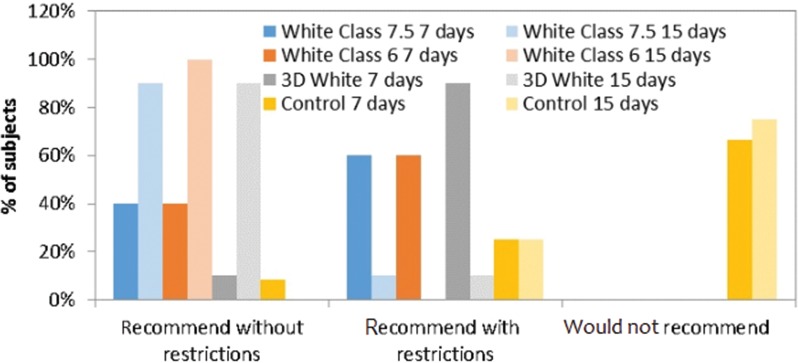
: Similar results were obtained one month after treatment with both tooth whitening gels and whitening strips. Patients were partially satisfied with the treatment after the first and second weeks and would recommend it. All products demonstrated color stability after 12 months of follow-up.
: The bleaching procedure was efficient, and the patients could perceive its result. Further investigations are needed to determine the effects of bleaching on young teeth.
评估12至20岁青少年在家进行牙齿美白后切牙和尖牙的比色变化,并通过问卷调查评估治疗过程中的满意度、敏感度和不适感。
30名青少年被随机分为以下几组:1)6.0%过氧化氢(含钙美白剂 - FGM公司);2)7.5%过氧化氢(含钙美白剂 - FGM公司);3)10%过氧化氢(欧乐B 3D美白 - 欧乐B公司);4)对照组 - 安慰剂。在治疗前以及治疗后7天、30天、180天和360天进行评估。采用弗里德曼方差分析来分析颜色。使用克鲁斯卡尔 - 沃利斯检验及之后的邓恩事后检验来比较不同评估时间的各组。对问卷答案进行排序,并采用非参数检验。使用克鲁斯卡尔 - 沃利斯检验及之后的学生 - 纽曼 - 基尔斯检验在每个时期对各组进行比较。分类数据采用费舍尔精确检验进行分析,威尔科克森检验用于不同时期的分析。使用海恩 - 霍尔姆逐步递减邦费罗尼程序校正P值。Clinicaltrials.gov:NCT01998386。
两种牙齿美白凝胶和美白牙贴在治疗后一个月获得了相似的结果。患者在第一周和第二周后对治疗部分满意,并会推荐该治疗。所有产品在随访12个月后均表现出颜色稳定性。
漂白程序有效,患者能够察觉到其效果。需要进一步研究以确定漂白对年轻牙齿的影响。