Cheikh Amine, Belefquih Bouchra, Chajai Younes, Cheikhaoui Younes, El Hassani Amine, Benouda Amina
Department of pharmacy, Abulcasis University, Cheikh Zaid Hospital, Rabat, Morocco.
Department of Microbiology, Faculty of Medicine, Mohammed VI University of Health Sciences, Microbiology Unit, National Reference Laboratory, Casablanca, Morocco.
BMC Infect Dis. 2017 Mar 29;17(1):237. doi: 10.1186/s12879-017-2346-4.
Children with cardiac defects need many hospitalizations and repetitive antibiotic therapies, with an increasing risk of colonization with multidrug-resistant bacteria (MDRB) such as extended-spectrum β-lactamase-producing Enterobacteriaceae (ESBL-E) Post-operative infections with these bacteria in paediatric cardiac surgery are life threatening. This article aims to study the prevalence of ESBL colonization among paediatric cardiac surgery patients, and to compare occurrence of post-operative infections with and without ESBL colonization. We also aim to study the correlation between the onset of postoperative infection and other parameters such as age, length of stay and preoperative antibiotic therapy.
A retrospective cohort study included paediatric cardiac surgery patients in Cheikh Zaid hospital in Rabat, Morocco, between the 1st of January 2011 and 31 December 2014. A screening for ESBL colonization was requested for children who had a risk factor (previous hospitalization and/or taking antibiotics) at admission. Swabs were collected from three sites (throat, nose and anus). Two groups were compared - patients colonized and not colonized with ESBLs. Statistical analysis was performed using R software.
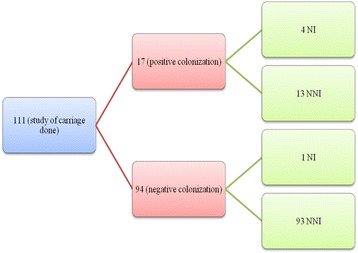
ESBL colonization screening was performed in 111 patients. Positive colonization was detected in 17 cases (15%). Klebsiella pneumoniae (KP): 9 (53%) was the most frequently isolated species. Among the 17 patients, 23.5% (4/17) developed a postoperative infection due to ESBLs versus only one patient without colonization (1%). There was a statically significant difference in terms of occurrence of postoperative infection between the two groups (p = 0.001). Relative risk of developing a postoperative infection with positive colonization was 22 (95% CI, 8.37-58.5).
The analysis of colonization with multidrug-resistant bacteria and the prevention of nosocomial infections appear to be important challenges for paediatric cardiac surgery. Systematic screening of ESBL colonization for cardiac surgery could have a significant contribution, on one hand to guide prophylactic antibiotic therapy of patients, and on the other, to prevent spread of those infections.
患有心脏缺陷的儿童需要多次住院治疗和反复进行抗生素治疗,感染产超广谱β-内酰胺酶肠杆菌科细菌(ESBL-E)等多重耐药菌(MDRB)的风险不断增加。小儿心脏手术中这些细菌引起的术后感染会危及生命。本文旨在研究小儿心脏手术患者中ESBL定植的患病率,并比较有无ESBL定植的患者术后感染的发生率。我们还旨在研究术后感染的发生与年龄、住院时间和术前抗生素治疗等其他参数之间的相关性。
一项回顾性队列研究纳入了2011年1月1日至2014年12月31日期间在摩洛哥拉巴特的谢赫·扎伊德医院接受小儿心脏手术的患者。对入院时有危险因素(既往住院和/或使用抗生素)的儿童进行ESBL定植筛查。从三个部位(咽喉、鼻腔和肛门)采集拭子。比较两组患者——ESBL定植组和非定植组。使用R软件进行统计分析。
对111例患者进行了ESBL定植筛查。17例(15%)检测到定植阳性。肺炎克雷伯菌(KP):9例(53%)是最常分离出的菌种。在这17例患者中,23.5%(4/17)因ESBL发生了术后感染,而未定植的患者中只有1例(1%)发生了术后感染。两组患者术后感染发生率存在统计学显著差异(p = 0.001)。定植阳性发生术后感染的相对风险为22(95%CI,8.37 - 58.5)。
多重耐药菌定植分析和医院感染预防似乎是小儿心脏手术面临的重要挑战。对心脏手术患者进行ESBL定植的系统筛查一方面可能对指导患者的预防性抗生素治疗有重大贡献,另一方面可防止这些感染的传播。