Heeke Carina, Stammel Nadine, Heinrich Manuel, Knaevelsrud Christine
Department of Clinical-Psychological Intervention, Freie Universität Berlin, Habelschwerdter Allee 45, 14195, Berlin, Germany.
Center Ueberleben gGmbH, Turmstr. 21, 10559, Berlin, Germany.
BMC Psychiatry. 2017 Mar 29;17(1):118. doi: 10.1186/s12888-017-1286-2.
Exposure to trauma and bereavement is common in conflict-affected regions. Previous research suggests considerable heterogeneity in responses to trauma and loss with varying symptom representations. The purpose of the current study was to (1) identify classes of prolonged grief disorder (PGD) and posttraumatic stress disorder (PTSD) symptom profiles among individuals who were exposed to both trauma and loss due to the Colombian armed conflict and (2) to examine whether sociodemographic, loss and trauma-related characteristics could predict class membership.
Three hundred eight victims of internal displacement who had experienced trauma and loss were assessed through measures of PGD (PG-13), PTSD (PCL-C), and social support (DUKE-UNC). Latent class analysis (LCA) was performed to analyze differential profiles by symptoms of PGD and PTSD and multinomial logistic regression was used to analyze predictors of class membership.
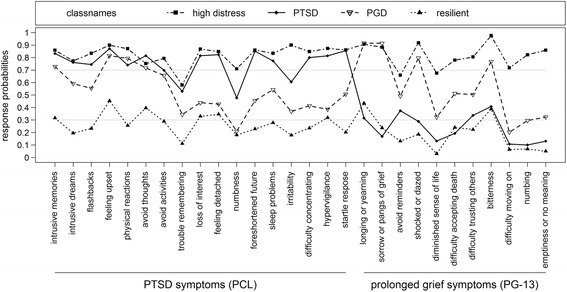
LCA revealed a four-class solution: a resilient class (23.6%), a PTSD-class (23.3%), a predominately PGD class (25.3%) and a high distress-class with overall high values of PGD and PTSD (27.8%). Relative to the resilient class, membership to the PGD class was predicted by the loss of a close family member and the exposure to a higher number of assaultive traumatic events, whereas membership to the PTSD class was predicted by the perception of less social support. Compared to the resilient class, participants in the high distress-class were more likely to be female, to have lost a close relative, experienced more accidental and assaultive traumatic events, and perceived less social support.
Specific symptom profiles emerged following exposure to trauma and loss within the context of the Colombian armed conflict. Profiles were associated with distinct types of traumatic experiences, the degree of closeness to the person lost, the amount of social support perceived, and gender. The results have implications for identifying distressed subgroups and informing interventions in accordance with the patient's symptom profile.
在受冲突影响地区,遭受创伤和亲人离世的情况很常见。先前的研究表明,对创伤和丧失的反应存在相当大的异质性,症状表现各不相同。本研究的目的是:(1)在因哥伦比亚武装冲突而遭受创伤和亲人离世的个体中,识别持续性悲伤障碍(PGD)和创伤后应激障碍(PTSD)症状谱的类别;(2)研究社会人口学、丧失和创伤相关特征是否能够预测类别归属。
通过PGD(PG-13)、PTSD(PCL-C)和社会支持(杜克大学-北卡罗来纳大学量表)对308名经历过创伤和亲人离世的国内流离失所受害者进行评估。进行潜在类别分析(LCA)以分析PGD和PTSD症状的差异特征,并使用多项逻辑回归分析类别归属的预测因素。
LCA揭示了一个四类解决方案:适应良好类(23.6%)、PTSD类(23.3%)、主要为PGD类(25.3%)和高痛苦类,PGD和PTSD总体得分较高(27.8%)。相对于适应良好类,失去亲密家庭成员以及遭受更多攻击性创伤事件可预测个体属于PGD类,而感知到较少的社会支持可预测个体属于PTSD类。与适应良好类相比,高痛苦类的参与者更可能为女性,失去过亲密亲属,经历过更多意外和攻击性创伤事件,且感知到的社会支持较少。
在哥伦比亚武装冲突背景下,遭受创伤和亲人离世后出现了特定的症状谱。这些症状谱与不同类型的创伤经历、与逝者的亲近程度、感知到的社会支持量以及性别有关。研究结果对于识别痛苦亚组以及根据患者的症状谱提供干预措施具有启示意义。