Thangaratinam Shakila, Allotey John, Marlin Nadine, Dodds Julie, Cheong-See Fiona, von Dadelszen Peter, Ganzevoort Wessel, Akkermans Joost, Kerry Sally, Mol Ben W, Moons Karl G M, Riley Richard D, Khan Khalid S
Women's Health Research Unit, Barts and the London School of Medicine and Dentistry, Queen Mary University of London, London, UK.
Multidisciplinary Evidence Synthesis Hub (mEsh), Queen Mary University of London, London, UK.
BMC Med. 2017 Mar 30;15(1):68. doi: 10.1186/s12916-017-0827-3.
Unexpected clinical deterioration before 34 weeks gestation is an undesired course in early-onset pre-eclampsia. To safely prolong preterm gestation, accurate and timely prediction of complications is required.
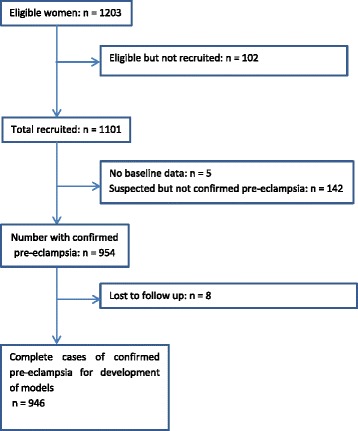
Women with confirmed early onset pre-eclampsia were recruited from 53 maternity units in the UK to a large prospective cohort study (PREP-946) for development of prognostic models for the overall risk of experiencing a complication using logistic regression (PREP-L), and for predicting the time to adverse maternal outcome using a survival model (PREP-S). External validation of the models were carried out in a multinational cohort (PIERS-634) and another cohort from the Netherlands (PETRA-216). Main outcome measures were C-statistics to summarise discrimination of the models and calibration plots and calibration slopes.
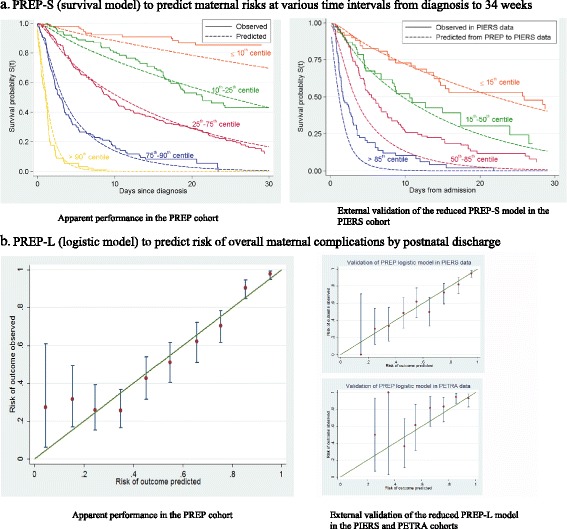
A total of 169 mothers (18%) in the PREP dataset had adverse outcomes by 48 hours, and 633 (67%) by discharge. The C-statistics of the models for predicting complications by 48 hours and by discharge were 0.84 (95% CI, 0.81-0.87; PREP-S) and 0.82 (0.80-0.84; PREP-L), respectively. The PREP-S model included maternal age, gestation, medical history, systolic blood pressure, deep tendon reflexes, urine protein creatinine ratio, platelets, serum alanine amino transaminase, urea, creatinine, oxygen saturation and treatment with antihypertensives or magnesium sulfate. The PREP-L model included the above except deep tendon reflexes, serum alanine amino transaminase and creatinine. On validation in the external PIERS dataset, the reduced PREP-S model showed reasonable calibration (slope 0.80) and discrimination (C-statistic 0.75) for predicting adverse outcome by 48 hours. Reduced PREP-L model showed excellent calibration (slope: 0.93 PIERS, 0.90 PETRA) and discrimination (0.81 PIERS, 0.75 PETRA) for predicting risk by discharge in the two external datasets.
PREP models can be used to obtain predictions of adverse maternal outcome risk, including early preterm delivery, by 48 hours (PREP-S) and by discharge (PREP-L), in women with early onset pre-eclampsia in the context of current care. They have a potential role in triaging high-risk mothers who may need transfer to tertiary units for intensive maternal and neonatal care.
ISRCTN40384046 , retrospectively registered.
妊娠34周前意外的临床病情恶化是早发型子痫前期不良病程。为安全延长早产孕周,需要准确及时地预测并发症。
确诊为早发型子痫前期的女性从英国53个产科单位招募入一项大型前瞻性队列研究(PREP - 946),以使用逻辑回归(PREP - L)建立发生并发症总体风险的预后模型,并使用生存模型(PREP - S)预测不良孕产妇结局发生时间。模型在一个多国队列(PIERS - 634)和来自荷兰的另一个队列(PETRA - 216)中进行外部验证。主要结局指标是C统计量以总结模型的辨别力以及校准图和校准斜率。
PREP数据集中共有169名母亲(18%)在48小时内出现不良结局,633名(67%)在出院时出现不良结局。预测48小时和出院时并发症的模型C统计量分别为0.84(95%CI,0.81 - 0.87;PREP - S)和0.82(0.80 - 0.84;PREP - L)。PREP - S模型包括产妇年龄、孕周、病史、收缩压、腱反射、尿蛋白肌酐比值、血小板、血清丙氨酸氨基转移酶、尿素、肌酐、血氧饱和度以及使用抗高血压药或硫酸镁治疗。PREP - L模型包括上述指标,但不包括腱反射、血清丙氨酸氨基转移酶和肌酐。在外部PIERS数据集中进行验证时,简化的PREP - S模型在预测48小时不良结局方面显示出合理的校准(斜率0.80)和辨别力(C统计量0.75)。简化的PREP - L模型在两个外部数据集中预测出院时风险方面显示出良好的校准(斜率:PIERS为0.93,PETRA为0.90)和辨别力(PIERS为0.81,PETRA为0.75)。
PREP模型可用于预测早发型子痫前期女性在当前治疗情况下48小时内(PREP - S)和出院时(PREP - L)不良孕产妇结局风险,包括早产。它们在对可能需要转至三级单位接受重症孕产妇和新生儿护理的高危母亲进行分诊方面具有潜在作用。
ISRCTN40384046,回顾性注册。