Duong-Quy Sy, Vu-Minh Thuc, Hua-Huy Thong, Tang-Thi-Thao Tram, Le-Quang Khiet, Tran-Thanh Dinh, Doan-Thi-Quynh Nhu, Le-Dong Nhat-Nam, Craig Timothy J, Dinh-Xuan Anh-Tuan
Department of Respiratory Physiology, Cochin Hospital, Paris Descartes University, Sorbonne Paris Cité, Paris, France; Department of Medicine, Penn State University, Hershey, PA, USA; Bio-Medical Research Center, Lam Dong Medical College, Dalat.
Department of Immuno-Allergology, ENT National Institute, Hanoi, Vietnam.
J Asthma Allergy. 2017 Mar 22;10:75-82. doi: 10.2147/JAA.S129047. eCollection 2017.
The measure of fractional exhaled nitric oxide (FENO) in the airways is a useful tool to guide the diagnosis and titration of inhaled corticosteroids in patients with asthma. However, its role in diagnosis of allergic rhinitis (AR), especially in subjects with asthma, is not well established.
To study the cutoff of nasal FENO in the diagnosis of subjects with AR and AR-asthma compared to age-matched subjects without AR or asthma and its correlations with the clinical and functional characteristics.
The study was cross sectional and descriptive. Subjects were grouped into control subjects, AR, and AR-asthma, based on the inclusion criteria. Exhaled NO (nasal FENO, bronchial FENO, and alveolar concentration of NO) was measured by multiple flow electro-luminescence device.
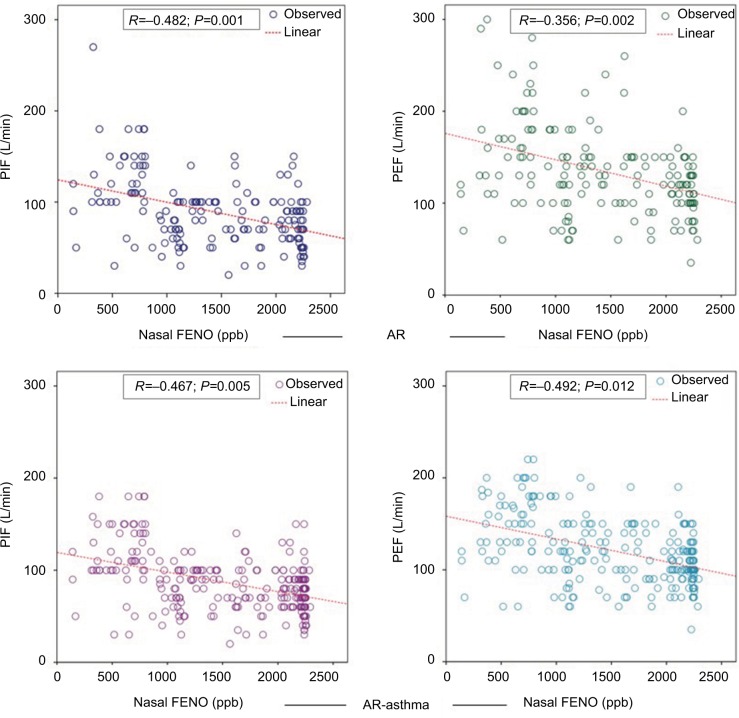
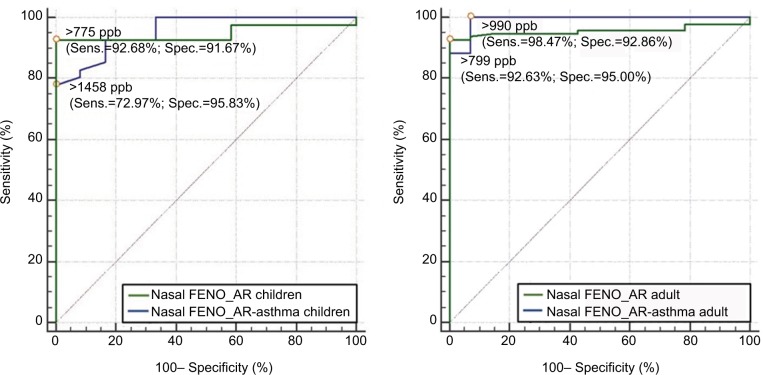
Six hundred twenty-eight subjects were included: 217 control subjects (children: n=98, 10±4 years; adults: n=119, 50±16 years), 168 subjects with AR (children: n=54, 10±3 years; adults: n=114, 49±15 years), and 243 subjects with AR-asthma (children: n=115, 10±3 years; adults: n=128, 51±14 years). Nasal peak inspiratory flow and peak expiratory flow were lower in subjects with AR and AR-asthma than in control subjects (<0.01 and <0.01; and <0.05 and <0.01, respectively). Nasal FENO levels were significantly higher in subjects with AR and AR-asthma than in control subjects (1614±629 and 1686±614 ppb vs 582±161 ppb; <0.001 and <0.001, respectively). In subjects with AR non-asthma, the cutoffs of nasal FENO for those diagnosed with AR were 775 ppb in children, 799 ppb in adults, and 799 in the general population (sensitivity: 92.68%, 92.63%, and 92.65%, respectively; specificity: 91.67%, 95.00%, and 96.87%, respectively). In subjects with AR-asthma, the cutoffs of nasal FENO were higher, especially in asthma children (1458 ppb; sensitivity: 72.97% and specificity: 95.83%).
Nasal FENO measurement is a useful technique for the diagnosis of AR in subjects with and without asthma.
气道中呼出一氧化氮分数(FENO)的测量是指导哮喘患者吸入性糖皮质激素诊断和滴定的有用工具。然而,其在变应性鼻炎(AR)诊断中的作用,尤其是在合并哮喘的患者中,尚未明确。
研究与年龄匹配的无AR或哮喘的受试者相比,AR和AR合并哮喘受试者诊断时的鼻腔FENO临界值及其与临床和功能特征的相关性。
本研究为横断面描述性研究。根据纳入标准将受试者分为对照组、AR组和AR合并哮喘组。采用多流量电致发光装置测量呼出一氧化氮(鼻腔FENO、支气管FENO和肺泡一氧化氮浓度)。
共纳入628名受试者:217名对照者(儿童:n = 98,10±4岁;成人:n = 119,50±16岁),168名AR患者(儿童:n = 54,10±3岁;成人:n = 114,49±15岁),243名AR合并哮喘患者(儿童:n = 115,10±3岁;成人:n = 128,51±14岁)。AR组和AR合并哮喘组的鼻腔吸气峰流速和呼气峰流速低于对照组(分别为<0.01和<0.01;以及<0.05和<0.01)。AR组和AR合并哮喘组的鼻腔FENO水平显著高于对照组(分别为1614±629和1686±614 ppb vs 582±161 ppb;均<0.001)。在无哮喘的AR患者中,诊断为AR的鼻腔FENO临界值在儿童中为775 ppb,成人中为799 ppb,总体人群中为799 ppb(敏感性分别为92.68%、92.63%和92.65%;特异性分别为91.67%、95.00%和96.87%)。在AR合并哮喘患者中,鼻腔FENO临界值更高,尤其是在哮喘儿童中(1458 ppb;敏感性:72.97%,特异性:95.83%)。
鼻腔FENO测量是诊断有无哮喘的AR患者的有用技术。