Li Yanyu, Liu Ling, Yin Zeyuan, Xu Hui, Li Shuang, Tao Wei, Cheng Hui, Du Lei, Zhou Xueyuan, Zhang Bei
Department of Gynaecology and Obstetrics, Xuzhou Central Hospital, Xuzhou, Jiangsu 221009, P.R. China; Xuzhou Clinical School, Xuzhou Medical College, Xuzhou, Jiangsu 221000, P.R. China.
Department of Pharmacology, Xuzhou Central Hospital, Xuzhou, Jiangsu 221009, P.R. China.
Oncol Lett. 2017 Feb;13(2):567-572. doi: 10.3892/ol.2016.5511. Epub 2016 Dec 16.
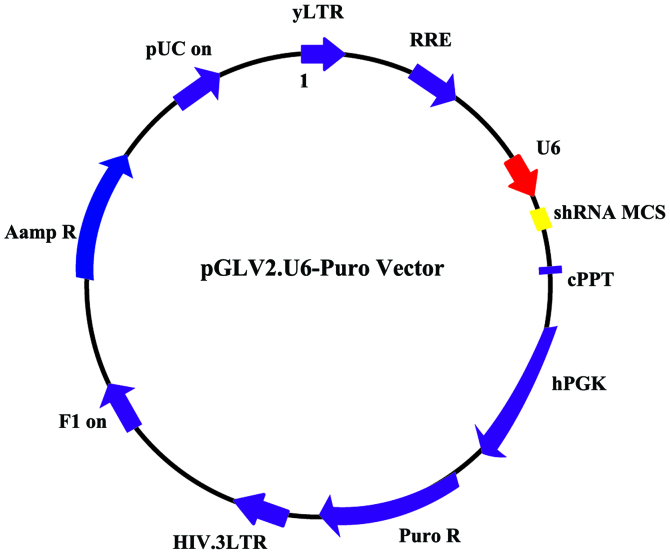
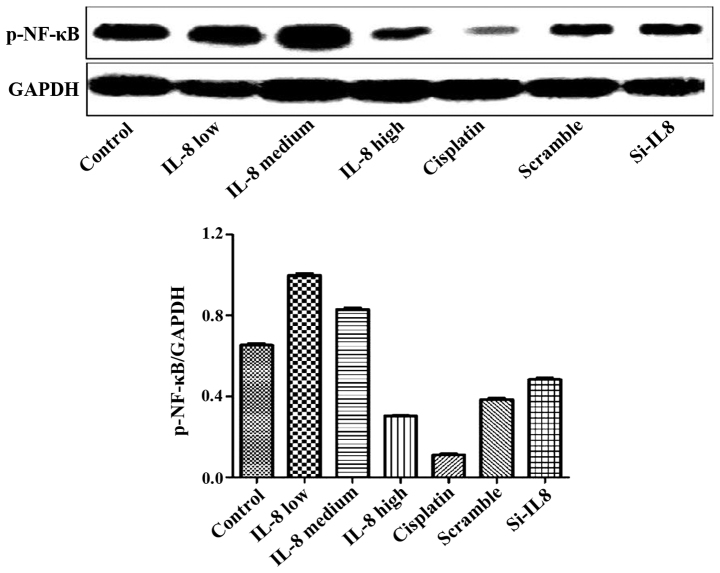
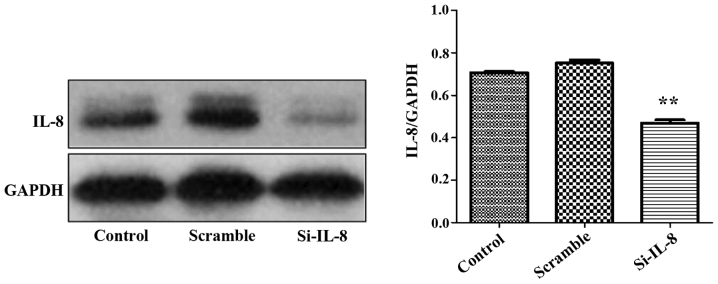
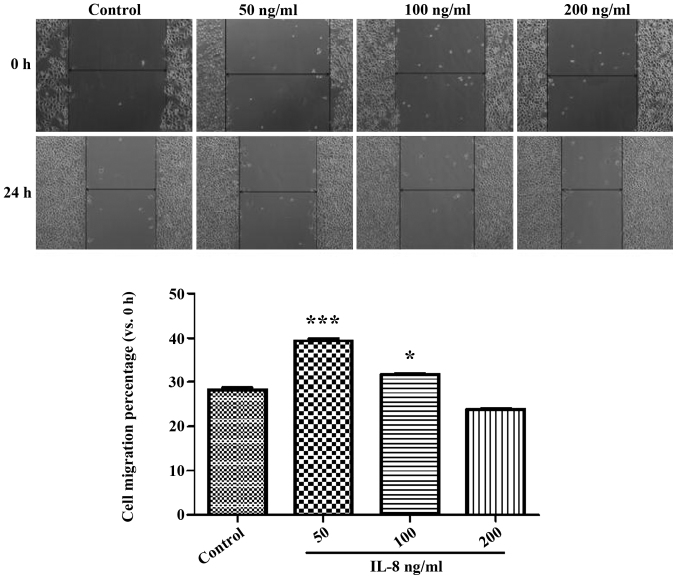
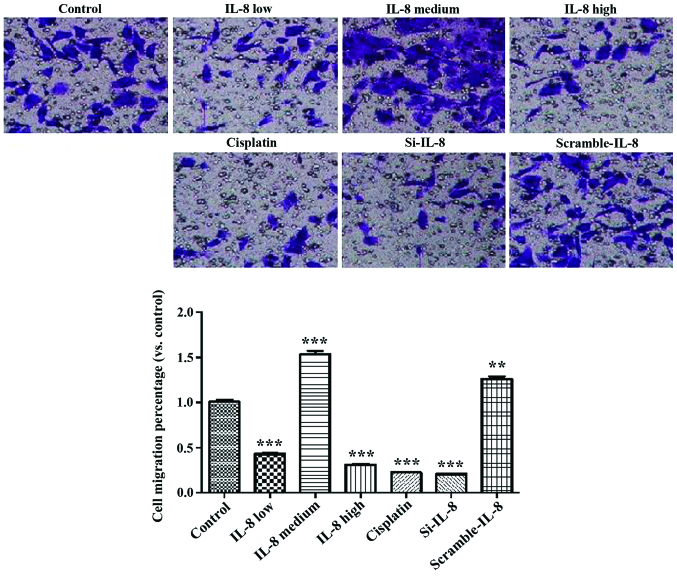
The aim of the study was to determine whether interleukin-8 (IL-8) affects human SKOV3 ovarian cancer cell migration and invasion by targeting silencing of IL-8 expression. Silencing small-interfering RNA (siRNA) targeting gene was constructed to infect SKOV3 cells by lentiviral vector. The expression of IL-8 and p-nuclear factor (NF)-κB protein was detected by western blot analysis. The wound scratch and Transwell tests were used to assay the cell migration and invasiveness of SKOV3 cells infected with lentiviral vector targeting gene siRNA. The levels of IL-8 protein expressed by SKOV3 cells infected by lentiviral vector targeting gene siRNA decreased by 72.3%. IL-8 (50 ng/ml) increased the ability of SKOV3 cells to suppress cell migration (p<0.01). Cisplatin and silencing of IL-8 achieved the ability to inhibit SKOV3 cell invasion (p<0.01), and 100 ng/ml concentration of IL-8 enhanced the ability of SKOV3 invasion (p<0.01). Silencing of IL-8 to a certain extent reduced the expression of p-NF-κB proteins, but it was not statistically significant. In conclusion, silencing of IL-8 may inhibit the migration and invasion of SKOV3 cells, which may be independent of the p-NF-κB protein.