Krašovec Rok, Belavkin Roman V, Aston John A, Channon Alastair, Aston Elizabeth, Rash Bharat M, Kadirvel Manikandan, Forbes Sarah, Knight Christopher G
Faculty of Life Sciences, University of Manchester, M13 9PT, UK.
School of Science and Technology, Middlesex University, London NW4 4BT, UK.
Microb Cell. 2014 Jun 25;1(7):250-252. doi: 10.15698/mic2014.07.158.
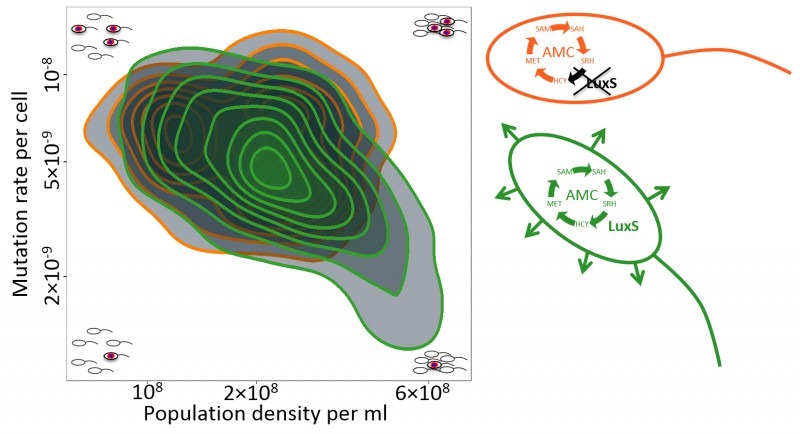
We do not need to rehearse the grim story of the global rise of antibiotic resistant microbes. But what if it were possible to control the rate with which antibiotic resistance evolves by mutation? It seems that some bacteria may already do exactly that: they modify the rate at which they mutate to antibiotic resistance dependent on their biological environment. In our recent study [Krašovec, Nat. Commun. (2014), 5, 3742] we find that this modification depends on the density of the bacterial population and cell-cell interactions (rather than, for instance, the level of stress). Specifically, the wild-type strains of we used will, in minimal glucose media, modify their rate of mutation to rifampicin resistance according to the density of wild-type cells. Intriguingly, the higher the density, the lower the mutation rate (Figure 1). Why this novel density-dependent 'mutation rate plasticity' (DD-MRP) occurs is a question at several levels. Answers are currently fragmentary, but involve the quorum-sensing gene and its role in the activated methyl cycle.
我们无需赘述全球抗生素耐药微生物不断增加的严峻情况。但如果能够控制抗生素耐药性通过突变产生的进化速度会怎样呢?似乎有些细菌可能已经做到了这一点:它们会根据自身的生物环境来改变对抗生素产生耐药性的突变速度。在我们最近的研究中[克拉绍韦茨,《自然·通讯》(2014年),第5卷,第3742页],我们发现这种改变取决于细菌群体的密度以及细胞间的相互作用(而非例如压力水平)。具体而言,我们所使用的野生型菌株,在最低限度的葡萄糖培养基中,会根据野生型细胞的密度来改变其对利福平耐药性的突变速度。有趣的是,密度越高,突变率越低(图1)。为何会出现这种新的密度依赖性“突变率可塑性”(DD - MRP)在多个层面都是个问题。目前答案尚不完整,但涉及群体感应基因及其在活化甲基循环中的作用。