Knorre Dmitry A, Sokolov Svyatoslav S, Zyrina Anna N, Severin Fedor F
Belozersky Institute of Physico-Chemical Biology, Moscow State University, Leninskiye Gory 1-40, Moscow 119991, Russia.
Faculty of Bioengineering and Bioinformatics, Moscow State University, Leninskiye Gory 1-73, Moscow 119991, Russia.
Microb Cell. 2016 Sep 22;3(11):532-539. doi: 10.15698/mic2016.11.537.
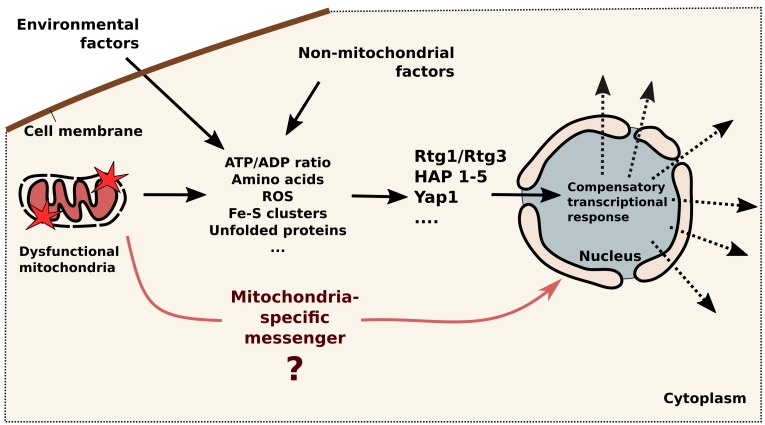
Apart from energy transformation, mitochondria play important signaling roles. In yeast, mitochondrial signaling relies on several molecular cascades. However, it is not clear how a cell detects a particular mitochondrial malfunction. The problem is that there are many possible manifestations of mitochondrial dysfunction. For example, exposure to the specific antibiotics can either decrease (inhibitors of respiratory chain) or increase (inhibitors of ATP-synthase) mitochondrial transmembrane potential. Moreover, even in the absence of the dysfunctions, a cell needs feedback from mitochondria to coordinate mitochondrial biogenesis and/or removal by mitophagy during the division cycle. To cope with the complexity, only a limited set of compounds is monitored by yeast cells to estimate mitochondrial functionality. The known examples of such compounds are ATP, reactive oxygen species, intermediates of amino acids synthesis, short peptides, Fe-S clusters and heme, and also the precursor proteins which fail to be imported by mitochondria. On one hand, the levels of these molecules depend not only on mitochondria. On the other hand, these substances are recognized by the cytosolic sensors which transmit the signals to the nucleus leading to general, as opposed to mitochondria-specific, transcriptional response. Therefore, we argue that both ways of mitochondria-to-nucleus communication in yeast are mostly (if not completely) unspecific, are mediated by the cytosolic signaling machinery and strongly depend on cellular metabolic state.
除了能量转换外,线粒体还发挥着重要的信号传导作用。在酵母中,线粒体信号传导依赖于几个分子级联反应。然而,目前尚不清楚细胞是如何检测到特定的线粒体功能异常的。问题在于线粒体功能障碍有许多可能的表现形式。例如,接触特定抗生素既可以降低(呼吸链抑制剂)也可以提高(ATP合酶抑制剂)线粒体跨膜电位。此外,即使在没有功能障碍的情况下,细胞在分裂周期中也需要线粒体的反馈来协调整个线粒体的生物合成和/或通过线粒体自噬进行清除。为了应对这种复杂性,酵母细胞只监测有限的一组化合物来评估线粒体功能。这类化合物的已知例子有ATP、活性氧、氨基酸合成中间体、短肽、铁硫簇和血红素,还有无法被线粒体导入的前体蛋白。一方面,这些分子的水平不仅取决于线粒体。另一方面,这些物质被胞质传感器识别,这些传感器将信号传递到细胞核,从而引发与线粒体特异性转录反应相反的一般转录反应。因此,我们认为酵母中线粒体与细胞核之间的这两种通讯方式大多(如果不是完全)是非特异性的,由胞质信号传导机制介导,并且强烈依赖于细胞代谢状态。