Department of Chemistry, University of Cambridge, Lensfield Road, Cambridge CB2 1EW, UK.
Nat Commun. 2017 Mar 30;8:14882. doi: 10.1038/ncomms14882.
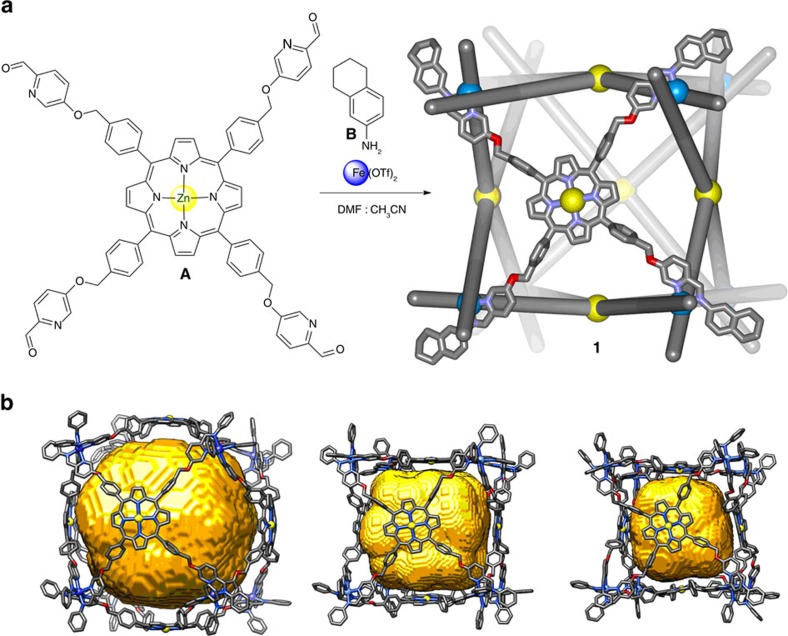
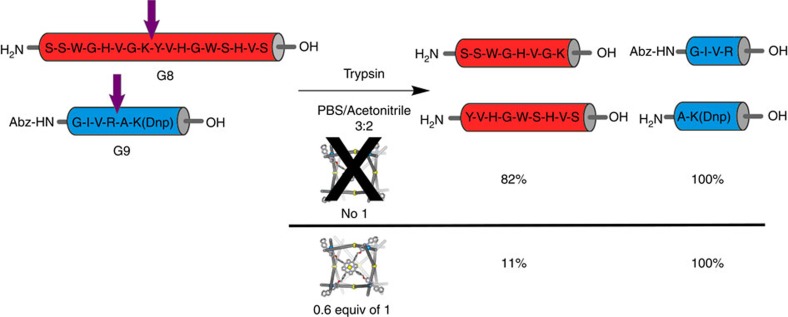
Self-assembly offers a general strategy for the preparation of large, hollow high-symmetry structures. Although biological capsules, such as virus capsids, are capable of selectively recognizing complex cargoes, synthetic encapsulants have lacked the capability to specifically bind large and complex biomolecules. Here we describe a cubic host obtained from the self-assembly of Fe and a zinc-porphyrin-containing ligand. This cubic cage is flexible and compatible with aqueous media. Its selectivity of encapsulation is driven by the coordination of guest functional groups to the zinc porphyrins. This new host thus specifically encapsulates guests incorporating imidazole and thiazole moieties, including drugs and peptides. Once encapsulated, the reactivity of a peptide is dramatically altered: encapsulated peptides are protected from trypsin hydrolysis, whereas physicochemically similar peptides that do not bind are cleaved.
自组装为制备大型中空高对称结构提供了一种通用策略。尽管生物胶囊,如病毒衣壳,能够选择性地识别复杂的货物,但合成的封装剂缺乏特异性结合大而复杂生物分子的能力。在这里,我们描述了一种由 Fe 和含有锌卟啉的配体自组装而成的立方主体。这种立方笼具有柔韧性,与水相介质兼容。其封装的选择性是由客体官能团与锌卟啉的配位驱动的。因此,这种新的主体特异性地封装了包含咪唑和噻唑部分的客体,包括药物和肽。一旦被封装,肽的反应性就会发生显著变化:被封装的肽可以防止胰蛋白酶水解,而不结合的物理化学性质相似的肽则被切割。