Tsakelidou Elisavet, Virgiliou Christina, Valianou Lemonia, Gika Helen G, Raikos Nikolaos, Theodoridis Georgios
Laboratory of Analytical Chemistry, Department of Chemistry, Aristotle University of Thessaloniki, 54124 Thessaloniki, Greece.
Laboratory of Forensic Medicine & Toxicology, Department of Medicine, Aristotle University of Thessaloniki, 54124 Thessaloniki, Greece.
Metabolites. 2017 Mar 30;7(2):13. doi: 10.3390/metabo7020013.
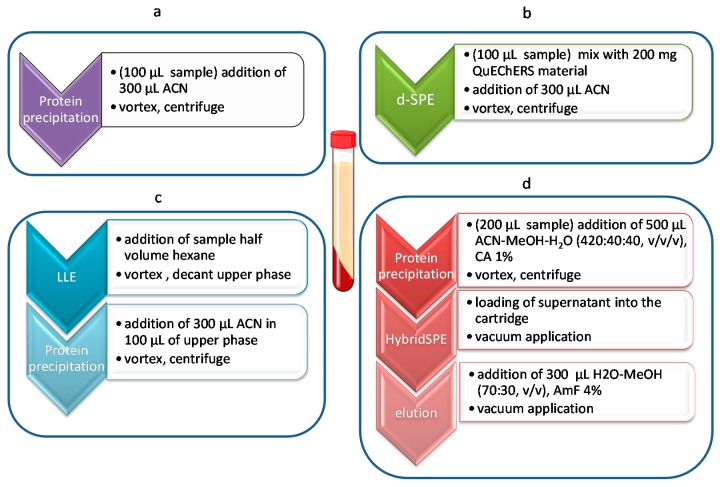
The effect of endogenous interferences of serum in multi-targeted metabolite profiling HILIC-MS/MS analysis was investigated by studying different sample preparation procedures. A modified QuEChERS dispersive SPE protocol, a HybridSPE protocol, and a combination of liquid extraction with protein precipitation were compared to a simple protein precipitation. Evaluation of extraction efficiency and sample clean-up was performed for all methods. SPE sorbent materials tested were found to retain hydrophilic analytes together with endogenous interferences, thus additional elution steps were needed. Liquid extraction was not shown to minimise matrix effects. In general, it was observed that a balance should be reached in terms of recovery, efficient clean-up, and sample treatment time when a wide range of metabolites are analysed. A quick step for removing phospholipids prior to the determination of hydrophilic endogenous metabolites is required, however, based on the results from the applied methods, further studies are needed to achieve high recoveries for all metabolites.
通过研究不同的样品制备程序,考察了血清内源性干扰物在多靶点代谢物谱HILIC-MS/MS分析中的影响。将改进的QuEChERS分散固相萃取方法、HybridSPE方法以及液液萃取与蛋白沉淀相结合的方法与简单的蛋白沉淀法进行了比较。对所有方法的萃取效率和样品净化效果进行了评估。结果发现,所测试的固相萃取吸附剂材料在保留亲水性分析物的同时也保留了内源性干扰物,因此需要额外的洗脱步骤。液液萃取并未显示出能最小化基质效应。总体而言,在分析多种代谢物时,需要在回收率、有效净化和样品处理时间之间取得平衡。然而,在测定亲水性内源性代谢物之前,需要一个快速去除磷脂的步骤,不过,基于所应用方法的结果,还需要进一步研究以实现所有代谢物的高回收率。