El-Diwany Ramy, Breitwieser Florian P, Soliman Mary, Skaist Alyza M, Srikrishna Geetha, Blankson Joel N, Ray Stuart C, Wheelan Sarah J, Thomas David L, Balagopal Ashwin
aDepartment of Medicine bMcKusick-Nathans Institute of Genetic Medicine,Center for Computational Biology cDepartment of Oncology, Sidney Kimmel Comprehensive Cancer Center, Johns Hopkins University School of Medicine, Baltimore, Maryland, USA.
AIDS. 2017 Jun 19;31(10):1405-1414. doi: 10.1097/QAD.0000000000001480.
To assess if the reduction in HIV-1 RNA in CD4 T cells is correlated with the persistence of immune activation following early antiretroviral therapy (ART).
Clinical trial (NCT01285050).
Next-generation sequencing was used to study total RNA from activated CD4 T cells (CD38 and human leukocyte antigen - antigen D related (HLA-DR) expressing) collected from 19 treatment-naïve HIV-1/hepatitis C virus-infected patients before and early after ART initiation (≥12 weeks after plasma HIV-1 RNA <50 copies/ml). To validate comparisons, pre and post-ART measures were adjusted for input RNA and overall read number.
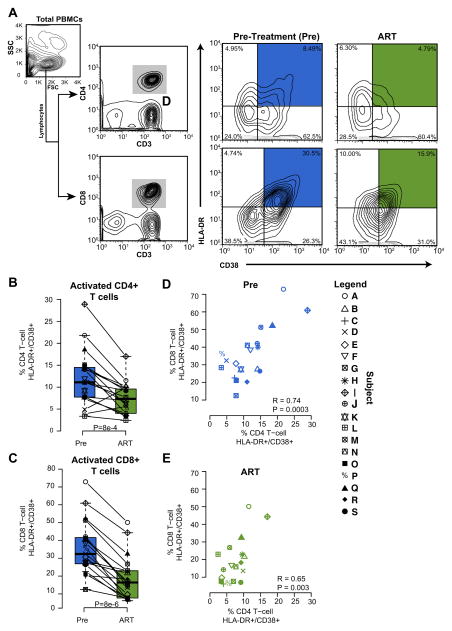
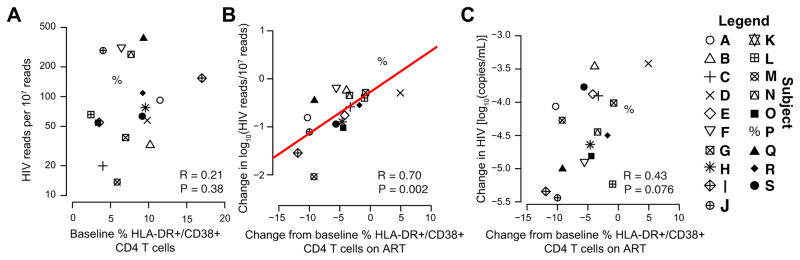
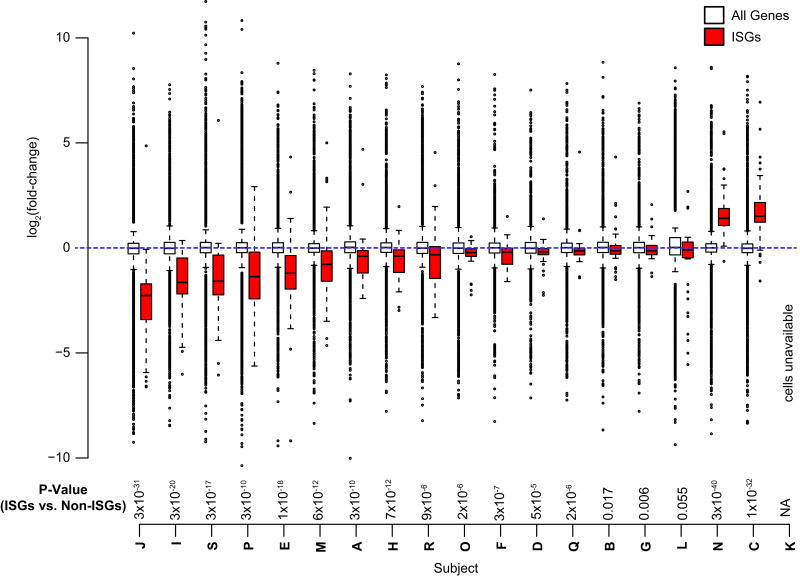
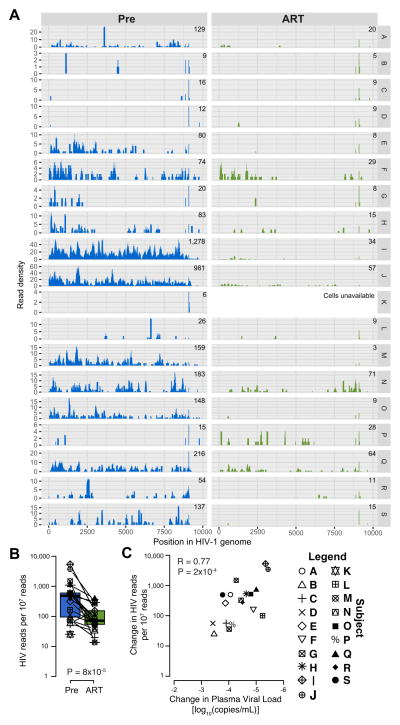
As expected, ART use was associated with a median [interquartile range (IQR)] 4.3% (2.2-8.3) reduction in the proportion of activated CD4 T cells (P = 0.0008). Whereas in those activated CD4 T cells no consistent differences in overall gene expression were detected, interferon-stimulated gene expression declined (P < 2 × 10). Pre-ART, sorted activated CD4 T cells contained a median (IQR) of 959 (252-1614) HIV-1 reads/10 reads compared with 72 (55-152) HIV-1 reads/10 reads after at least 12 weeks of suppressive ART (P = 8 × 10). The decrease in HIV-1 reads in activated CD4 T cells was associated with the change in plasma HIV-1 RNA levels (r = 0.77, P = 2 × 10) and the change in the proportion of activated CD4 T cells (r = 0.70, P = 0.0016).
Months of ART led to a marked decrease in cell-associated HIV-1 RNA and interferon-stimulated genes expression in activated CD4 T cells that were strongly associated with the reduction in the proportion of activated CD4 T cells.
评估早期抗逆转录病毒治疗(ART)后,CD4 T细胞中HIV-1 RNA的减少是否与免疫激活的持续存在相关。
临床试验(NCT01285050)。
采用新一代测序技术研究从19例初治HIV-1/丙型肝炎病毒感染患者ART开始前及早期(血浆HIV-1 RNA<50拷贝/ml后≥12周)收集的活化CD4 T细胞(表达CD38和人类白细胞抗原-抗原D相关分子(HLA-DR))的总RNA。为验证比较结果,对ART前后的测量值进行输入RNA和总读数调整。
如预期,ART治疗使活化CD4 T细胞比例中位数[四分位间距(IQR)]降低4.3%(2.2-8.3)(P = 0.0008)。虽然在这些活化CD4 T细胞中未检测到整体基因表达的一致差异,但干扰素刺激基因表达下降(P<2×10)。ART治疗前,分选的活化CD4 T细胞中HIV-1读数中位数(IQR)为959(252-1614)/10读数,而在至少12周的抑制性ART治疗后为72(55-152)/10读数(P = 8×10)。活化CD4 T细胞中HIV-1读数的减少与血浆HIV-1 RNA水平的变化(r = 0.77,P = 2×10)及活化CD4 T细胞比例的变化(r = 0.70,P = 0.0016)相关。
数月的ART治疗导致活化CD4 T细胞中与细胞相关的HIV-1 RNA及干扰素刺激基因表达显著下降,且与活化CD4 T细胞比例的降低密切相关。