Wu Qiong, Nie Jun, Wu Fu-Xia, Zou Xiu-Lan, Chen Feng-Yi
Department of Pediatrics, People's Hospital of China Three Gorges University, The 1st People's Hospital of Yichang, Yichang, Hubei, China (mainland).
Department of Cardiothoracic Surgery, People's Hospital of China Three Gorges University, The 1st People's Hospital of Yichang, Yichang, Hubei, China (mainland).
Med Sci Monit. 2017 Mar 30;23:1533-1539. doi: 10.12659/msm.900856.
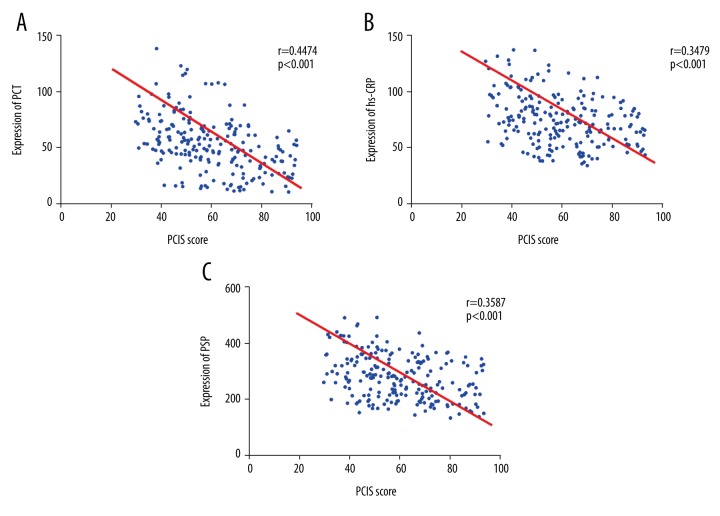
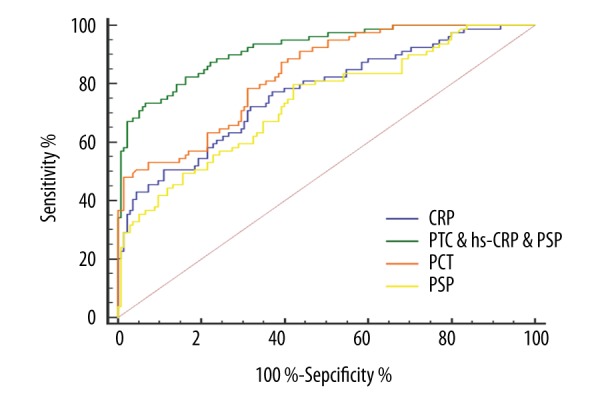
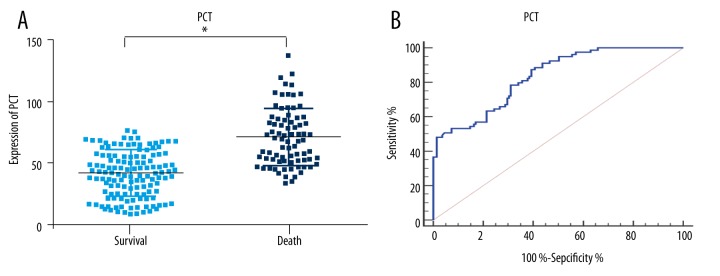
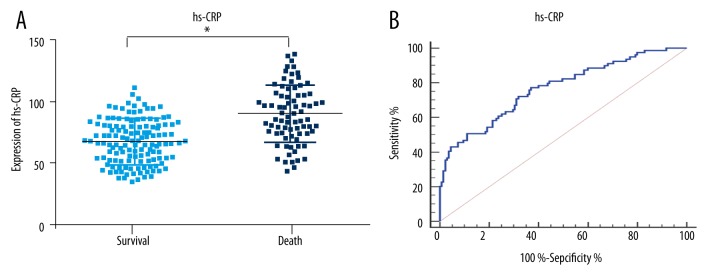
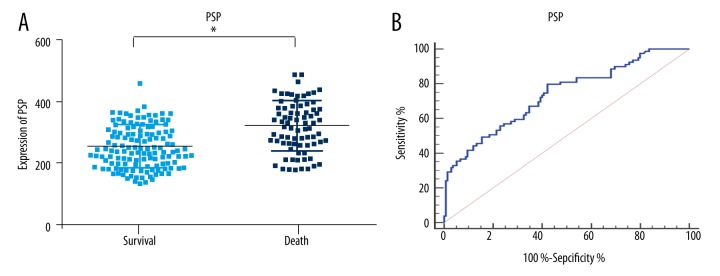
BACKGROUND To investigate the prognostic value of procalcitonin (PCT), high-sensitivity C-reactive protein (hs-CRP), and pancreatic stone protein (PSP) in children with sepsis. MATERIAL AND METHODS A total of 214 patients with sepsis during hospitalization were enrolled. Serum levels of PCT, hs-CRP, and PSP were measured on day 1 of hospitalization and the survival rates of children were recorded after a follow-up of 28 days. Pearson's correlation analysis was conducted to test the association of PCT, hs-CRP, and PSP with pediatric critical illness score (PCIS). Logistic regression models were used to analyze the risk factors contributing to patients' death. The AUC was used to determine the value of PCT, hs-CRP, and PSP in the prognosis of patients with sepsis. RESULTS The expression of PCT, hs-CRP, and PSP in the dying patients was higher than in the surviving patients (p<0.001). Pearson's correlation analysis showed that serum PCT, hs-CRP, and PSP levels were negatively correlated with PCIS (p<0.001). Multivariate logistic regression revealed that PCT, hs-CRP, and PSP were independent risk factors for the prognosis of patients with sepsis (p<0.001). ROC analysis showed the AUC values of PCT, hs-CRP, and PSP were 0.83 (95% CI, 0.77-0.88), 0.76 (95% CI, 0.70-0.82), and 0.73 (95% CI, 0.67-0.79), respectively. The combined AUC value of PCT, hs-CRP, and PSP, was 0.92 (95% CI, 0.87-0.95), which was significantly increased compared with PCT, hs-CRP, or PSP (p<0.001). CONCLUSIONS The combination of serum PCT, hs-CRP, and PSP represents a promising biomarker of risk, and is a useful clinical tool for risk stratification of children with sepsis.
探讨降钙素原(PCT)、高敏C反应蛋白(hs-CRP)和胰石蛋白(PSP)在儿童脓毒症中的预后价值。
共纳入214例住院期间的脓毒症患儿。在住院第1天测量血清PCT、hs-CRP和PSP水平,并记录28天随访后儿童的生存率。进行Pearson相关性分析以检验PCT、hs-CRP和PSP与儿科危重病评分(PCIS)的相关性。使用逻辑回归模型分析导致患者死亡的危险因素。AUC用于确定PCT、hs-CRP和PSP在脓毒症患者预后中的价值。
死亡患者中PCT、hs-CRP和PSP的表达高于存活患者(p<0.001)。Pearson相关性分析表明,血清PCT、hs-CRP和PSP水平与PCIS呈负相关(p<0.001)。多因素逻辑回归显示,PCT、hs-CRP和PSP是脓毒症患者预后的独立危险因素(p<0.001)。ROC分析显示,PCT、hs-CRP和PSP的AUC值分别为0.83(95%CI,0.77-0.88)、0.76(95%CI,0.70-0.82)和0.73(95%CI,0.67-0.79)。PCT、hs-CRP和PSP的联合AUC值为0.92(95%CI,0.87-0.95),与PCT、hs-CRP或PSP相比显著升高(p<0.001)。
血清PCT、hs-CRP和PSP的联合检测是一种很有前景的风险生物标志物,是儿童脓毒症风险分层的有用临床工具。