Mikkelsen Søren, Schaffalitzky de Muckadell Caroline, Binderup Lars Grassmé, Lossius Hans Morten, Toft Palle, Lassen Annmarie Touborg
Mobile Emergency Care Unit, Department of Anaesthesiology and Intensive Care Medicine V, Odense University Hospital, Odense, Denmark.
Department of Clinical Research, University of Southern Denmark, Odense, Denmark.
Scand J Trauma Resusc Emerg Med. 2017 Mar 31;25(1):35. doi: 10.1186/s13049-017-0381-1.
Discussions on ethical aspects of life-and-death decisions within the hospital are often made in plenary. The prehospital physician, however, may be faced with ethical dilemmas in life-and-death decisions when time-critical decisions to initiate or refrain from resuscitative efforts need to be taken without the possibility to discuss matters with colleagues. Little is known whether these considerations regarding ethical issues in crucial life-and-death decisions are documented prehospitally. This is a review of the ethical considerations documented in the prehospital medical records of patients in a Danish prehospital setting for whom the decision to resuscitate or not was made at the scene.
The study is based on discharge summaries of all patients subjected to crucial life-and-death decisions by the Mobile Emergency Care Unit in Odense in the years 2010 to 2014. The medical records with possible documentation of ethical issues were independently reviewed by two philosophers in order to identify explicit ethical or philosophical considerations pertaining to the decision to resuscitate or not.
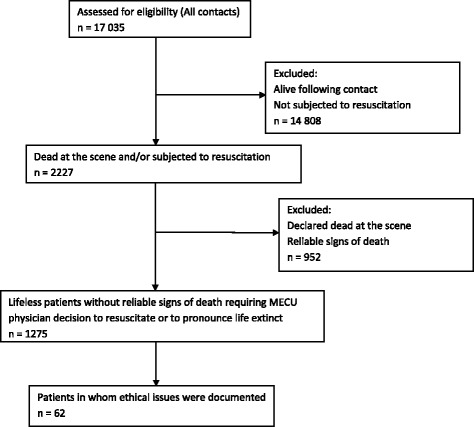
In total, 1275 patients were either declared dead at the scene without exhibiting layman's reliable signs of death or admitted to hospital following resuscitation. In a total of 62 patients, 85 specific ethical issues related to resuscitation were documented. The expressions of the ethical considerations were generally vague or unclear and almost exclusively concerned the interests of the patient and not the relatives. In the vast majority of cases where an ethical content was identified, the ethical considerations led to a decision to terminate treatment.
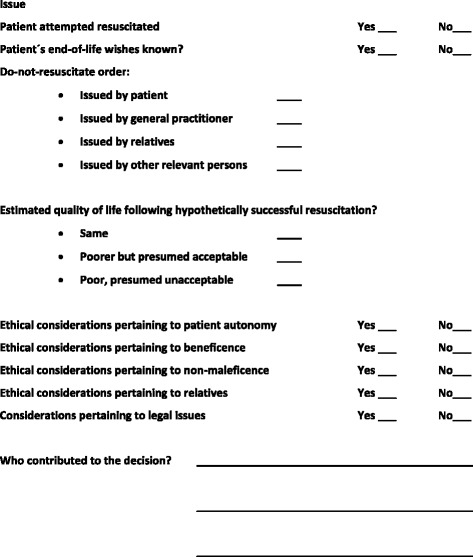
A strengthened practice of documenting ethical considerations in prehospital life-and-death decision-making in the patient's medical records is required. We suggest that a template be implemented in the prehospital medical records describing the basis for any ethical decisions. This template should contain information regarding the persons involved in the deliberations and notes on ethical considerations. The documentation should include considerations concerning the patient's end-of-life wishes, the estimations of the quality of life before and after the incident, and a summary of other ethical concerns taken into account, such as the integrity of the patient and frame of mind of relatives.
医院内关于生死决策伦理方面的讨论通常在全体会议上进行。然而,院前急救医生在生死决策中可能会面临伦理困境,因为在需要做出启动或不启动复苏努力的紧急决策时,没有与同事讨论的可能性。对于这些关键生死决策中的伦理问题考量在院前是否有记录,人们知之甚少。这是一项对丹麦院前环境中患者的院前医疗记录中记录的伦理考量进行的综述,这些患者在现场做出了是否进行复苏的决定。
该研究基于2010年至2014年欧登塞市移动急救单元对所有面临关键生死决策的患者的出院总结。两名哲学家独立审查了可能记录有伦理问题的医疗记录,以确定与是否进行复苏决策相关的明确伦理或哲学考量。
共有1275名患者在现场被宣布死亡但未表现出非专业人员可靠的死亡迹象,或在复苏后被送往医院。在总共62名患者中,记录了85个与复苏相关的具体伦理问题。伦理考量的表述通常模糊或不明确,几乎完全涉及患者的利益而非亲属的利益。在绝大多数识别出伦理内容的案例中,伦理考量导致了终止治疗的决定。
需要加强在患者医疗记录中记录院前生死决策伦理考量的做法。我们建议在院前医疗记录中实施一个模板,描述任何伦理决策的依据。该模板应包含参与审议的人员信息以及伦理考量的记录。记录应包括对患者临终愿望的考量、事件前后生活质量的评估,以及所考虑的其他伦理问题的总结,如患者的完整性和亲属的心态。