Cardiovascular Division, King's College London, London, United Kingdom.
Cardiovascular Division, King's College London, London, United Kingdom
J Am Heart Assoc. 2017 Mar 30;6(4):e004934. doi: 10.1161/JAHA.116.004934.
The objective of this study was to evaluate whether aortic pulse wave velocity (Ao-PWV) predicts estimated glomerular filtration rate (eGFR) decline in patients with type 2 diabetes mellitus.
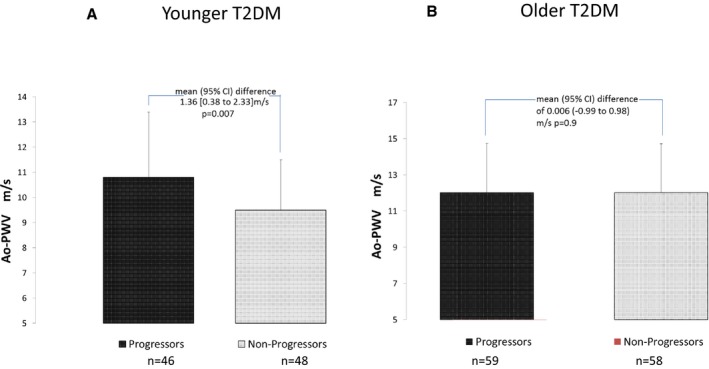
This prospective single-center cohort study investigated 211 type 2 diabetes mellitus patients with eGFR ≥45 mL/min with a baseline mean age of 60.1 years (range, 30-82 years). The mean±SD baseline eGFR was 85±26.1 mL/min. We divided the cohort into 2 groups above (n=117, "older") and below (n=94, "younger") the mean age to evaluate whether Ao-PWV predicted progression of kidney disease differentially in older and younger patients. The primary end point was reaching a final eGFR below the median for the age group and an eGFR fall ≥1 mL/min per year. Median follow-up was 9 years (range, 3-11 years) and ≈50% of patients in both groups reached the primary end point. In older patients, Ao-PWV was similar in those who did and did not reach the primary end point. By contrast, younger patients who reached the primary end point had a higher Ao-PWV at baseline compared with those who did not (10.8 m/s versus 9.5 m/s, respectively; mean difference of 1.36 m/s [95% CI, 0.38-2.33], =0.007). Ao-PWV was an independent predictor of the primary end point (incident risk ratio, 1.09; 95% CI, 1.02-1.18) after adjustment for traditional risk factors only in younger patients (=0.02). A 1m/s increase in Ao-PWV was associated with a mean fall in eGFR of 2.1 mL/min per year (95% CI, 0.09-4.1) independent of other risk factors in younger patients (=0.04).
Ao-PWV predicts eGFR decline, before the onset of advanced renal dysfunction, and is a potential target for renoprotection in younger patients with type 2 diabetes mellitus.
本研究旨在评估主动脉脉搏波速度(Ao-PWV)是否可预测 2 型糖尿病患者估算肾小球滤过率(eGFR)下降。
这是一项前瞻性单中心队列研究,纳入了 211 例 eGFR≥45ml/min 的 2 型糖尿病患者,其基线平均年龄为 60.1 岁(范围 30-82 岁)。平均±SD 基线 eGFR 为 85±26.1ml/min。我们将队列分为年龄大于(n=117,“年长”)和小于(n=94,“年轻”)平均值的两组,以评估 Ao-PWV 是否在年长和年轻患者中对肾脏疾病进展有不同的预测作用。主要终点是达到与年龄组中位数相比 eGFR 更低的终末值和 eGFR 每年下降≥1ml/min。中位随访时间为 9 年(范围 3-11 年),两组中约 50%的患者达到了主要终点。在年长患者中,达到主要终点和未达到主要终点的患者之间 Ao-PWV 相似。相比之下,达到主要终点的年轻患者的基线 Ao-PWV 高于未达到主要终点的患者(分别为 10.8m/s 和 9.5m/s,平均差异为 1.36m/s[95%CI,0.38-2.33],=0.007)。在仅调整传统危险因素后,Ao-PWV 是主要终点的独立预测因素(发病风险比,1.09;95%CI,1.02-1.18),=0.02)。在年轻患者中,Ao-PWV 每增加 1m/s,eGFR 每年平均下降 2.1ml/min(95%CI,0.09-4.1),与其他危险因素无关(=0.04)。
Ao-PWV 可预测 eGFR 下降,发生在肾功能不全晚期之前,是 2 型糖尿病年轻患者肾脏保护的潜在靶点。