Little Iain, Vinogradova Yana, Orton Elizabeth, Kai Joe, Qureshi Nadeem
Division of Primary Care, University of Nottingham, Nottingham, UK.
BMJ Open. 2017 Mar 29;7(3):e012665. doi: 10.1136/bmjopen-2016-012665.
To determine whether sickle cell carriers ('sickle cell trait') have an increased risk of venous thromboembolism (VTE).
Cohort study with nested case-control analysis.
General population with data from 609 UK general practices in the Clinical Practice Research Datalink (CPRD).
All individuals registered with a CPRD general practice between 1998 and 2013, with a medical record of screening for sickle cell between 18 and 75 years of age.
Incidence of VTE per 10 000 person-years (PY) among sickle cell carriers and non-carriers; and adjusted OR for VTE among sickle cell carriers compared with non-carriers.
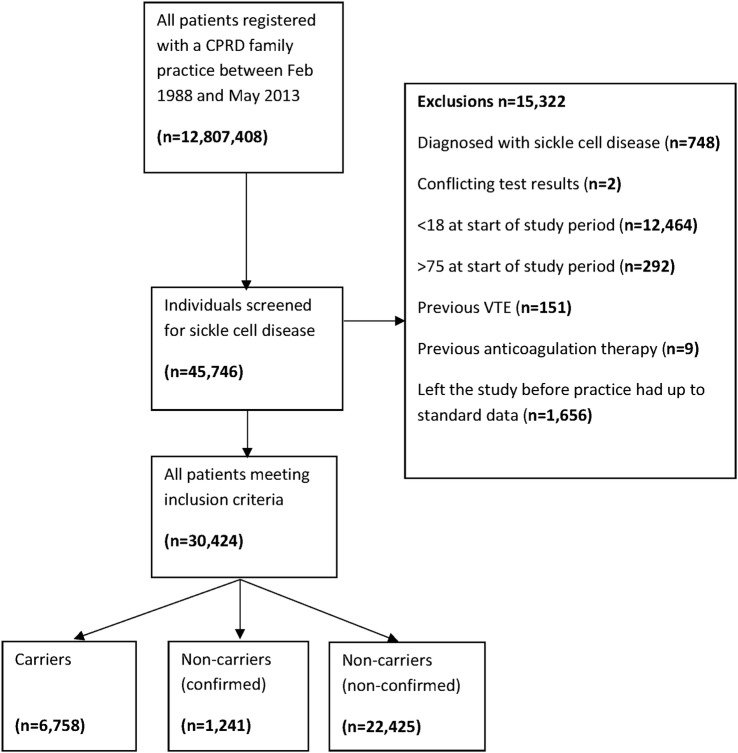
We included 30 424 individuals screened for sickle cell, with a follow-up time of 179 503 PY, identifying 55 VTEs in 6758 sickle cell carriers and 125 VTEs in 23 666 non-carriers. VTE incidence among sickle cell carriers (14.9/10 000 PY; 95% CI 11.4 to 19.4) was significantly higher than non-carriers (8.8/10 000 PY; 95% CI 7.4 to 10.4). Restricting analysis to confirmed non-carriers was non-significant, but performed on a small sample. In the case-control analysis (180 cases matched to 1775 controls by age and gender), sickle cell carriers remained at increased risk of VTE after adjusting for body mass index, pregnancy, smoking status and ethnicity (OR 1.78, 95% CI 1.18 to 2.69, p=0.006), with the greatest risk for pulmonary embolism (PE) (OR 2.27, 95% CI 1.17 to 4.39, p=0.011).
Although absolute numbers are small, in a general population screened for sickle cell, carriers have a higher incidence and risk of VTE, particularly PE, than non-carriers. Clinicians should be aware of this elevated risk in the clinical care of sickle cell carriers, or when discussing carrier screening, and explicitly attend to modifiable risk factors for VTE in these individuals. More complete primary care coding of carrier status could improve analysis.
确定镰状细胞携带者(“镰状细胞性状”)发生静脉血栓栓塞(VTE)的风险是否增加。
采用巢式病例对照分析的队列研究。
来自临床实践研究数据链(CPRD)中609家英国全科诊所数据的普通人群。
1998年至2013年间在CPRD全科诊所注册的所有个体,年龄在18至75岁之间且有镰状细胞筛查的医疗记录。
镰状细胞携带者和非携带者中每10000人年(PY)的VTE发病率;以及镰状细胞携带者与非携带者相比VTE的校正比值比(OR)。
我们纳入了30424名接受镰状细胞筛查的个体,随访时间为179503人年,在6758名镰状细胞携带者中识别出55例VTE,在23666名非携带者中识别出125例VTE。镰状细胞携带者的VTE发病率(14.9/10000人年;95%可信区间11.4至19.4)显著高于非携带者(8.8/10000人年;95%可信区间7.4至10.4)。将分析限制在确诊的非携带者中无显著差异,但样本量较小。在病例对照分析中(按年龄和性别将180例病例与1775例对照匹配),在调整体重指数、妊娠、吸烟状况和种族后,镰状细胞携带者发生VTE的风险仍然增加(OR 1.78,95%可信区间1.18至2.69,p = 0.006),肺栓塞(PE)风险最高(OR 2.27,95%可信区间1.17至4.39,p = 0.011)。
尽管绝对数字较小,但在接受镰状细胞筛查的普通人群中,携带者发生VTE的发病率和风险高于非携带者,尤其是PE。临床医生在镰状细胞携带者的临床护理中或讨论携带者筛查时应意识到这种升高的风险,并明确关注这些个体中VTE的可改变风险因素。更完整的携带者状态初级保健编码可改善分析。