Gupta A, Mayer E A, Hamadani K, Bhatt R, Fling C, Alaverdyan M, Torgerson C, Ashe-McNalley C, Van Horn J D, Naliboff B, Tillisch K, Sanmiguel C P, Labus J S
G Oppenheimer Center for Neurobiology of Stress and Resilience, Los Angeles, CA, USA.
Department of Medicine, David Geffen School of Medicine, UCLA, Los Angeles, CA, USA.
Int J Obes (Lond). 2017 Aug;41(8):1185-1195. doi: 10.1038/ijo.2017.86. Epub 2017 Mar 31.
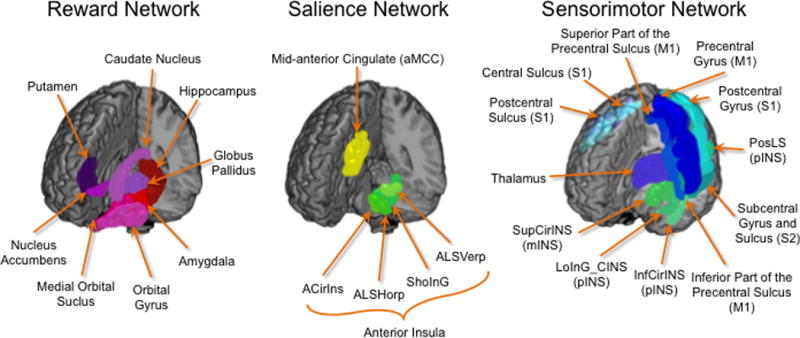
BACKGROUND/OBJECTIVES: The brain has a central role in regulating ingestive behavior in obesity. Analogous to addiction behaviors, an imbalance in the processing of rewarding and salient stimuli results in maladaptive eating behaviors that override homeostatic needs. We performed network analysis based on graph theory to examine the association between body mass index (BMI) and network measures of integrity, information flow and global communication (centrality) in reward, salience and sensorimotor regions and to identify sex-related differences in these parameters.
SUBJECTS/METHODS: Structural and diffusion tensor imaging were obtained in a sample of 124 individuals (61 males and 63 females). Graph theory was applied to calculate anatomical network properties (centrality) for regions of the reward, salience and sensorimotor networks. General linear models with linear contrasts were performed to test for BMI and sex-related differences in measures of centrality, while controlling for age.
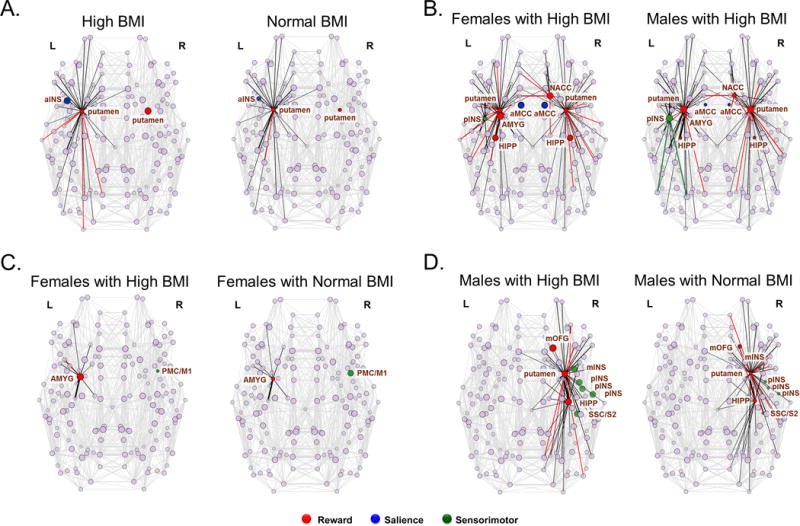
In both males and females, individuals with high BMI (obese and overweight) had greater anatomical centrality (greater connectivity) of reward (putamen) and salience (anterior insula) network regions. Sex differences were observed both in individuals with normal and elevated BMI. In individuals with high BMI, females compared to males showed greater centrality in reward (amygdala, hippocampus and nucleus accumbens) and salience (anterior mid-cingulate cortex) regions, while males compared to females had greater centrality in reward (putamen) and sensorimotor (posterior insula) regions.
In individuals with increased BMI, reward, salience and sensorimotor network regions are susceptible to topological restructuring in a sex-related manner. These findings highlight the influence of these regions on integrative processing of food-related stimuli and increased ingestive behavior in obesity, or in the influence of hedonic ingestion on brain topological restructuring. The observed sex differences emphasize the importance of considering sex differences in obesity pathophysiology.
背景/目的:大脑在调节肥胖中的摄食行为方面起着核心作用。与成瘾行为类似,奖励和显著刺激处理过程中的失衡会导致适应不良的饮食行为,从而凌驾于稳态需求之上。我们基于图论进行了网络分析,以研究体重指数(BMI)与奖励、显著和感觉运动区域的完整性、信息流和全局通信(中心性)的网络测量之间的关联,并确定这些参数中的性别差异。
受试者/方法:对124名个体(61名男性和63名女性)的样本进行了结构和扩散张量成像。应用图论计算奖励、显著和感觉运动网络区域的解剖网络属性(中心性)。进行具有线性对比的一般线性模型,以测试BMI和中心性测量中的性别差异,同时控制年龄。
在男性和女性中,高BMI(肥胖和超重)个体在奖励(壳核)和显著(前岛叶)网络区域具有更大的解剖中心性(更强的连通性)。在BMI正常和升高的个体中均观察到性别差异。在高BMI个体中,与男性相比,女性在奖励(杏仁核、海马体和伏隔核)和显著(前扣带回中部皮质)区域表现出更大的中心性,而与女性相比,男性在奖励(壳核)和感觉运动(后岛叶)区域具有更大的中心性。
在BMI增加的个体中,奖励、显著和感觉运动网络区域易以性别相关的方式发生拓扑重组。这些发现突出了这些区域对食物相关刺激的整合处理以及肥胖中摄食行为增加的影响,或者享乐性摄食对脑拓扑重组的影响。观察到的性别差异强调了在肥胖病理生理学中考虑性别差异的重要性。