Gao Caixia, Quan Jinqiang, Jiang Xinjie, Li Changwen, Lu Xiaoye, Chen Hongyan
Laboratory Animal and Comparative Medicine Team, State Key Laboratory of Veterinary Biotechnology, Harbin Veterinary Research Institute, Chinese Academy of Agricultural Sciences (CAAS) , Harbin , China.
Front Immunol. 2017 Mar 15;8:282. doi: 10.3389/fimmu.2017.00282. eCollection 2017.
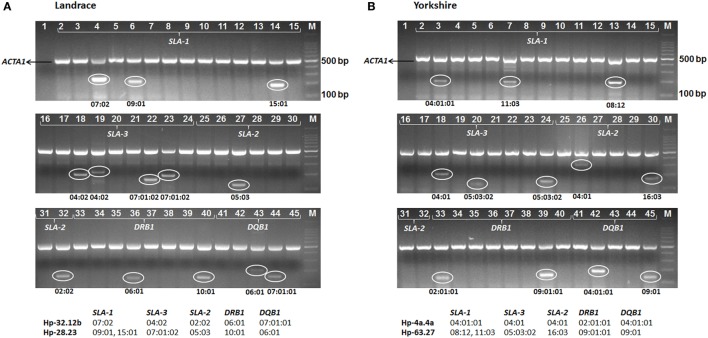
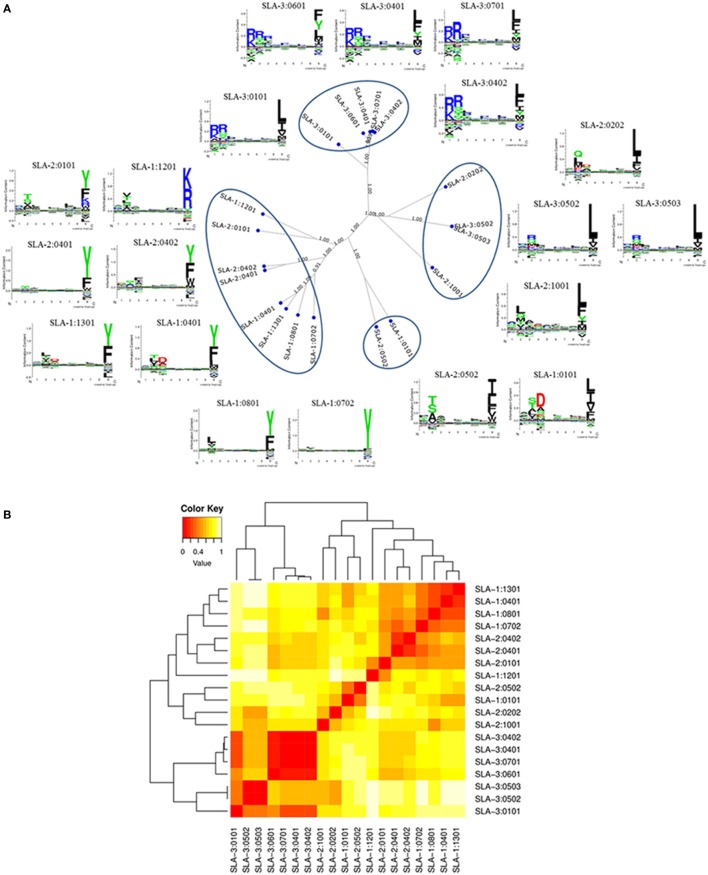
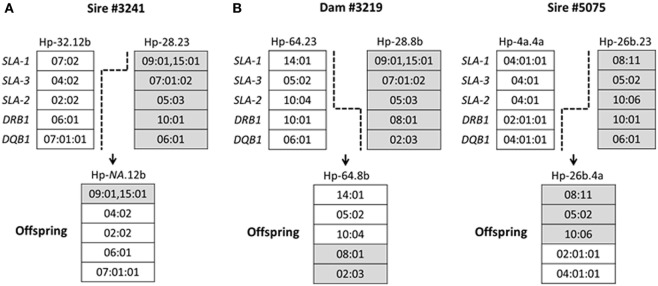
The highly polymorphic swine major histocompatibility complex (MHC), termed swine leukocyte antigen (SLA), is associated with different levels of immunologic responses to infectious diseases, vaccines, and transplantation. Pig breeds with known SLA haplotypes are important genetic resources for biomedical research. Canadian Yorkshire and Landrace pigs represent the current specific pathogen-free (SPF) breeding stock maintained in the isolation environment at the Harbin Veterinary Research Institute, Chinese Academy of Agricultural Sciences. In this study, we identified 61 alleles at five polymorphic SLA loci (, and ) representing 17 class I haplotypes and 11 class II haplotypes using reverse transcription-polymerase chain reaction (RT-PCR) sequence-based typing and PCR-sequence specific primers methods in 367 Canadian SPF Yorkshire and Landrace pigs. The official designation of the alleles has been assigned by the SLA Nomenclature Committee of the International Society for Animal Genetics and released in updated Immuno Polymorphism Database-MHC SLA sequence database [Release 2.0.0.3 (2016-11-03)]. The submissions confirmed some unassigned alleles and standardized nomenclatures of many previously unconfirmed alleles in the GenBank database. Three class I haplotypes, Hp-37.0, 63.0, and 73.0, appeared to be novel and have not previously been reported in other pig populations. One crossover within the class I region and two between class I and class II regions were observed, resulting in three new recombinant haplotypes. The presence of the duplicated locus was confirmed in three class I haplotypes Hp-28.0, Hp-35.0, and Hp-63.0. Furthermore, we also analyzed the functional diversities of 19 identified frequent SLA class I molecules in this study and confirmed the existence of four supertypes using the method. These results will be useful for studying the adaptive immune response and immunological phenotypic differences in pigs, screening potential T-cell epitopes, and further developing the more effective vaccines.
高度多态的猪主要组织相容性复合体(MHC),称为猪白细胞抗原(SLA),与对传染病、疫苗和移植的不同水平免疫反应相关。具有已知SLA单倍型的猪品种是生物医学研究的重要遗传资源。加拿大约克夏猪和长白猪代表了中国农业科学院哈尔滨兽医研究所在隔离环境中维持的当前无特定病原体(SPF)种畜。在本研究中,我们使用基于逆转录-聚合酶链反应(RT-PCR)测序的分型和PCR序列特异性引物方法,在367头加拿大SPF约克夏猪和长白猪中,在五个多态性SLA位点(、和)鉴定出61个等位基因,代表17种I类单倍型和11种II类单倍型。这些等位基因的官方命名已由国际动物遗传学会的SLA命名委员会指定,并在更新的免疫多态性数据库-MHC SLA序列数据库[版本2.0.0.3(2016-11-03)]中发布。这些提交内容确认了一些未指定的等位基因,并规范了GenBank数据库中许多先前未确认等位基因的命名。三种I类单倍型Hp-37.0、63.0和73.0似乎是新的,以前在其他猪群中未见报道。在I类区域内观察到一次交叉,在I类和II类区域之间观察到两次交叉,产生了三种新的重组单倍型。在三种I类单倍型Hp-28.0、Hp-35.0和Hp-63.0中证实了重复的位点的存在。此外,我们还分析了本研究中鉴定出的19种常见SLA I类分子的功能多样性,并使用方法确认了四种超型的存在。这些结果将有助于研究猪的适应性免疫反应和免疫表型差异,筛选潜在的T细胞表位,并进一步开发更有效的疫苗。