Dunn Kelly E, Yepez-Laubach Claudia, Nuzzo Paul A, Fingerhood Michael, Kelly Anne, Berman Suzan, Bigelow George E
Johns Hopkins University School of Medicine, Departments of Psychiatry and Behavioral Sciences, United States.
Johns Hopkins University School of Medicine, Departments of Psychiatry and Behavioral Sciences, United States.
Drug Alcohol Depend. 2017 Apr 1;173 Suppl 1(Suppl 1):S39-S47. doi: 10.1016/j.drugalcdep.2016.12.003.
Opioid overdose (OD) has become a significant public health problem in need of effective interventions. The majority of existing educational interventions target provision of naloxone and are conducted in-person; these elements present logistical barriers that may limit wide-spread implementation. This study developed and evaluated an easily disseminated opioid OD educational intervention and compared computerized versus pamphlet delivery METHODS: Participants (N=76) undergoing opioid detoxification were randomly assigned to receive OD education via a Pamphlet (N=25), Computer (N=24), or Computer+Mastery (N=27) with identical content for all delivery modalities. Primary outcomes were changes from pre- to post-intervention in knowledge of opioid effects, opioid OD symptoms, and recommended opioid OD responses, as well as intervention acceptability. Also assessed at 1 and 3-month follow-ups were retention of knowledge and change in reported OD risk behaviors.
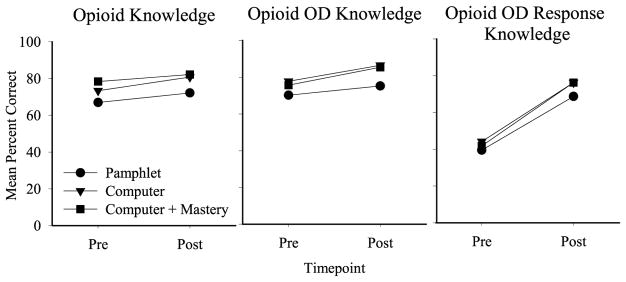
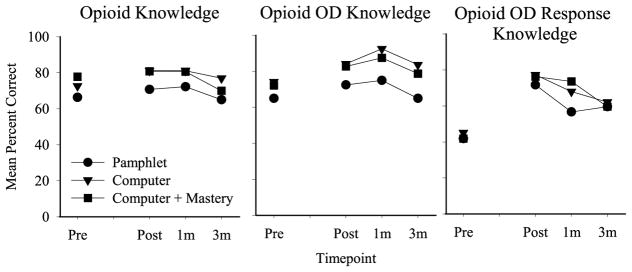
Knowledge increased following all three intervention-delivery modalities with few between-group differences observed in knowledge gain or acceptability ratings. Largest gains were in the domain of opioid OD response (from 41.8% to 73.8% mean correct responses; p<0.001). Knowledge was well sustained at the 1 and 3-month follow-ups among completers, where a significant reduction was seen in the critical behavioral risk factor of using opioids while alone.
Opioid overdose education delivered by computer or written pamphlet produced sustained increases in knowledge and reduction in a key behavioral risk factor.
Results support further evaluation of this educational intervention that can be used alone or to complement naloxone-training programs.
阿片类药物过量(OD)已成为一个需要有效干预措施的重大公共卫生问题。现有的大多数教育干预措施都以提供纳洛酮为目标,且是面对面进行的;这些因素带来了后勤方面的障碍,可能会限制广泛实施。本研究开发并评估了一种易于传播的阿片类药物过量教育干预措施,并比较了计算机化交付与小册子交付两种方式。
接受阿片类药物戒毒的参与者(N = 76)被随机分配通过小册子(N = 25)、计算机(N = 24)或计算机+掌握(N = 27)接受OD教育,所有交付方式的内容相同。主要结果是干预前后在阿片类药物作用知识、阿片类药物过量症状以及推荐的阿片类药物过量应对措施方面的变化,以及干预的可接受性。在1个月和3个月的随访中还评估了知识的保留情况以及报告的OD风险行为的变化。
所有三种干预交付方式后知识均有所增加,在知识增益或可接受性评分方面观察到的组间差异很少。最大的增益出现在阿片类药物过量应对领域(平均正确回答率从41.8%提高到73.8%;p<0.001)。在完成者的1个月和3个月随访中,知识得到了很好的维持,独自使用阿片类药物这一关键行为风险因素显著降低。
通过计算机或书面小册子提供的阿片类药物过量教育使知识持续增加,并降低了一个关键行为风险因素。
结果支持对这种可单独使用或补充纳洛酮培训项目的教育干预措施进行进一步评估。