Ab Malik Normaliza, Mohamad Yatim Sa'ari, Lam Otto Lok Tao, Jin Lijian, McGrath Colman Patrick Joseph
Periodontology and Dental Public Health, The University of Hong Kong, Hong Kong SAR, China.
Faculty of Dentistry, Universiti Sains Islam Malaysia (USIM), Kuala Lumpur, Malaysia.
J Med Internet Res. 2017 Mar 31;19(3):e87. doi: 10.2196/jmir.7024.
Oral hygiene care is of key importance among stroke patients to prevent complications that may compromise rehabilitation or potentially give rise to life-threatening infections such as aspiration pneumonia.
The aim of this study was to evaluate the effectiveness of a Web-based continuing professional development (CPD) program on "general intention" of the health carers to perform daily mouth cleaning for stroke patients using the theory of planned behavior (TPB).
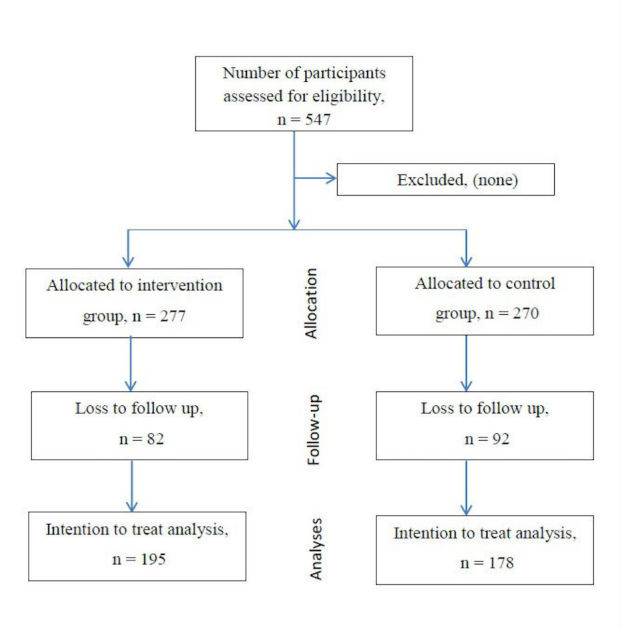
A double-blind cluster randomized controlled trial was conducted among 547 stroke care providers across 10 hospitals in Malaysia. The centers were block randomized to receive either (1) test intervention (a Web-based CPD program on providing oral hygiene care to stroke patients using TPB) or (2) control intervention (a Web-based CPD program not specific to oral hygiene). Domains of TPB: "attitude," "subjective norm" (SN), "perceived behavior control" (PBC), "general intention" (GI), and "knowledge" related to providing oral hygiene care were assessed preintervention and at 1 month and 6 months postintervention.
The overall response rate was 68.2% (373/547). At 1 month, between the test and control groups, there was a significant difference in changes in scores of attitude (P=.004) and subjective norm (P=.01), but not in other TPB domains (GI, P=.11; PBC, P=.51; or knowledge, P=.08). At 6 months, there were significant differences in changes in scores of GI (P=.003), attitude (P=.009), SN (P<.001) and knowledge (P=.001) between the test and control groups. Regression analyses identified that the key factors associated with a change in GI at 6 months were changes in SN (beta=.36, P<.001) and changes in PBC (beta=.23, P<.001).
The Web-based CPD program based on TPB increased general intention, attitudes, subjective norms, and knowledge to provide oral hygiene care among stroke carers for their patients. Changing subjective norms and perceived behavioral control are key factors associated with changes in general intention to provide oral hygiene care.
National Medical Research Register, Malaysia NMRR-13-1540-18833 (IIR); https://www.nmrr.gov.my/ fwbLoginPage.jsp.
口腔卫生护理对中风患者至关重要,可预防可能影响康复或引发危及生命感染(如吸入性肺炎)的并发症。
本研究旨在运用计划行为理论(TPB)评估基于网络的继续职业发展(CPD)项目对医护人员为中风患者进行日常口腔清洁的“总体意向”的有效性。
在马来西亚10家医院的547名中风护理提供者中进行了一项双盲整群随机对照试验。各中心被整群随机分组,分别接受(1)试验干预(一项基于网络的使用TPB为中风患者提供口腔卫生护理的CPD项目)或(2)对照干预(一项非特定于口腔卫生的基于网络的CPD项目)。在干预前、干预后1个月和6个月评估TPB的各个领域:与提供口腔卫生护理相关的“态度”、“主观规范”(SN)、“感知行为控制”(PBC)、“总体意向”(GI)和“知识”。
总体应答率为68.2%(373/547)。在1个月时,试验组和对照组之间,态度得分变化(P = 0.004)和主观规范得分变化(P = 0.01)存在显著差异,但在其他TPB领域(GI,P = 0.11;PBC,P = 0.51;知识,P = 0.08)无显著差异。在6个月时,试验组和对照组之间,GI得分变化(P = 0.003)、态度得分变化(P = 0.009)、SN得分变化(P < 0.001)和知识得分变化(P = 0.001)存在显著差异。回归分析确定,与6个月时GI变化相关的关键因素是SN变化(β = 0.36,P < 0.001)和PBC变化(β = 0.23,P < 0.001)。
基于TPB的网络CPD项目提高了中风护理人员为其患者提供口腔卫生护理的总体意向、态度、主观规范和知识。改变主观规范和感知行为控制是与提供口腔卫生护理总体意向变化相关的关键因素。
马来西亚国家医学研究注册处,NMRR - 13 - 1540 - 18833(IIR);https://www.nmrr.gov.my/fwbLoginPage.jsp。