Shahidi Neal, Ou George, Lam Eric, Enns Robert, Telford Jennifer
St. Paul's Hospital, Division of Gastroenterology, Department of Medicine, University of British Columbia, Vancouver, BC, Canada.
Endosc Int Open. 2017 Apr;5(4):E239-E243. doi: 10.1055/s-0043-100507.
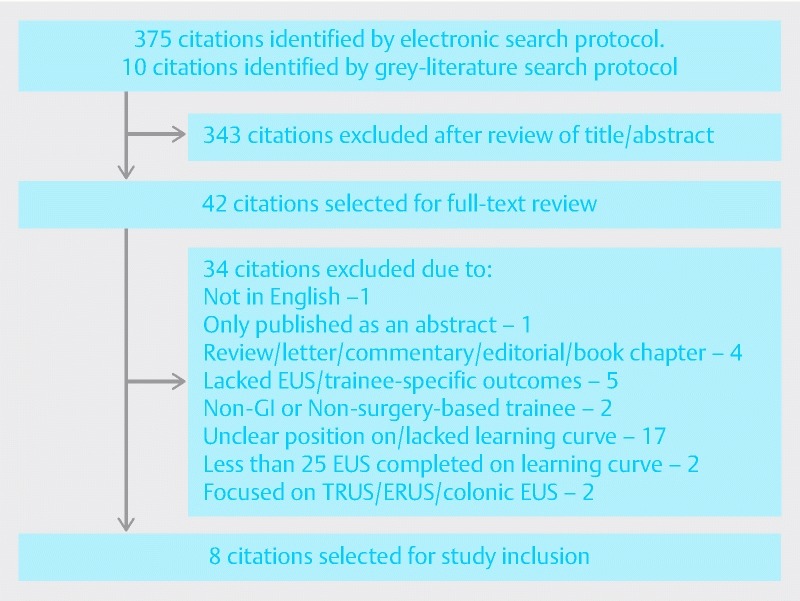
The American Society for Gastrointestinal Endoscopy (ASGE) recommends that trainees complete 150 endoscopic ultrasound (EUS) procedures before assessing competency. However, this recommendation is largely based on limited evidence and expert opinion. With new evidence suggesting that this historical threshold is underestimating training requirements, we evaluated the learning curve for achieving competency in EUS. Two investigators independently searched MEDLINE for full-text citations assessing the learning curve for achieving competency in EUS in the period 1946 to 25 March 2016. A learning curve was defined as either a tabulated or graphic representation of competency as a function of increasing EUS experience. Eight studies assessing 28 trainees and 7051 EUS procedures were included. When stratifying studies based on procedural indication: three studies assessed competency in evaluating mucosal lesions, three studies assessed competency in EUS fine-needle aspiration (EUS-FNA), and two studies assessed comprehensive competency. Among studies assessing mucosal lesion T-staging accuracy, competency was achieved by 65 to 231 procedures. Among studies assessing EUS-FNA, competency was achieved by 30 to 40 procedures. Among the two studies assessing comprehensive competency in EUS, competency was not achieved in either study across all trainees. Only four of 17 trainees reached competency by 225 to 295 EUS procedures. As EUS competency assessment has evolved to more closely reflect independent clinical practice, the number of procedures required to achieve competency has risen well above ASGE recommendations. Advanced endoscopy training programs and specialty societies need to re-assess the structure of EUS training.
美国胃肠内镜学会(ASGE)建议,实习生在评估能力之前需完成150例内镜超声(EUS)操作。然而,这一建议很大程度上基于有限的证据和专家意见。鉴于新证据表明这一历史阈值低估了培训要求,我们评估了实现EUS能力的学习曲线。两名研究人员独立检索了MEDLINE,以获取1946年至2016年3月25日期间评估实现EUS能力学习曲线的全文引用文献。学习曲线被定义为能力随EUS经验增加的表格或图形表示。纳入了八项评估28名实习生和7051例EUS操作的研究。根据操作指征对研究进行分层时:三项研究评估了评估黏膜病变的能力,三项研究评估了EUS细针穿刺抽吸术(EUS-FNA)的能力,两项研究评估了综合能力。在评估黏膜病变T分期准确性的研究中,65至231例操作可实现能力达标。在评估EUS-FNA的研究中,30至40例操作可实现能力达标。在两项评估EUS综合能力的研究中,所有实习生在任何一项研究中均未达到能力达标。17名实习生中只有4人在225至295例EUS操作后达到能力达标。随着EUS能力评估的发展,以更紧密地反映独立临床实践,实现能力所需的操作数量已远高于ASGE的建议。先进的内镜培训项目和专业学会需要重新评估EUS培训的结构。