Schulz Christina-Alexandra, Persson Margaretha, Christensson Anders, Hindy George, Almgren Peter, Nilsson Peter M, Melander Olle, Engström Gunnar, Orho-Melander Marju
Department of Clinical Sciences, Skåne University Hospital Malmo Clinical Research Center, Lund University, Malmo, Sweden.
Kidney Int Rep. 2017 Mar;2(2):239-247. doi: 10.1016/j.ekir.2016.11.004.
The soluble urokinase-type plasminogen activator receptor (suPAR) has recently been associated with a decline in kidney function and incidence of chronic kidney disease in patients with cardiovascular disease undergoing cardiac catheterization, yet little is known whether suPAR is associated with deterioration of kidney function in the general population.
In the population-based Malmö Diet and Cancer Study cohort, plasma levels of suPAR were quantified in 5381 participants at baseline (1991-1994), and creatinine was measured and used to calculate estimated glomerulus filtration rate (eGFR) at baseline and follow-up (2007-2012). Incident chronic kidney disease was defined as eGFR < 60 ml/min per 1.73 m at follow-up.
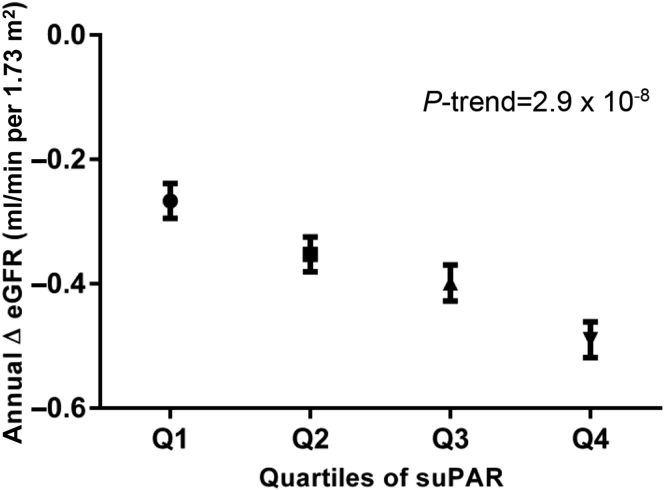
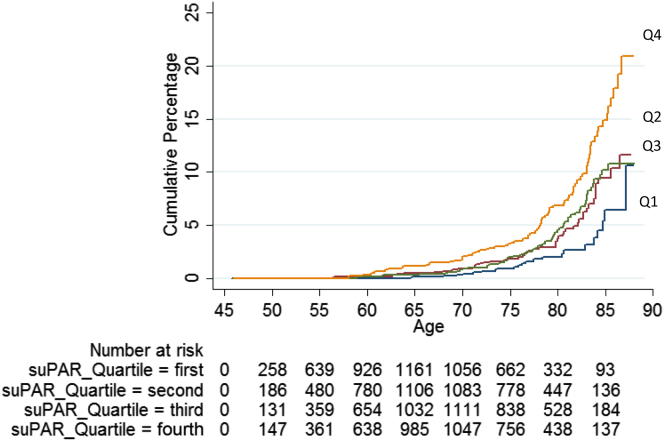
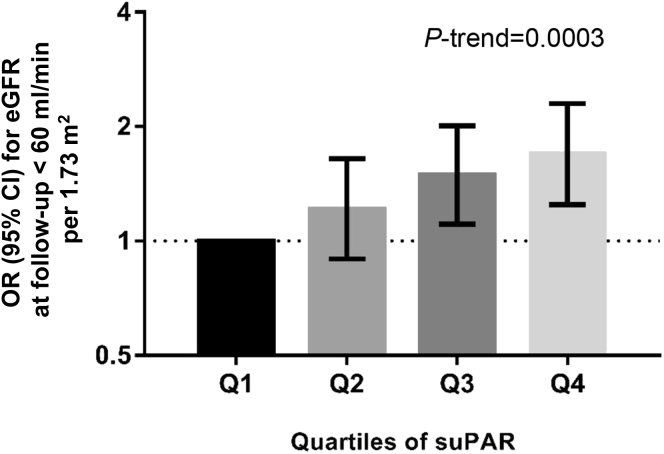
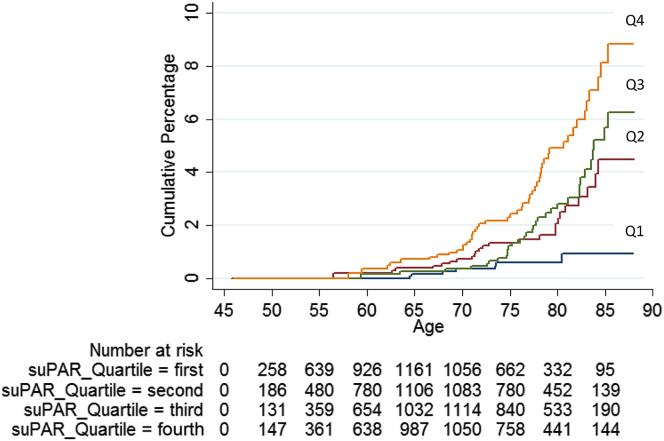
Participants within the highest quartile of suPAR had a significantly lower mean eGFR at follow-up than those within the lowest quartile (mean 68 vs. 74 ml/min per 1.73 m; -trend = 4.3 × 10). In multivariate regression analysis, suPAR (per 1 SD increment of log-transformed suPAR) was associated with a decline in eGFR ( = 3.3 × 10) and incident chronic kidney disease (561 events, odds ratio = 1.25; 95% confidence interval, 1.10-1.41). Furthermore, we identified 110 cases of hospitalization due to impaired kidney function via linkage to national registers of inpatient and outpatient hospital diagnoses. During a mean follow-up time of 19 years, suPAR was associated with risk for hospitalization due to impaired kidney function (hazard ratio = 1.49; 95% confidence interval, 1.27-1.74) in multivariate Cox proportional hazard analysis.
The increased suPAR level at baseline was associated with a significantly higher longitudinal decline in eGFR, higher incidence of chronic kidney disease, and hospitalization due to impaired kidney function in a cohort of healthy middle-aged participants.
可溶性尿激酶型纤溶酶原激活物受体(suPAR)最近被发现与接受心脏导管插入术的心血管疾病患者的肾功能下降及慢性肾病发病率有关,但对于suPAR是否与普通人群的肾功能恶化相关,人们知之甚少。
在基于人群的马尔默饮食与癌症研究队列中,对5381名参与者在基线期(1991 - 1994年)的血浆suPAR水平进行了定量分析,并在基线期和随访期(2007 - 2012年)测量了肌酐水平,用于计算估计肾小球滤过率(eGFR)。将随访期内eGFR < 60 ml/min per 1.73 m²定义为新发慢性肾病。
suPAR最高四分位数组的参与者在随访期的平均eGFR显著低于最低四分位数组(平均分别为68 vs. 74 ml/min per 1.73 m²;P趋势 = 4.3 × 10⁻⁴)。在多变量回归分析中,suPAR(对数转换后的suPAR每增加1个标准差)与eGFR下降(P = 3.3 × 10⁻³)及新发慢性肾病(561例事件,比值比 = 1.25;95%置信区间,1.10 - 1.41)相关。此外,通过与国家住院和门诊医院诊断登记册建立联系,我们确定了110例因肾功能受损而住院的病例。在平均19年的随访期内,在多变量Cox比例风险分析中,suPAR与因肾功能受损而住院的风险相关(风险比 = 1.49;95%置信区间,1.27 - 1.74)。
在一组健康的中年参与者中,基线期suPAR水平升高与eGFR的纵向显著下降、慢性肾病的更高发病率以及因肾功能受损而住院有关。