Iversen Esben, Kallemose Thomas, Hornum Mads, Bengaard Anne Kathrine, Nehlin Jan Olof, Rasmussen Line Jee Hartmann, Sandholdt Haakon, Tavenier Juliette, Feldt-Rasmussen Bo, Andersen Ove, Eugen-Olsen Jesper, Houlind Morten Baltzer
Department of Clinical Research, Copenhagen University Hospital Amager and Hvidovre, Hvidovre, Denmark.
Department of Nephrology, Rigshospitalet, Copenhagen, Denmark.
Clin Kidney J. 2022 Feb 21;15(8):1534-1541. doi: 10.1093/ckj/sfac048. eCollection 2022 Aug.
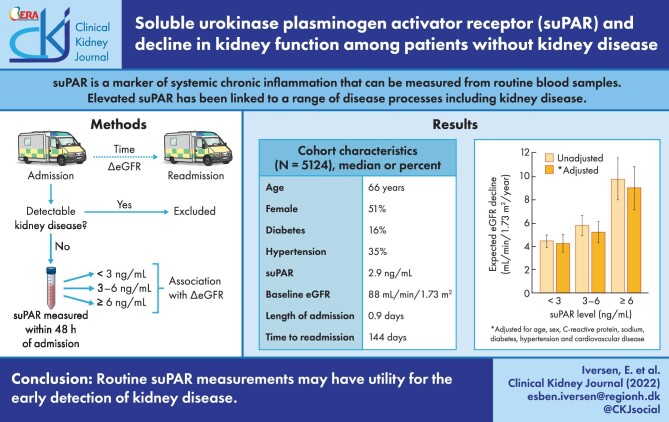
Hospitalized patients are at an increased risk of developing kidney disease after discharge, often despite the absence of any clinical indicators during hospitalization. Soluble urokinase plasminogen activator receptor (suPAR) is a marker of systemic chronic inflammation that can be measured from routine blood samples. We determined whether elevated suPAR during hospitalization is associated with a decline in estimated glomerular filtration rate (eGFR) after discharge.
This was a retrospective longitudinal cohort study of patients without detectable kidney disease presenting to the emergency department on two separate occasions during a 3-year period. The association between suPAR and a decline in eGFR was assessed by linear mixed models for repeated measures adjusting for age, sex, C-reactive protein, sodium, diabetes, hypertension and cardiovascular disease.
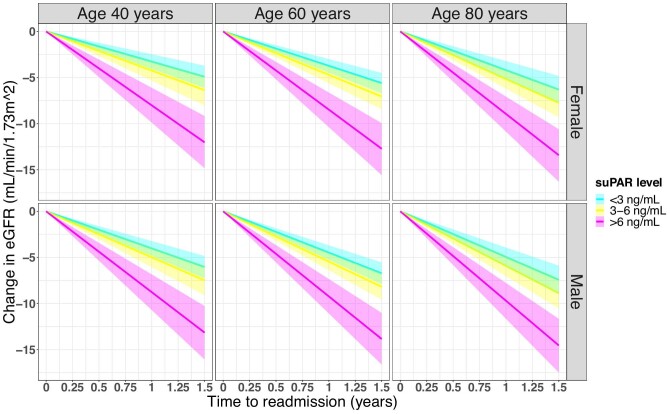
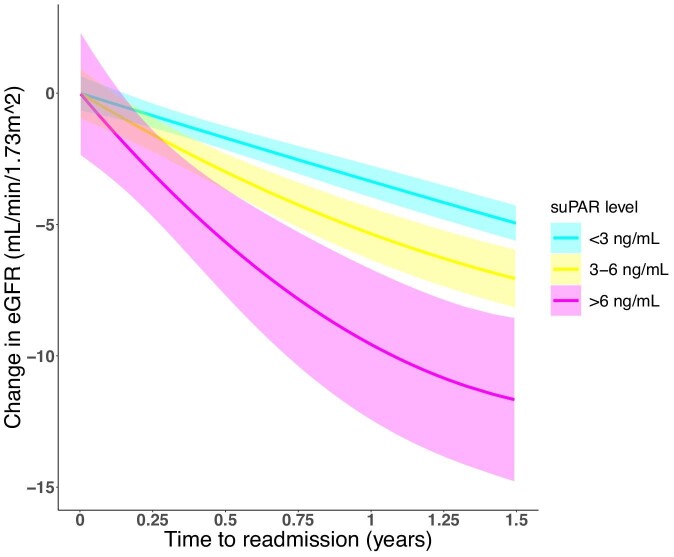
In total, 5124 patients (median age 65.9 years, 51.0% female) were included. The median suPAR was 2.9 ng/mL, the median time to readmission was 144 days and the expected rate of eGFR decline over this period was 5.1 mL/min/1.73 m/year. Adjusting for other risk factors, patients with suPAR <3, 3-6 or ≥6 ng/mL had an expected eGFR decline of 4.3, 5.2 or 9.0 mL/min/1.73 m/year, respectively. Similarly, patients with suPAR in the lowest (<2.4 ng/mL), middle (2.4-3.6 ng/mL) or highest (≥3.6 ng/mL) tertile had an expected eGFR decline of 4.2, 4.6 or 6.5 mL/min/1.73 m/year, respectively. In both cases, a higher suPAR level was significantly and independently associated with a higher rate of eGFR decline ( < .001).
A higher suPAR level was associated with accelerated eGFR decline among patients presenting to the emergency department, suggesting that routine suPAR measurements may have utility for the early detection of kidney disease.
住院患者出院后发生肾病的风险增加,通常在住院期间没有任何临床指标的情况下也是如此。可溶性尿激酶型纤溶酶原激活物受体(suPAR)是一种全身慢性炎症的标志物,可从常规血液样本中检测出来。我们确定住院期间suPAR升高是否与出院后估计肾小球滤过率(eGFR)下降有关。
这是一项回顾性纵向队列研究,研究对象为在3年期间两次分别到急诊科就诊且未检测出肾病的患者。通过线性混合模型对重复测量数据进行分析,评估suPAR与eGFR下降之间的关联,并对年龄、性别、C反应蛋白、钠、糖尿病、高血压和心血管疾病进行校正。
总共纳入了5124例患者(中位年龄65.9岁,女性占51.0%)。suPAR的中位数为2.9 ng/mL,再次入院的中位时间为144天,在此期间eGFR下降的预期速率为5.1 mL/min/1.73 m²/年。校正其他风险因素后,suPAR<3、3 - 6或≥6 ng/mL的患者eGFR下降的预期速率分别为4.3、5.2或9.0 mL/min/1.73 m²/年。同样,suPAR处于最低(<2.4 ng/mL)、中间(2.4 - 3.6 ng/mL)或最高(≥3.6 ng/mL)三分位数的患者eGFR下降的预期速率分别为4.2、4.6或6.5 mL/min/1.73 m²/年。在这两种情况下,较高的suPAR水平均与较高的eGFR下降速率显著且独立相关(P<0.001)。
较高的suPAR水平与到急诊科就诊患者的eGFR加速下降有关,这表明常规测量suPAR可能有助于早期发现肾病。