M Harsha Raj, Ghosh Debidas, Banerjee Rita, Salimath Bharathi P
a Department of Studies in Biotechnology , Molecular Oncology Lab, University of Mysore , Mysore , India.
b Department of Bio-Medical Laboratory Science & Management , Vidyasagar University , Midnapore , West Bengal , India.
Pharm Biol. 2017 Dec;55(1):1489-1499. doi: 10.1080/13880209.2017.1307422.
Abnormal angiogenesis and evasion of apoptosis are hallmarks of cancer. Accordingly, anti-angiogenic and pro-apoptotic therapies are effective strategies for cancer treatment. Medicinal plants, namely, Eugenia jambolana Lam. (Myrtaceae), Musa paradisiaca L. (Musaceae), and Coccinia indica Wight & Arn. (Cucurbitaceae), have not been greatly investigated for their anticancer potential.
We investigated the anti-angiogenic and pro-apoptotic efficacy of ethyl acetate (EA) and n-butanol (NB) extracts of E. jambolana (seeds), EA extracts of M. paradisiaca (roots) and C. indica (leaves) with respect to mammary neoplasia.
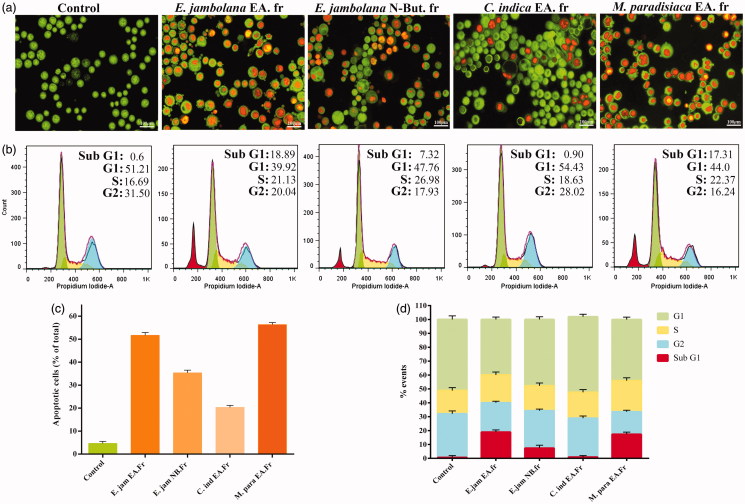
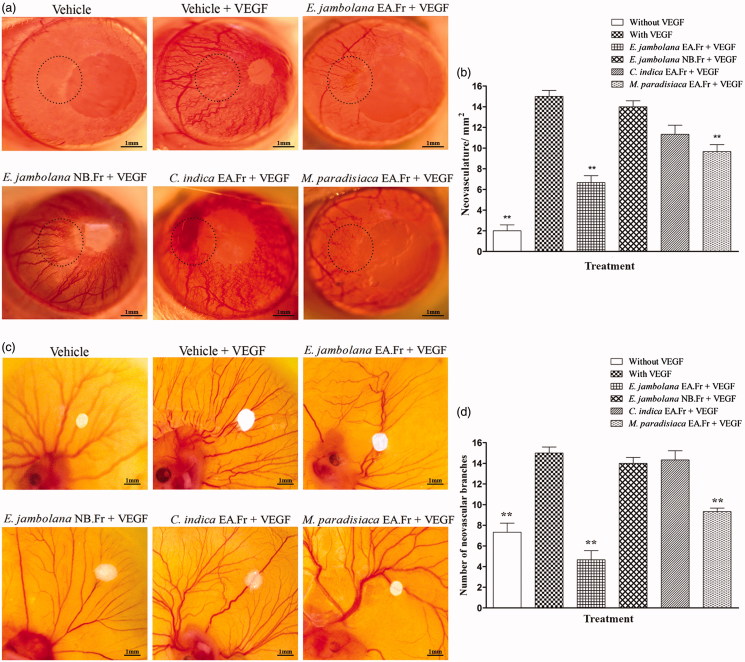
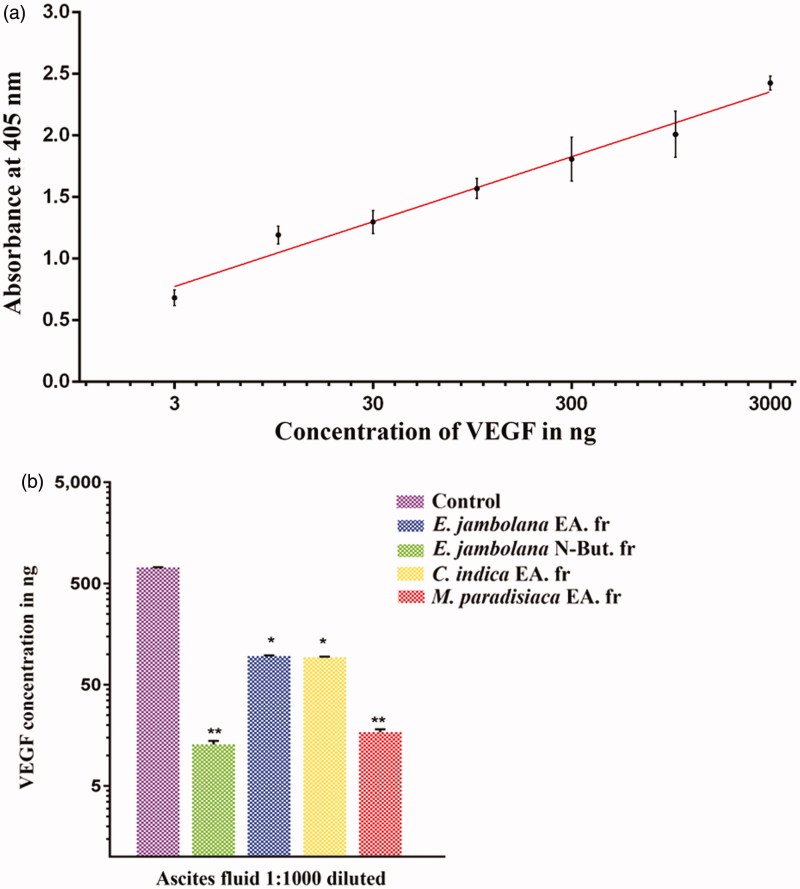
Effect of extracts (2-200 μg/mL) on cytotoxicity and MCF-7, MDA-MB-231 and endothelial cell (EC) proliferation and in vitro angiogenesis were evaluated by MTT, [H]thymidine uptake and EC tube formation assays, respectively. In vivo tumour proliferation, VEGF secretion and angiogenesis were assessed using the Ehrlich ascites tumour (EAT) model followed by rat corneal micro-pocket and chicken chorioallantoic membrane (CAM) assays. Apoptosis induction was assessed by morphological and cell cycle analysis.
EA extracts of E. jambolana and M. paradisiaca exhibited the highest cytotoxicity (IC 25 and 60 μg/mL), inhibited cell proliferation (up to 81%), and tube formation (83% and 76%). In vivo treatment reduced body weight (50%); cell number (16.5- and 14.7-fold), secreted VEGF (∼90%), neoangiogenesis in rat cornea (2.5- and 1.5-fold) and CAM (3- and 1.6-fold) besides EAT cells accumulation in sub-G1 phase (20% and 18.38%), respectively.
Considering the potent anti-angiogenic and pro-apoptotic properties, lead molecules from EA extracts of E. jambolana and M. paradisiaca can be developed into anticancer drugs.
异常血管生成和逃避细胞凋亡是癌症的标志。因此,抗血管生成和促凋亡疗法是癌症治疗的有效策略。药用植物,即蒲桃(桃金娘科)、大蕉(芭蕉科)和印度栝楼(葫芦科),其抗癌潜力尚未得到充分研究。
我们研究了蒲桃(种子)的乙酸乙酯(EA)和正丁醇(NB)提取物、大蕉(根)和印度栝楼(叶)的EA提取物对乳腺肿瘤的抗血管生成和促凋亡功效。
分别通过MTT法、[H]胸腺嘧啶摄取法和内皮细胞(EC)管形成试验评估提取物(2 - 200μg/mL)对细胞毒性以及MCF - 7、MDA - MB - 231和内皮细胞增殖和体外血管生成的影响。使用艾氏腹水瘤(EAT)模型,随后进行大鼠角膜微袋和鸡胚绒毛尿囊膜(CAM)试验,评估体内肿瘤增殖、VEGF分泌和血管生成。通过形态学和细胞周期分析评估凋亡诱导情况。
蒲桃和大蕉的EA提取物表现出最高的细胞毒性(IC25分别为60μg/mL和25μg/mL),抑制细胞增殖(高达81%)和管形成(分别为83%和76%)。体内治疗使体重减轻(50%);细胞数量减少(分别为16.5倍和14.7倍),VEGF分泌减少(约90%),大鼠角膜新生血管生成减少(分别为2.5倍和1.5倍)以及CAM减少(分别为3倍和1.6倍),此外EAT细胞在亚G1期的积累分别为20%和18.38%。
考虑到其强大的抗血管生成和促凋亡特性,蒲桃和大蕉EA提取物中的先导分子可开发成抗癌药物。