Twigg Michael J, Wright David, Kirkdale Charlotte L, Desborough James A, Thornley Tracey
School of Pharmacy, University of East Anglia, Norwich Research Park, Norwich, United Kingdom.
Boots UK, Beeston, Nottingham, United Kingdom.
PLoS One. 2017 Apr 3;12(4):e0174500. doi: 10.1371/journal.pone.0174500. eCollection 2017.
The UK government advocates person-centred healthcare which is ideal for supporting patients to make appropriate lifestyle choices and to address non-adherence. The Community Pharmacy Future group, a collaboration between community pharmacy companies and independents in the UK, introduced a person-centred service for patients with multiple long-term conditions in 50 pharmacies in Northern England.
Describe the initial findings from the set up and delivery of a novel community pharmacy-based person-centred service.
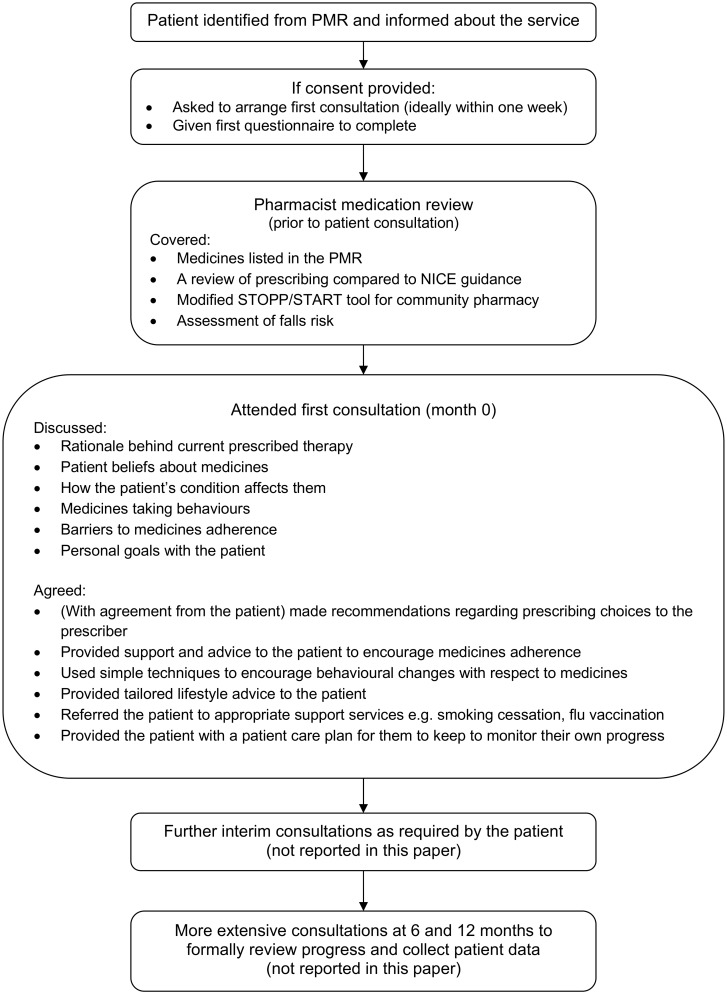
Patients over fifty years of age prescribed more than one medicine including at least one for cardiovascular disease or diabetes were enrolled. Medication review and person-centred consultation resulted in agreed health goals and steps towards achieving them. Data were collated and analysed to determine appropriateness of patient recruitment process and quality of outcome data collection. A focus group of seven pharmacists was used to ascertain initial views on the service.
Within 3 months of service initiation, 683 patients had baseline clinical data recorded, of which 86.9% were overweight or obese, 53.7% had hypertension and 80.8% had high cardiovascular risk. 544 (77.2%) patients set at least one goal during the first consultation with 120 (22.1%) setting multiple goals. A majority of patients identified their goals as improvement in condition, activity or quality of life. Pharmacists could see the potential patient benefit and the extended role opportunities the service provided. Allowing patients to set their own goals occasionally identified gaps to be addressed in pharmacist knowledge.
Pharmacists successfully recruited a large number of patients who were appropriate for such a service. Patients were willing to identify goals with the pharmacist, the majority of which, if met, may result in improvements in quality of life. While challenges in delivery were acknowledged, allowing patients to identify their own personalised goals was seen as a positive approach to providing patient services.
英国政府倡导以患者为中心的医疗保健,这对于支持患者做出适当的生活方式选择和解决不依从问题非常理想。英国社区药房未来组织是社区药房公司与独立药房的合作组织,于2019年在英格兰北部的50家药房为患有多种长期疾病的患者推出了以患者为中心的服务。
描述一项基于社区药房的新型以患者为中心服务的设立和实施的初步结果。
招募年龄超过50岁、开具了不止一种药物(包括至少一种用于心血管疾病或糖尿病的药物)的患者。药物审查和以患者为中心的咨询产生了商定的健康目标以及实现这些目标的步骤。整理和分析数据以确定患者招募过程的适当性和结果数据收集的质量。使用由七名药剂师组成的焦点小组来确定对该服务的初步看法。
在服务启动后的3个月内,记录了683名患者的基线临床数据,其中86.9%超重或肥胖,53.7%患有高血压,80.8%有高心血管风险。544名(77.2%)患者在首次咨询期间设定了至少一个目标,其中120名(22.1%)设定了多个目标。大多数患者将他们的目标确定为病情、活动或生活质量的改善。药剂师能够看到该服务为患者带来的潜在益处以及提供的扩展角色机会。允许患者设定自己的目标偶尔会发现药剂师知识方面需要解决的差距。
药剂师成功招募了大量适合此类服务的患者。患者愿意与药剂师确定目标,如果大多数目标得以实现,可能会改善生活质量。虽然认识到在实施过程中存在挑战,但允许患者确定自己的个性化目标被视为提供患者服务的一种积极方法。