Garcia Marc A, Valderrama-Hinds Luis M, Chiu Chi-Tsun, Mutambudzi Miriam S, Chen Nai-Wei, Raji Mukaila
Sealy Center on Aging, University of Texas Medical Branch, Galveston, Texas.
Institute of European and American Studies, Academia Sinica, Taipei, Taiwan.
J Am Geriatr Soc. 2017 Jul;65(7):1591-1596. doi: 10.1111/jgs.14875. Epub 2017 Mar 30.
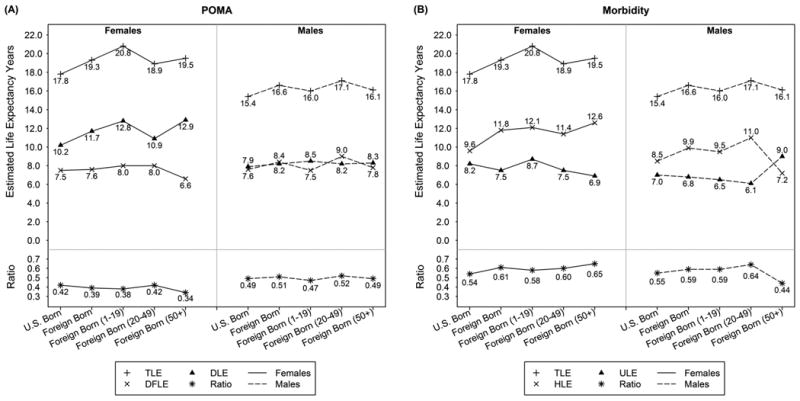
The U.S. Mexican American population enjoys longer life expectancies relative to other racial/ethnic groups but is disproportionately affected by chronic conditions and functional limitations. Studying the impact of heterogeneity in age, time and other characteristics of migration among older Mexican Americans can inform our understanding of health disparities and healthcare needs in later-life. This research used 20 years of data from the Hispanic Established Populations for the Epidemiologic Study of the Elderly to assess the proportion of life spent with functional limitations and one or more morbidity (according to age of migration and sex) in the U.S. Mexican-American population. The results indicate that early-life and late-life migrant women spend more years with Performance-Oriented Mobility Assessment limitations than U.S.-born women. Conversely, midlife migrant women were not statistically different from U.S.-born women in years spent disabled. In men, midlife migrants had longer life expectancies and had more disability-free years than U.S.-born men. For morbidity, late-life migrant women spent a significantly smaller proportion of their elderly years with morbidity than U.S.-born women, but late-life migrant men spent more years with morbidity than U.S.-born men. These findings illustrate that older Mexican Americans in the United States are heterogeneous in nativity and health outcomes. More years spent disabled or unhealthy may result in greater burden on family members and greater dependence on public resources. These findings have implications for the development of social and health policies to appropriately target the medical conditions and disabilities of older Mexican Americans entering late life.
与其他种族/族裔群体相比,美国墨西哥裔美国人的预期寿命更长,但却受到慢性病和功能受限的影响尤为严重。研究年龄、时间以及老年墨西哥裔美国人移民的其他特征的异质性影响,有助于我们了解晚年的健康差异和医疗需求。本研究使用了来自西班牙裔老年人流行病学研究既定人群的20年数据,以评估美国墨西哥裔人口中因功能受限和一种或多种疾病(根据移民年龄和性别)而度过的生命比例。结果表明,早年和晚年移民女性因以表现为导向的行动能力评估受限而度过的年份比美国出生的女性更多。相反,中年移民女性在残疾年份方面与美国出生的女性在统计学上没有差异。在男性中,中年移民的预期寿命更长,无残疾年份比美国出生的男性更多。对于疾病,晚年移民女性在老年时期患疾病的比例明显低于美国出生的女性,但晚年移民男性患疾病的年份比美国出生的男性更多。这些发现表明,在美国的老年墨西哥裔美国人在出生地和健康结果方面存在异质性。残疾或不健康的年份增加可能会给家庭成员带来更大负担,并增加对公共资源的依赖。这些发现对制定社会和卫生政策具有启示意义,以便针对进入晚年的老年墨西哥裔美国人的医疗状况和残疾情况制定适当的政策。