Anstey Kaarin J, Eramudugolla Ranmalee, Chopra Sidhant, Price Jasmine, Wood Joanne M
Centre for Research on Ageing, Health and Wellbeing, Australian National University, Canberra, Australia.
School of Optometry and Vision Science, Queensland University of Technology, Brisbane City, QLD, Australia.
J Alzheimers Dis. 2017;57(4):1197-1205. doi: 10.3233/JAD-161209.
With population aging, drivers with mild cognitive impairment (MCI) are increasing; however, there is little evidence available regarding their safety.
We aimed to evaluate risk of unsafe on-road driving performance among older adults with MCI.
The study was a cross-sectional observational study, set in Canberra, Australia. Participants were non-demented, current drivers (n = 302) aged 65 to 96 years (M = 75.7, SD = 6.18, 40% female) recruited through the community and primary and tertiary care clinics. Measures included a standardized on-road driving test (ORT), a battery of screening measures designed to evaluate older driver safety (UFOV®, DriveSafe, Multi-D), a neurocognitive test battery, and questionnaires on driving history and behavior.
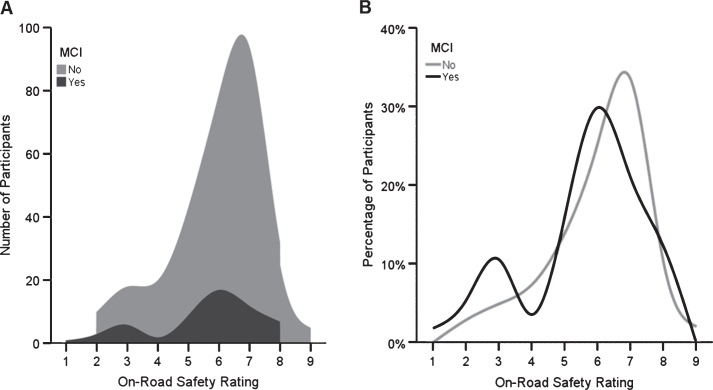
Using Winblad criteria, 57 participants were classified as having MCI and 245 as cognitively normal (CN). While the MCI group had a significantly lower overall safety rating on the ORT (5.61 versus 6.05, p = 0.03), there was a wide range of driving safety scores in the CN and MCI groups. The MCI group performed worse than the CN group on the off-road screening tests. The best fitting model of predictors of ORT performance across the combined sample included age, the Multi-D, and DriveSafe, classifying 90.4% of the sample correctly.
Adults with MCI exhibit a similar range of driving ability to CN adults, although on average they scored lower on off-road and on-road assessments. Driving specific tests were more strongly associated with safety ratings than traditional neuropsychological tests.
随着人口老龄化,患有轻度认知障碍(MCI)的驾驶员数量在增加;然而,关于他们的安全性的证据很少。
我们旨在评估患有MCI的老年人在道路上不安全驾驶行为的风险。
该研究是一项横断面观察性研究,在澳大利亚堪培拉进行。参与者是通过社区以及初级和三级护理诊所招募的65至96岁的非痴呆现任驾驶员(n = 302)(M = 75.7,标准差 = 6.18,40%为女性)。测量指标包括标准化道路驾驶测试(ORT)、一系列旨在评估老年驾驶员安全性的筛查措施(UFOV®、DriveSafe、Multi-D)、神经认知测试组,以及关于驾驶历史和行为的问卷。
根据温布拉德标准,57名参与者被归类为患有MCI,245名认知正常(CN)。虽然MCI组在ORT上的总体安全评级显著较低(5.61对6.05,p = 0.03),但CN组和MCI组的驾驶安全得分范围很广。MCI组在越野筛查测试中的表现比CN组差。在合并样本中,ORT表现的最佳预测模型包括年龄、Multi-D和DriveSafe,正确分类了90.4%的样本。
患有MCI的成年人表现出与认知正常成年人相似的驾驶能力范围,尽管平均而言,他们在越野和道路评估中的得分较低。与传统神经心理学测试相比,特定驾驶测试与安全评级的相关性更强。