Tai-Seale Ming, Olson Cliff W, Li Jinnan, Chan Albert S, Morikawa Criss, Durbin Meg, Wang Wei, Luft Harold S
Ming Tai-Seale (
Cliff W. Olson is director of the Information Management Group at the Palo Alto Medical Foundation Research Institute.
Health Aff (Millwood). 2017 Apr 1;36(4):655-662. doi: 10.1377/hlthaff.2016.0811.
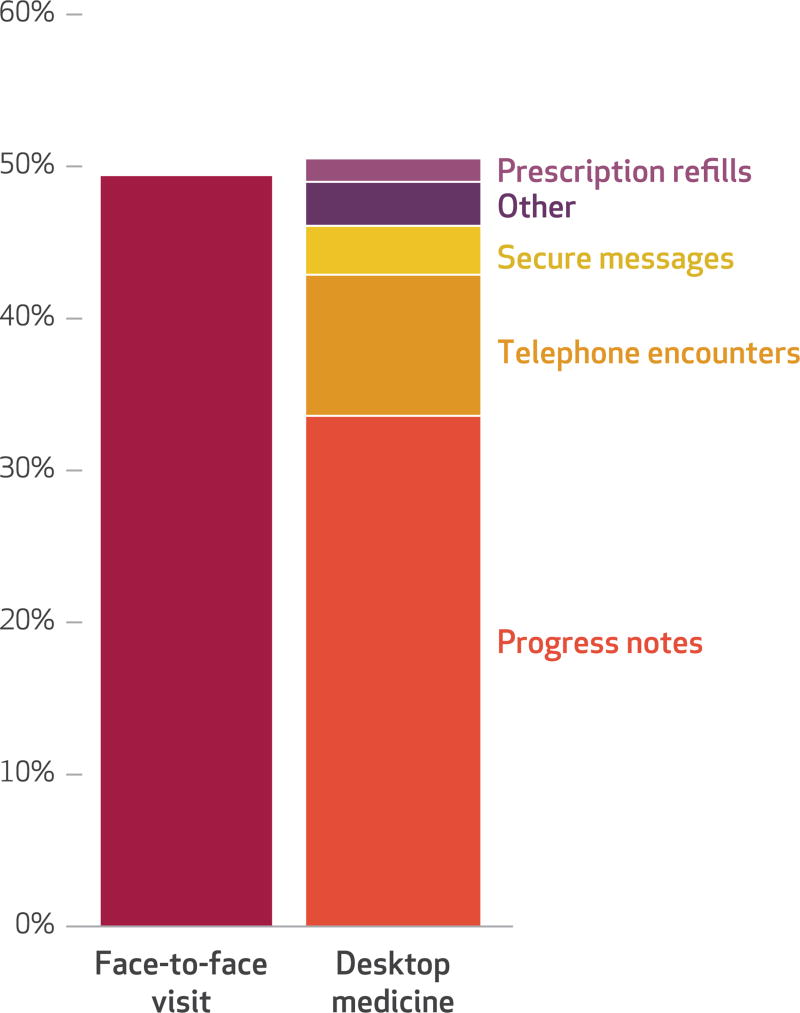
Time spent by physicians is a key resource in health care delivery. This study used data captured by the access time stamp functionality of an electronic health record (EHR) to examine physician work effort. This is a potentially powerful, yet unobtrusive, way to study physicians' use of time. We used data on physicians' time allocation patterns captured by over thirty-one million EHR transactions in the period 2011-14 recorded by 471 primary care physicians, who collectively worked on 765,129 patients' EHRs. Our results suggest that the physicians logged an average of 3.08 hours on office visits and 3.17 hours on desktop medicine each day. Desktop medicine consists of activities such as communicating with patients through a secure patient portal, responding to patients' online requests for prescription refills or medical advice, ordering tests, sending staff messages, and reviewing test results. Over time, log records from physicians showed a decline in the time allocated to face-to-face visits, accompanied by an increase in time allocated to desktop medicine. Staffing and scheduling in the physician's office, as well as provider payment models for primary care practice, should account for these desktop medicine efforts.
医生花费的时间是医疗服务中的一项关键资源。本研究利用电子健康记录(EHR)的访问时间戳功能所捕获的数据,来考察医生的工作投入。这是一种研究医生时间利用情况的潜在有力且不引人注意的方式。我们使用了471名初级保健医生在2011年至2014年期间记录的超过3100万笔EHR交易中所捕获的医生时间分配模式数据,这些医生共同处理了765,129名患者的电子健康记录。我们的研究结果表明,医生每天平均花费3.08小时进行门诊,3.17小时进行线上医疗工作。线上医疗工作包括通过安全的患者门户与患者沟通、回复患者的在线处方续签或医疗建议请求、安排检查、发送员工消息以及查看检查结果等活动。随着时间的推移,医生的日志记录显示,分配给面对面诊疗的时间有所减少,而分配给线上医疗工作的时间有所增加。医生办公室的人员配置和排班,以及初级保健实践的医疗服务提供者支付模式,都应考虑到这些线上医疗工作的投入。