Department of Surgical Sciences, Radiology, Uppsala University, Uppsala, Sweden.
Department of Neuroradiology, University Medical Center Freiburg, Freiburg, Germany.
Eur Radiol. 2017 Oct;27(10):4237-4246. doi: 10.1007/s00330-017-4784-1. Epub 2017 Apr 3.
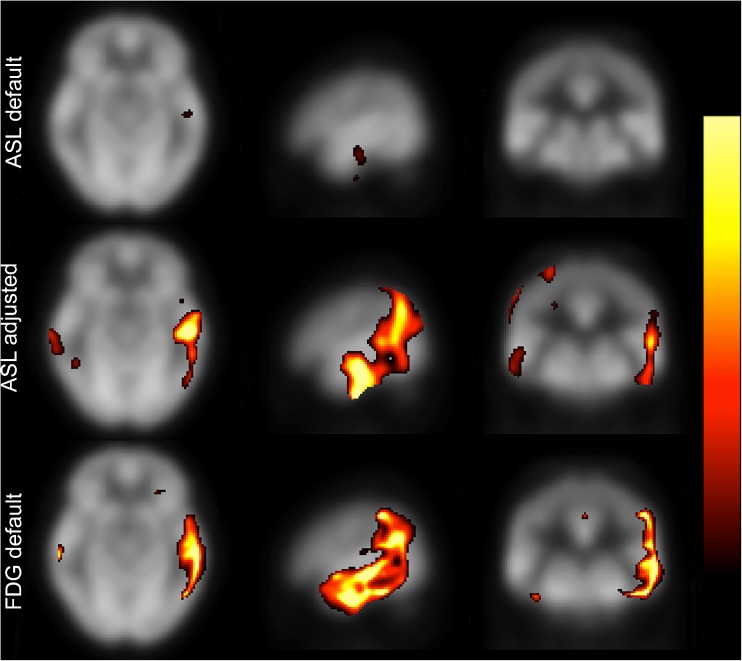
Cerebral perfusion analysis based on arterial spin labeling (ASL) MRI has been proposed as an alternative to FDG-PET in patients with neurodegenerative disease. Z-maps show normal distribution values relating an image to a database of controls. They are routinely used for FDG-PET to demonstrate disease-specific patterns of hypometabolism at the individual level. This study aimed to compare the performance of Z-maps based on ASL to FDG-PET.
Data were combined from two separate sites, each cohort consisting of patients with Alzheimer's disease (n = 18 + 7), frontotemporal dementia (n = 12 + 8) and controls (n = 9 + 29). Subjects underwent pseudocontinuous ASL and FDG-PET. Z-maps were created for each subject and modality. Four experienced physicians visually assessed the 166 Z-maps in random order, blinded to modality and diagnosis.
Discrimination of patients versus controls using ASL-based Z-maps yielded high specificity (84%) and positive predictive value (80%), but significantly lower sensitivity compared to FDG-PET-based Z-maps (53% vs. 96%, p < 0.001). Among true-positive cases, correct diagnoses were made in 76% (ASL) and 84% (FDG-PET) (p = 0.168).
ASL-based Z-maps can be used for visual assessment of neurodegenerative dementia with high specificity and positive predictive value, but with inferior sensitivity compared to FDG-PET.
• ASL-based Z-maps yielded high specificity and positive predictive value in neurodegenerative dementia. • ASL-based Z-maps had significantly lower sensitivity compared to FDG-PET-based Z-maps. • FDG-PET might be reserved for ASL-negative cases where clinical suspicion persists. • Findings were similar at two study sites.
基于动脉自旋标记(ASL)MRI 的脑灌注分析已被提议作为神经退行性疾病患者的 FDG-PET 替代方法。Z 图显示了与对照数据库相关的图像的正态分布值。它们通常用于 FDG-PET,以在个体水平上显示疾病特异性的低代谢模式。本研究旨在比较基于 ASL 的 Z 图与 FDG-PET 的性能。
数据来自两个独立的站点合并,每个队列包括阿尔茨海默病患者(n=18+7)、额颞叶痴呆患者(n=12+8)和对照组(n=9+29)。受试者接受了伪连续 ASL 和 FDG-PET。为每个受试者和模态创建了 Z 图。四位经验丰富的医生以随机顺序对 166 张 Z 图进行了视觉评估,对模态和诊断均不知情。
使用基于 ASL 的 Z 图对患者与对照组进行区分,特异性(84%)和阳性预测值(80%)较高,但敏感性明显低于基于 FDG-PET 的 Z 图(53%比 96%,p<0.001)。在真正的阳性病例中,正确诊断率为 76%(ASL)和 84%(FDG-PET)(p=0.168)。
基于 ASL 的 Z 图可用于对神经退行性痴呆进行视觉评估,具有较高的特异性和阳性预测值,但敏感性低于 FDG-PET。
• 基于 ASL 的 Z 图在神经退行性痴呆中具有高特异性和阳性预测值。
• 与基于 FDG-PET 的 Z 图相比,基于 ASL 的 Z 图的敏感性显著降低。
• 对于临床怀疑持续存在但 ASL 为阴性的病例,可能需要保留 FDG-PET。
• 在两个研究地点的发现相似。