Moug Susan J, Bryce Adam, Mutrie Nanette, Anderson Annie S
The University of Glasgow, Royal Alexandra Hospital, Corsebar Road, Paisley, PA2 9PN, UK.
The University of Glasgow, University Avenue, Glasgow, G12 8QQ, UK.
Int J Colorectal Dis. 2017 Jun;32(6):765-775. doi: 10.1007/s00384-017-2797-5. Epub 2017 Apr 3.
Lifestyle interventions have been proposed to improve cancer survivorship in patients with colorectal cancer (CRC), but with treatment pathways becoming increasingly multi-modal and prolonged, opportunities for interventions may be limited. This systematic review assessed the evidence for the feasibility of performing lifestyle interventions in CRC patients and evaluated any short- and long-term health benefits.
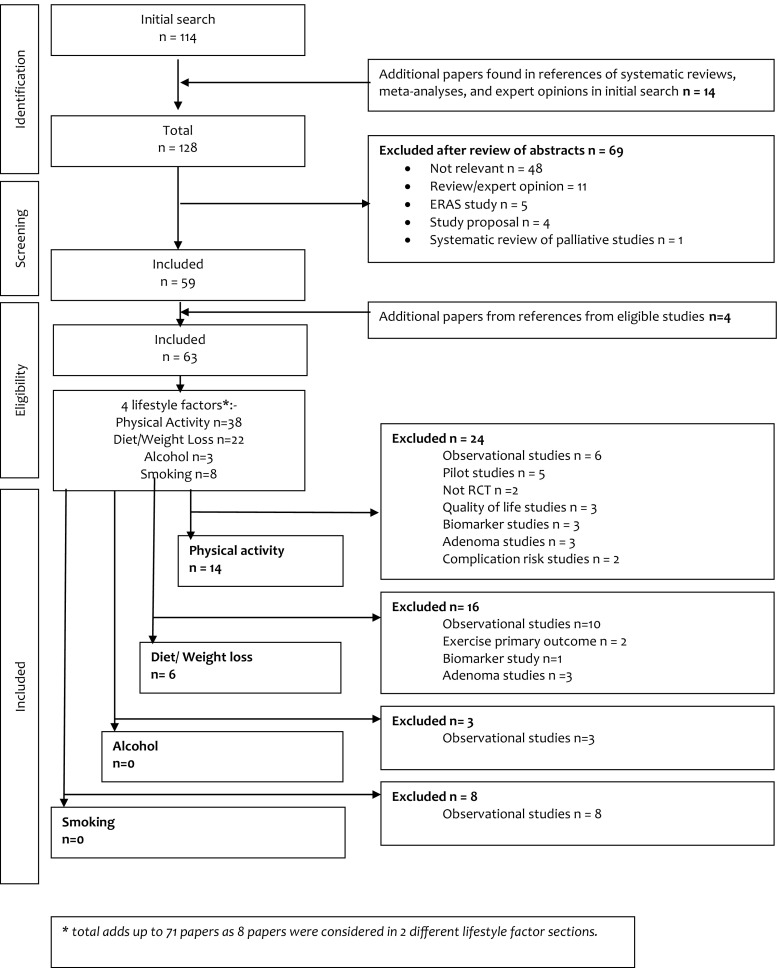
Using PRISMA Guidelines, selected keywords identified randomised controlled studies (RCTs) of lifestyle interventions [smoking, alcohol, physical activity (PA) and diet/excess body weight] in CRC patients. These electronic databases were searched in June 2015: Dynamed, Cochrane Database, OVID MEDLINE, OVID EMBASE, and PEDro.
Fourteen RCTs were identified: PA RCTs (n = 10) consisted mainly of telephone-prompted walking or cycling interventions of varied durations, predominately in adjuvant setting; dietary/excess weight interventions RCTs (n = 4) focused on low-fat and/or high-fibre diets within a multi-modal lifestyle intervention. There were no reported RCTs in smoking or alcohol cessation/reduction. PA and/or dietary/excess weight interventions reported variable recruitment rates, but good adherence and retention/follow-up rates, leading to short-term improvements in dietary quality, physical, psychological and quality-of-life parameters. Only one study assessed long-term follow-up, finding significantly improved cancer-specific survival after dietary intervention.
This is the first systematic review on lifestyle interventions in patients with CRC finding these interventions to be feasible with improvements in short-term health. Future work should focus on defining the optimal type of intervention (type, duration, timing and intensity) that not only leads to improved short-term outcomes but also assesses long-term survival.
已提出生活方式干预措施来改善结直肠癌(CRC)患者的癌症生存状况,但随着治疗途径变得越来越多模式化且疗程延长,进行干预的机会可能有限。本系统评价评估了对CRC患者进行生活方式干预可行性的证据,并评估了其短期和长期健康益处。
采用PRISMA指南,通过选定的关键词检索了CRC患者生活方式干预(吸烟、饮酒、体育活动[PA]和饮食/超重)的随机对照试验(RCT)。于2015年6月检索了以下电子数据库:Dynamed、Cochrane数据库、OVID MEDLINE、OVID EMBASE和PEDro。
共识别出14项RCT:PA RCT(n = 10)主要包括不同时长的电话提示步行或骑行干预,主要在辅助治疗环境中进行;饮食/超重干预RCT(n = 4)在多模式生活方式干预中侧重于低脂和/或高纤维饮食。未检索到关于戒烟或戒酒/减少饮酒量的RCT。PA和/或饮食/超重干预的招募率各不相同,但依从性良好,保留率/随访率也不错,从而使饮食质量、身体、心理和生活质量参数在短期内得到改善。只有一项研究评估了长期随访情况,发现饮食干预后癌症特异性生存率显著提高。
这是第一项关于CRC患者生活方式干预的系统评价,发现这些干预措施可行且能改善短期健康状况。未来的工作应侧重于确定最佳的干预类型(类型、时长、时机和强度),这不仅能改善短期结局,还能评估长期生存率。