Forberger Sarah, Bammann Karin, Bauer Jürgen, Boll Susanne, Bolte Gabriele, Brand Tilman, Hein Andreas, Koppelin Frauke, Lippke Sonia, Meyer Jochen, Pischke Claudia R, Voelcker-Rehage Claudia, Zeeb Hajo
Leibniz Institute for Prevention Research and Epidemiology-BIPS, 28359 Bremen, Germany.
Working Group Epidemiology of Demographic Change, Institute for Public Health und Nursing Research (IPP), Faculty for Human and Health Sciences, University of Bremen, 28359 Bremen, Germany.
Int J Environ Res Public Health. 2017 Apr 4;14(4):379. doi: 10.3390/ijerph14040379.
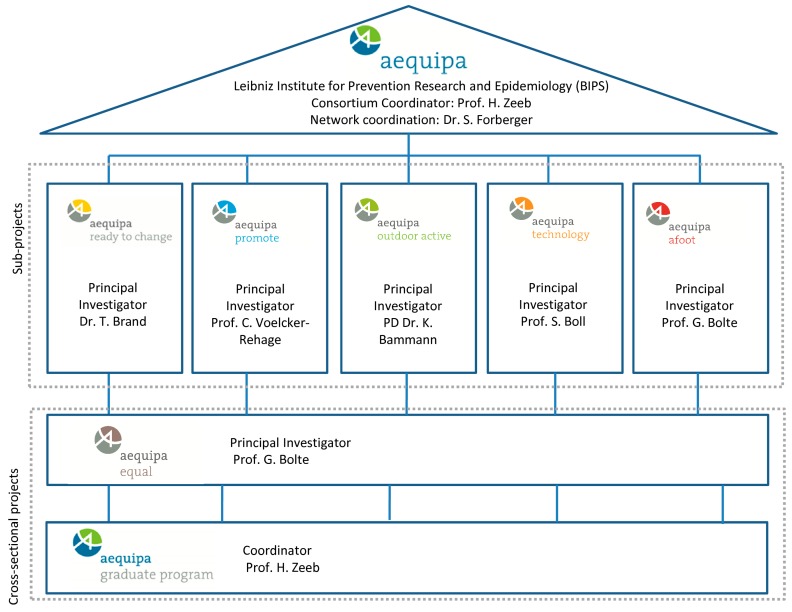
The paper introduces the theoretical framework and methods/instruments used by the Physical Activity and Health Equity: Primary Prevention for Healthy Ageing (AEQUIPA) prevention research network as an interdisciplinary approach to tackle key challenges in the promotion of physical activity among older people (65+). Drawing on the social-ecological model, the AEQUIPA network developed an interdisciplinary methodological design including quantitative/qualitative studies and systematic reviews, while combining expertise from diverse fields: public health, psychology, urban planning, sports sciences, health technology and geriatrics. AEQUIPA tackles key challenges when promoting physical activity (PA) in older adults: tailoring of interventions, fostering community readiness and participation, strengthening intersectoral collaboration, using new technological devices and evaluating intervention generated inequalities. AEQUIPA aims to strengthen the evidence base for age-specific preventive PA interventions and to yield new insights into the explanatory power of individual and contextual factors. Currently, the empirical work is still underway. First experiences indicate that thenetwork has achieved a strong regional linkage with communities, local stakeholders and individuals. However, involving inactive persons and individuals from minority groups remained challenging. A review of existing PA intervention studies among the elderly revealed the potential to assess equity effects. The results will add to the theoretical and methodological discussion on evidence-based age-specific PA interventions and will contribute to the discussion about European and national health targets.
本文介绍了“体育活动与健康公平:健康老龄化的一级预防”(AEQUIPA)预防研究网络所使用的理论框架和方法/工具,这是一种跨学科方法,旨在应对在促进老年人(65岁及以上)体育活动方面的关键挑战。基于社会生态模型,AEQUIPA网络开发了一种跨学科方法设计,包括定量/定性研究和系统评价,同时整合了来自不同领域的专业知识:公共卫生、心理学、城市规划、体育科学、健康技术和老年医学。AEQUIPA在促进老年人体育活动(PA)时应对关键挑战:干预措施的量身定制、促进社区准备和参与、加强部门间合作、使用新技术设备以及评估干预产生的不平等。AEQUIPA旨在加强针对特定年龄段预防性体育活动干预措施的证据基础,并对个体和背景因素的解释力产生新的见解。目前,实证工作仍在进行中。初步经验表明,该网络已与社区、当地利益相关者和个人建立了强大的区域联系。然而,让不活动的人和少数群体的个人参与仍然具有挑战性。对现有老年人体育活动干预研究的综述揭示了评估公平效应的潜力。这些结果将补充关于基于证据的特定年龄段体育活动干预措施的理论和方法讨论,并将有助于有关欧洲和国家健康目标的讨论。